

Key Takeaways
- Movement you’ll repeat — walking, yoga, or strength training — produces medium-sized effects on depression and helps rebuild sleep and energy floors.1,2
- Protecting sleep with a consistent wake time, wind-down routine, and caffeine cutoff creates the foundation your mood depends on the next day.3,16
- Eating for steady energy — Mediterranean-style meals anchored in protein, vegetables, and whole grains — lowers depression risk without requiring a kitchen overhaul.10,13
- Two minutes of mindfulness between meetings trains the same skill as longer sessions, and mindfulness rivals CBT and antidepressants in many cases.14
- Self-compassion — naming what happened, acknowledging the feeling, responding like you would to a friend — reduces anxiety and depression over time.5
- Capping passive screen time with a screens-off evening, a pre-bed curfew, and killing autoplay protects the nervous-system quiet anxiety needs to settle.6,15
- Ten minutes outside on purpose — a park lunch, a walking meeting, a weekend anchor — lowers stress and sharpens thinking with minimal effort.4
- One honest exchange with one person each week counters the isolation that feeds anxiety, and it works even when your energy is thin.7,9
- Rethinking alcohol as a coping tool matters because even moderate drinking disrupts the sleep architecture doing the heavy lifting for your mood.16,18
What Actually Moves the Needle on Anxiety and Low Mood
You already know the drill. Drink water. Get sunlight. Breathe deeply. If wellness advice alone fixed anxiety and low mood, you’d be fine by now.
Here’s the more honest version: a small set of daily habits has real, measurable effects on how you feel, and none of them require a 5 a.m. wake-up or a retreat in the mountains. Regular movement, better sleep, steadier meals, brief mindfulness, self-compassion, time outside, less passive scrolling, and one honest conversation each week — these show medium-sized effects on depression, anxiety, and stress in the research, not miracles. Medium is meaningful. Medium is what makes Tuesday feel different from last Tuesday.1,3
This piece walks through eight habits grouped by how a workday actually flows: body, mind, environment, relationships. You’ll also see clear signals for when habits stop being enough and outpatient care — psychiatry, counseling, or both — belongs in the plan alongside them. Start where you have energy. One habit counts.9
Body: The Habits That Change Your Chemistry
Move in a Way You’ll Actually Repeat
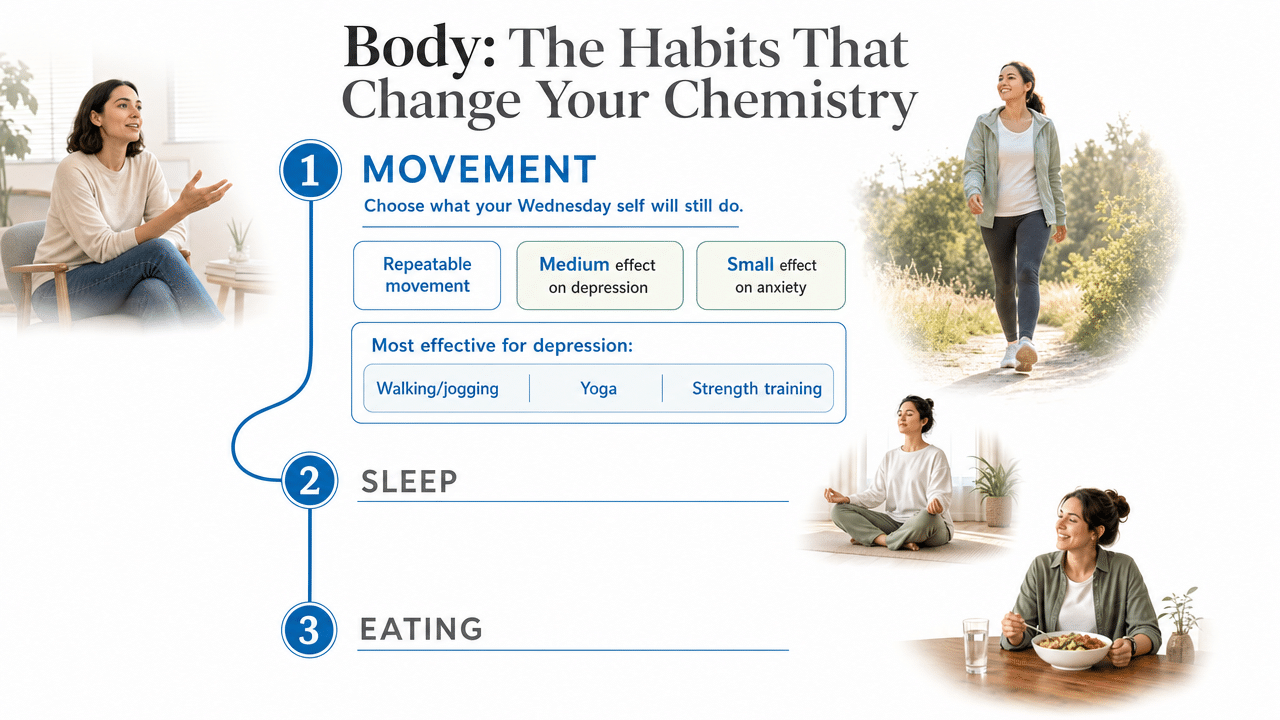
You do not need a training plan. You need a form of movement your Wednesday self will still do when your Tuesday was rough.
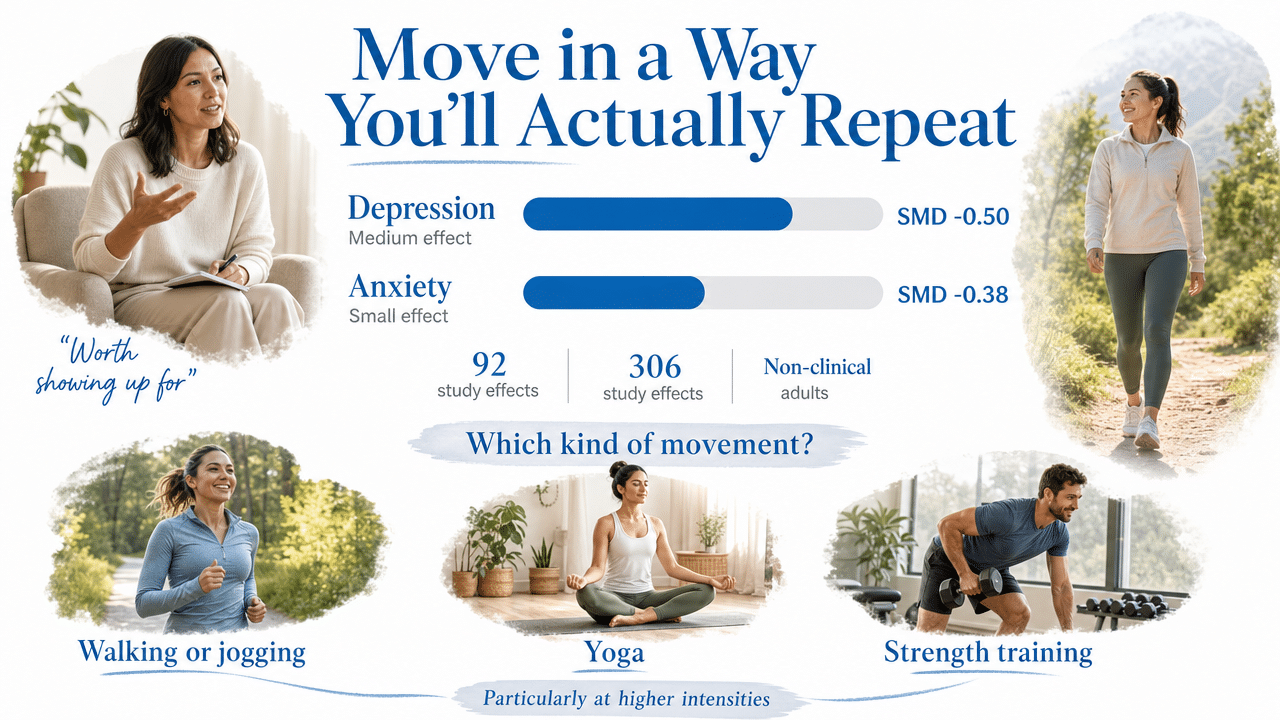
Here’s what the evidence actually says: physical activity produces a medium-sized effect on depression (SMD = -0.50) and a small effect on anxiety (SMD = -0.38), based on a meta-meta-analysis covering 92 depression and 306 anxiety study effects in non-clinical adults. Medium is not magic. Medium is the difference between dragging through a 2 p.m. slump and feeling recognizably like yourself. That’s worth showing up for.1
The follow-up question — which kind of movement — has a cleaner answer than it used to. A 2024 network meta-analysis of randomized trials found that walking or jogging, yoga, and strength training were more effective than other forms of exercise for depression, particularly at higher intensities. Notice what’s missing from that list: nothing exotic. No cold plunge. No wearable. Just three formats you can start this week without buying anything.2
Try this: a 15-minute walk after logging off, three days this week. If that lands, add a fourth. If your knees hate running, yoga at home or a short strength circuit counts the same. The CDC’s baseline is 2.5 hours of activity per week, but you don’t have to hit that on day one to feel a shift.8
One quiet win of this habit: it stacks. Walking after work often improves sleep that night, which improves the next morning, which makes movement easier the next day. You’re not just exercising. You’re rebuilding a floor.
And if you’ve been telling yourself you’ll start when you feel motivated — you won’t. You’ll start when you make it small enough to feel embarrassing to skip.
Protect Sleep Like It’s a Meeting
You would not skip a 10 a.m. with your boss. You would not double-book a client call. But bedtime? That’s the first thing that slides when a project runs late or a group chat runs long.
Here’s the case for treating sleep as non-negotiable: interventions that improved sleep quality — things like brief CBT for insomnia and basic sleep hygiene — produced medium-sized effects on depression, anxiety, and stress across randomized trials. On the other side of that coin, chronic sleep deficiency is linked to depression, impaired decision-making, and how you feel and react during the day. Sleep is not a luxury sitting on top of your mental health. It’s part of the foundation.3,16
The fix does not require a full overhaul. Pick one lever:
- A consistent wake time, even on weekends. Your circadian system responds to when you get up more than when you go to bed.
- A 30-minute wind-down. Same order each night: dim lights, phone somewhere else, one boring task. The predictability is doing the work.
- A hard stop on caffeine after 2 p.m. Half-life matters more than you think when anxiety is already elevated.
If you’re already doing the basics and still lying awake at 1 a.m. three nights a week, that’s a signal, not a personal failing. Persistent insomnia often responds well to structured treatment like CBT for insomnia, sometimes paired with a medication review — the kind of thing outpatient care can sort out in a few sessions.
Eat for Steady Energy, Not Willpower
Skip breakfast, coffee until noon, sad-desk-salad at 1 p.m., vending machine at 3, takeout at 9. If that sounds familiar, your mood is doing a lot of work your food should be helping with.
The research here is less dramatic than a diet-book headline but more useful. Cohort studies have linked higher adherence to a Mediterranean-style eating pattern — vegetables, fruits, whole grains, legumes, fish, olive oil — with lower risk of developing depressive symptoms. On the flip side, Harvard’s nutritional psychiatry summary notes that a dietary pattern heavy in ultra-processed foods and added sugars is associated with impaired brain function and worsening mood. You do not have to overhaul your kitchen. You have to nudge the ratio.10,13
A workable target for a busy week: build most meals around vegetables, fruit, whole grains, and a protein you actually like, with healthy fats like olive oil or nuts on the side. That’s it. No macro spreadsheet.17
Tactical version for the Anxious Young Professional workday:
- Anchor breakfast in protein, even something small. It flattens the mid-morning crash that anxiety loves to hijack.
- Batch two lunches on Sunday. Grain bowl, roasted vegetables, a protein, olive oil. Two containers. Done.
- Keep boring emergency food in your desk drawer — nuts, fruit, whole-grain crackers — so 3 p.m. doesn’t become a vending-machine decision.
A note worth naming: if food feels tangled up with anxiety, restriction, or shame, that’s not a willpower gap. That’s a real thing that counselors treat. Eating steadily is a wellness habit; how you relate to eating is sometimes therapy territory.
Mind: Short Practices That Work Between Meetings
Two Minutes of Mindfulness, Not Twenty
You keep bookmarking meditation apps and forgetting to open them. That’s not a discipline problem. That’s a design problem — you’re trying to install a 20-minute habit inside a 15-minute break.
Shrink it. Two minutes between meetings is enough to matter. One long inhale through the nose, a slower exhale, repeat until the countdown timer runs out. That’s it. You can do it with your camera off. You can do it in a parked car before walking into the house. You can do it in a bathroom stall on a bad day, and it still counts.
Here’s why the small dose is worth taking seriously: a 2018 analysis of more than 12,000 participants found that mindfulness-based approaches worked as well as evidence-based therapies like cognitive behavioral therapy and antidepressants for anxiety and depression in many cases. That does not mean two minutes of breathing equals a full CBT course. It means the underlying practice — noticing what your mind is doing without arguing with it — has serious clinical evidence behind it. Small, repeated doses build the same skill longer sessions do.14
A few formats that fit a real workday:
- Box breathing before a hard call. Four in, four hold, four out, four hold. Two rounds.
- A one-song body scan while your coffee brews. Notice your jaw, your shoulders, your hands. Do not fix anything.
- A between-meeting reset. Close the laptop lid for 90 seconds. Feet on the floor. Eyes anywhere but the screen.
If your mind wanders 40 times, that’s not failure. Noticing the wander is the practice. You are training a muscle, not achieving a state.
Talk to Yourself Like Someone You’d Actually Help
Listen to your inner monologue after a mistake at work. If a friend talked to you the way you talk to yourself, you would stop returning their calls.
Self-compassion is not the same as letting yourself off the hook. It’s the practice of responding to your own struggle the way you’d respond to a colleague’s — with honesty and warmth instead of contempt. And there’s data behind it. A randomized controlled trial of a brief, self-guided self-compassion program found that increases in self-compassion were accompanied by decreases in anxiety and depression over time. Brief. Self-guided. No retreat required.5
Here’s a version that fits between meetings:
- Name what happened plainly. “I sent the wrong file to the client.”
- Acknowledge the feeling. “This is embarrassing, and I’m anxious about the follow-up.”
- Say the sentence you’d say to a friend. “Most people would feel this way. I can fix what’s fixable and move on.”
Write it in a notes app if that helps. Say it in your head if it doesn’t. The point is not to feel better instantly. The point is to stop compounding the original problem with an hour of self-attack.
The hardest part of this habit is that it can feel dishonest at first, like you’re being soft on yourself. It’s not softness. It’s accuracy. You are not the worst version of yourself on your worst day, and the voice in your head telling you otherwise is a symptom, not a fact.
If that voice is loud most days — cruel, constant, harder to argue with than it used to be — that’s worth bringing to a counselor. Self-compassion practice pairs well with therapy. It’s not a substitute for it.
Environment: The Inputs You Can Redesign
Put a Ceiling on Passive Screen Time
You are not weak for losing 40 minutes to a scroll session at 11 p.m. The apps are engineered to keep you there. But the input matters, and so does the ceiling you decide to put on it.
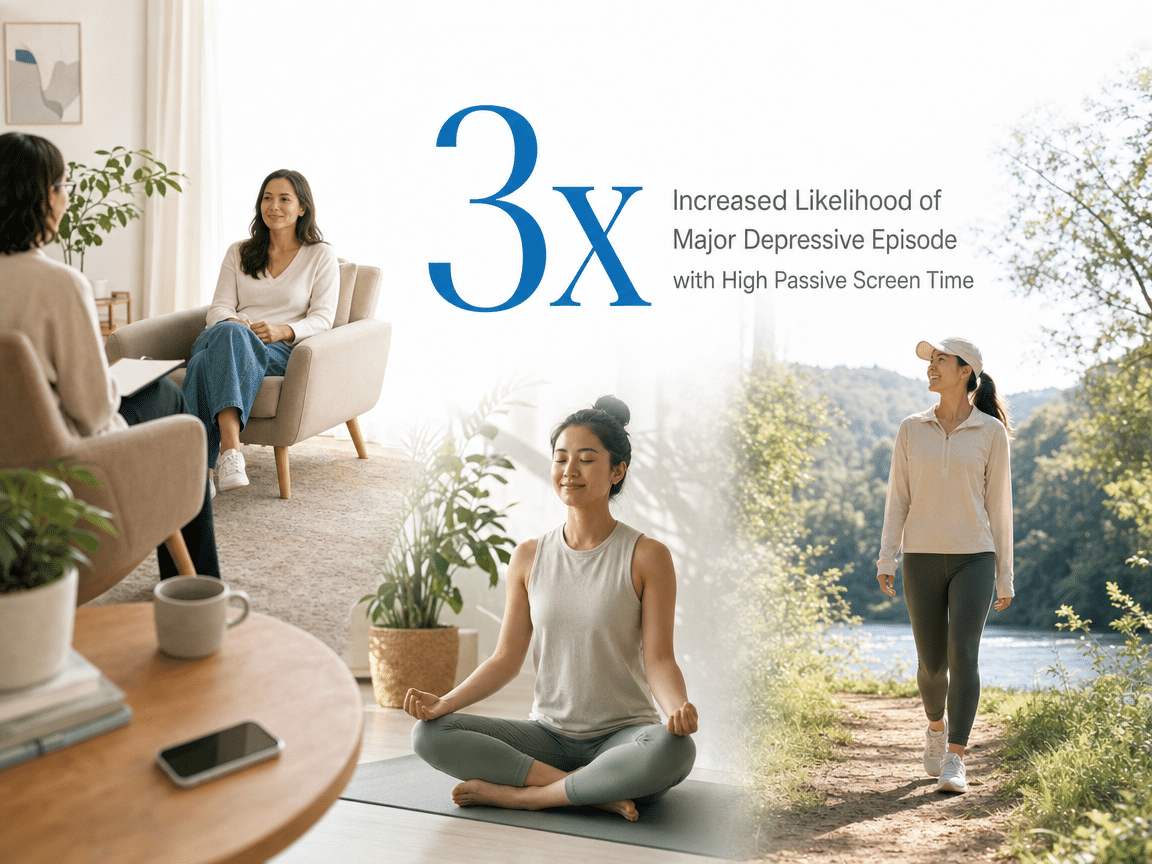
Here’s the number to sit with, with its scope stated up front: in a systematic review of adolescents, those with 4 or more hours of passive screen time per day were 3 times more likely to meet DSM-IV-TR criteria for a major depressive episode compared with peers who had under 2 hours. That finding is in adolescents, not adults, so do not treat it as a diagnosis of your Sunday afternoon. Treat it as a signal. Passive consumption — endless feeds, autoplay, doom-scrolling news — is not the same as a video call with your sister or a workout playlist. Content and context matter more than raw minutes.6
A few ceilings that hold up on a real week:15
- One screens-off evening. Pick the night your calendar is quietest. Phone in another room after dinner. That’s the whole habit.
- A hard curfew 30 minutes before bed. Sleep and screens are the same fight. Winning one helps the other.
- Kill autoplay. In your top two apps, turn it off. You will scroll less by default, without any willpower involved.
What you’re protecting is not productivity. It’s the nervous-system quiet that anxiety needs to settle. If you finish a long scroll feeling worse than when you started, believe your body. That’s data.
Get Outside on Purpose
Not a hike. Not a weekend upstate. Ten minutes on a bench near a tree, on a Tuesday, counts.
A review of nature-exposure research found that experimental studies suggested a protective effect of contact with natural environments on mental health outcomes and cognitive function — lower stress, better mood, sharper thinking. The dose does not have to be dramatic. Walking to a park at lunch, taking a call from a balcony instead of your desk, eating breakfast near a window that actually opens — these are small environmental swaps that stack.4
On a workday, the version that survives contact with your calendar looks like this:
- A 10-minute outdoor lunch, three days this week. Leave the phone in your pocket. Let your eyes look at something more than six feet away.
- Walking meetings for one-on-ones where you don’t need to share a screen.
- A weekend anchor — one longer outing, even 30 minutes at a nearby park. Not for the Instagram post. For the reset.
If you live somewhere the weather is fighting you this month, indoor nature still counts for something: a plant on your desk, a window with a view of something growing, sound of running water. Not as potent as the real thing, but not nothing.
This is the habit anxious professionals dismiss first because it feels too soft to matter. It matters. The research is quieter than exercise research, but the direction is the same: your body treats time outside as evidence that you are safe.
Relationships: The Habit Most People Skip
Keep One Person Close This Week
Connection is the habit anxious professionals cut first. It’s also the one that pays back the fastest.
When your calendar is full and your energy is low, the group text goes unanswered. The lunch gets rescheduled twice, then quietly dropped. You tell yourself you’ll reach out after this sprint, this launch, this week. The sprint never actually ends. Meanwhile, the CDC lists staying connected with others as a core stress-coping strategy — right alongside sleep, movement, and limiting alcohol. NIMH names social connection as part of the foundation that supports professional treatment, not a nice-to-have on top of it.7,9
Here’s the version that survives a bad week: one person, one exchange, this week. Not your whole friend group. Not a dinner party. One text that isn’t logistics. One 15-minute call on your commute. One voice memo to the friend who always sends you three back.
A few formats that work when your energy is thin:
- Walk-and-talk phone calls with someone who knew you before your job title.
- A standing 20 minutes on the same day each week with the same person. Predictability lowers the activation cost.
- Reply, even badly. A one-line answer beats a perfect one you never send.
Isolation feeds anxiety and low mood the way scrolling feeds insomnia. You do not have to feel like being social. You have to send the message anyway.
Rethink Alcohol as a Coping Tool
The 6 p.m. glass of wine that takes the edge off. The second one that makes dinner feel manageable. The third that costs you an hour of sleep and the whole next morning. If that pattern is familiar, you are not alone, and you are not doing anything unusual for a stressed professional. But alcohol and anxiety are a worse deal than they look.
The CDC defines moderate drinking as 1 drink or less per day for women and 2 or less per day for men, on days when alcohol is consumed. That’s the ceiling, not a target. And even at those levels, alcohol disrupts sleep architecture — the exact system doing the heavy lifting for your mood the next day.16,18
A few honest experiments worth running this month:
- Two alcohol-free weeknights. Notice how you sleep. Notice how Wednesday morning feels.
- A different ritual for the transition home. A walk, a shower, tea, 10 minutes with a book. The wine was doing a job. Give the job to something else.
- Track how you feel the day after, not just the night of. That’s where the real cost shows up.
If cutting back feels harder than it should — if you’ve tried and slipped, or if drinking is tangled with anxiety in a way that scares you a little — that’s exactly what dual-diagnosis outpatient care is built for. Not judgment. A plan.
When Habits Aren’t Enough: Signs to Add Clinical Care
Habits move the needle. They do not move it infinitely. Somewhere along the way, the honest question isn’t “which habit should I add?” — it’s “am I trying to walk my way out of something that needs actual treatment?”
A few signals worth taking seriously, without diagnosing yourself:11,18
- Symptoms lasting most of the day, most days, for two weeks or more — persistent low mood, flat interest in things you used to like, or anxiety that doesn’t turn off between meetings.
- Sleep, appetite, or focus that stays broken even after you’ve tried the sleep and food habits above for a few weeks.
- Drinking or substance use that’s creeping up as a way to manage how you feel, especially if you’ve tried to cut back and slipped.
- Any thoughts of harming yourself. That’s a same-week conversation, not a someday one.
Put Your Wellness Month Intentions Into Action
Take the first real step toward lasting support and personal progress.Frequently Asked Questions
How long does it take for these wellness habits to actually help my mood?
Most people notice small shifts within one to two weeks — better sleep, a slightly quieter mind after a walk. Research on sleep-quality interventions shows medium-sized effects on depression and anxiety, but those effects build over weeks of consistency, not days. Give any single habit four weeks before you judge it. That’s enough time to feel a real difference without demanding overnight change from yourself.3
Which habit should I start first if I only have energy for one?
Start with sleep or a short daily walk — whichever feels less impossible tonight. Both have solid evidence behind them and both make every other habit easier to add later. If your sleep is already decent, pick the walk. If you’re running on five hours, protect the wind-down first. One habit, done for a week, beats four habits abandoned by Thursday. Pick the smaller one.8
Can these habits replace therapy or medication for anxiety or depression?
No, and framing it that way sets you up to feel like a failure. NIMH is clear that lifestyle strategies support treatment for moderate-to-severe conditions rather than replace it. Habits and clinical care work together — the habits make treatment more effective, and treatment often gives you the baseline energy to keep the habits going. Think of them as complementary tools, not competitors for the same slot.9
How do I know when it’s time to add outpatient psychiatric or counseling care?
If low mood or anxiety has been present most of the day, most days, for two weeks or more, that’s a signal. So is sleep or appetite that stays broken after you’ve tried the basics. Any thoughts of self-harm mean this week, not someday. Outpatient care — psychiatry, counseling, or both, in person or via telehealth — layers on top of what you’re already doing.11
What kind of exercise works best for depression and anxiety?
The 2024 BMJ network meta-analysis found walking or jogging, yoga, and strength training more effective than other forms of exercise for depression, particularly at higher intensities. Notice what’s not on the list — anything expensive or complicated. The best format is the one you’ll repeat on a bad week. If you dread running, pick yoga. If yoga bores you, walk. Consistency matters more than category.2
Is it okay to drink alcohol while working on my mental health?
The CDC’s moderation ceiling is 1 drink or less per day for women and 2 or less for men, on days when you drink. But alcohol disrupts sleep, which is doing real work for your mood the next day. If cutting back feels harder than it should, or if drinking has become how you manage anxiety, that’s worth naming with a clinician. Dual-diagnosis outpatient care exists for exactly that.18
References
- A meta-meta-analysis of the effect of physical activity on depression and anxiety. https://pubmed.ncbi.nlm.nih.gov/25739893/
- Effect of exercise for depression: systematic review and network meta-analysis of randomised controlled trials. https://www.bmj.com/content/384/bmj-2023-075847
- Improving sleep quality leads to better mental health: A meta-analysis of randomized controlled trials. https://pmc.ncbi.nlm.nih.gov/articles/PMC8651630/
- Associations between Nature Exposure and Health: A Review of the Evidence. https://pmc.ncbi.nlm.nih.gov/articles/PMC8125471/
- A Randomized Control Trial of a Brief Self-Compassion Intervention for Anxiety and Depression. https://pmc.ncbi.nlm.nih.gov/articles/PMC8695611/
- The associations between screen time and mental health in adolescents: A systematic review. https://pmc.ncbi.nlm.nih.gov/articles/PMC10117262/
- How to Cope with Stress. https://www.cdc.gov/mentalhealth/stress-coping/cope-with-stress/index.html
- Physical Activity and Health. https://www.cdc.gov/physicalactivity/basics/pa-health/index.htm
- Caring for Your Mental Health. https://www.nimh.nih.gov/health/topics/caring-for-your-mental-health
- Mediterranean diet and depression: A systematic review. https://www.ncbi.nlm.nih.gov/pmc/articles/PMC5579396/
- Healthy Sleep. https://www.nhlbi.nih.gov/health/sleep
- Effects of exercise on depression: systematic review and meta-analysis. https://www.bmj.com/content/372/bmj.n608
- Nutritional psychiatry: Your brain on food. https://www.health.harvard.edu/blog/nutritional-psychiatry-your-brain-on-food-201511168626
- Meditation and Mindfulness: Effectiveness and Safety. https://www.nccih.nih.gov/health/meditation-and-mindfulness-effectiveness-and-safety
- Managing Stress | Mental Health. https://www.cdc.gov/mental-health/living-with/index.html
- Sleep Deprivation and Deficiency. https://www.nhlbi.nih.gov/health/sleep-deprivation
- Harvard Healthy Eating Plate. https://www.hsph.harvard.edu/nutritionsource/healthy-eating-plate/
- Moderate Drinking. https://www.cdc.gov/alcohol/fact-sheets/moderate-drinking.htm