

Key Takeaways
- Name the specific changes you’ve observed and then ask directly, ‘Are you thinking about suicide?’—clear phrasing avoids invitations to deny what they’re feeling.
- Listen without trying to fix, argue, or list reasons to live; calm, judgment-free presence is itself a meaningful intervention.2
- In the first hour after a yes, ask about a plan, reduce access to lethal means, and do not leave them alone.1
- Bridge them to trained support by calling or texting 988 together, or helping them book an outpatient appointment on the spot.11
- Follow up within 48 hours and keep checking in, since the days after disclosure are when continued care and connection matter most.2
You’re the Right Person to Ask
You’ve been circling this for days, maybe weeks. Someone you love has gone quiet in a way that feels different, or they’ve said something that worries you. You’re likely reading this late at night, scared that bringing it up might make things worse, but also terrified of what might happen if you don’t.
The fear you’re feeling is not a sign you’re the wrong person to address this. It means you’re paying attention on how to talk to someone about suicide. The people who ask difficult questions about suicide are rarely trained clinicians. They are partners, siblings, friends, roommates, and coworkers who noticed something and decided to speak up. Public health guidance from the CDC emphasizes that recognizing warning signs and connecting people to support is a crucial part of prevention, not a task reserved for professionals.9
You don’t need perfect words or a memorized script. You need to be willing to be present, ask a direct question, and stay even if the answer is difficult. This guide provides a five-step conversation framework you can use, with example sentences. It also covers what to do immediately after they confide in you, what to avoid saying, and how to transition to ongoing professional care. You’ve already taken the hardest step by seeking information.
Why Asking Directly Is Safer Than Staying Silent
Many people hesitate to initiate this conversation due to a common fear: “What if I bring it up and make it worse? What if I plant the idea in their head?” This understandable human fear is often the main reason potential helpers remain silent. Let’s address this with evidence.
A 2020 systematic review and meta-analysis published in Psychological Medicine analyzed eight studies specifically examining the impact of asking someone about suicide. The findings showed no statistically significant negative effect on suicide-related behavior, non-suicidal self-injury, or psychological distress. The authors concluded there were no harmful outcomes from asking. Similarly, an earlier review investigating whether questions about suicide induced suicidal ideation found no statistically significant increase, suggesting that discussing it might even reduce ideation in treatment-seeking individuals.6,7
The National Institute of Mental Health (NIMH) explicitly states in its public FAQ that asking about suicidal thoughts does not cause or increase those thoughts. The Substance Abuse and Mental Health Services Administration (SAMHSA) reinforces this, assuring that asking will not put the idea into someone’s head or make an attempt more likely.3,11
Silence, conversely, leaves someone isolated with thoughts they are already experiencing. If a loved one has been contemplating ending their life, your question doesn’t introduce a new idea. Instead, it introduces you—a person who noticed, cared enough to be uncomfortable, and is willing to listen. This presence is the crucial change.
Before You Start: What to Have Ready
You don’t need a prepared speech, but you do need to prepare the environment and have a brief mental plan for the next steps. Five minutes of preparation can prevent scrambling when the conversation becomes serious.1,10
Pick a private, unhurried spot. Avoid places like a busy kitchen or a car ride with a fixed endpoint. Choose somewhere you can both sit without interruptions and without feeling rushed. If you live together, wait until others are out or asleep. If not, invite them over or ask to visit—in-person conversations are generally more effective than text when possible.
Save crisis numbers in your phone beforehand. The 988 Suicide and Crisis Lifeline (call or text 988) should be easily accessible. Also, add 911. Having these numbers ready is a key recommendation in suicide prevention guides, ensuring you’re not searching for them if they disclose suicidal thoughts.
Write down what you’ve observed. Note two or three specific changes, such as them not responding to texts, giving away cherished possessions, or expressing extreme fatigue with life. This isn’t about building a case, but rather grounding the conversation in concrete observations so it doesn’t feel like an accusation or a vague suspicion.
Steady yourself. Take a deep breath. It’s okay if you cry. However, you must avoid panicking and cannot promise to keep their thoughts a secret. Everything else can be worked through together.
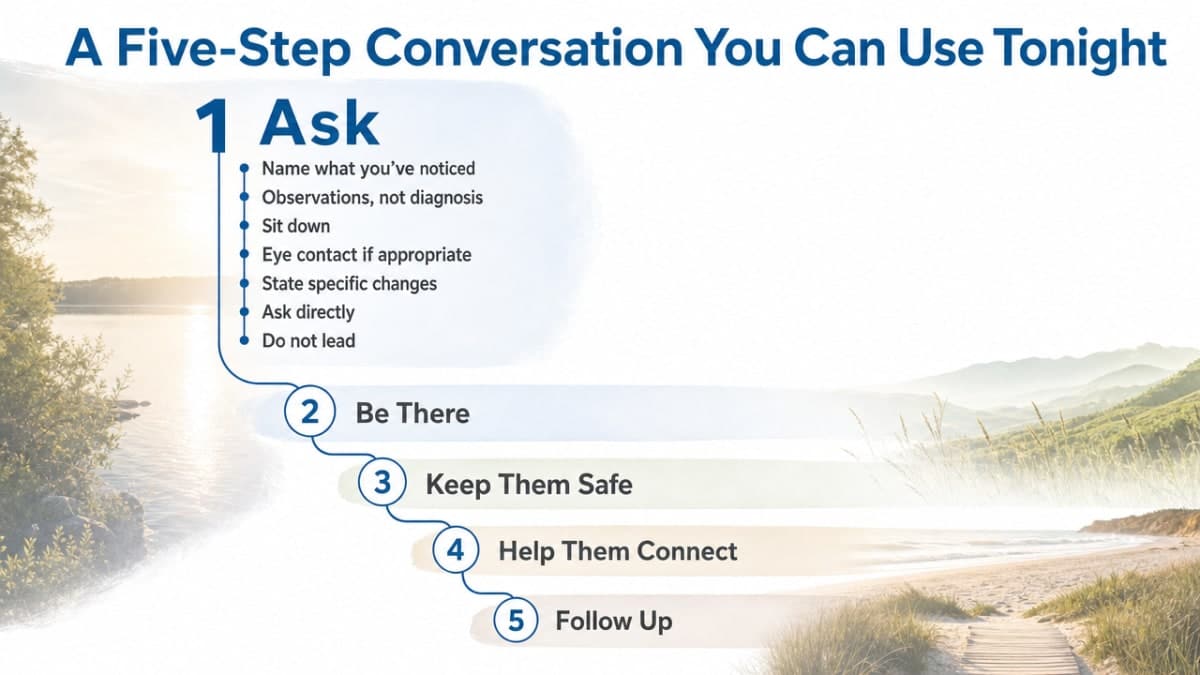
A Five-Step Conversation You Can Use Tonight
Step 1: Name What You’ve Noticed, Then Ask Directly
Begin by stating your observations, not with a diagnosis. The NIMH’s 5 Action Steps framework—Ask, Be There, Keep Them Safe, Help Them Connect, Follow Up—is a common guide for crisis counselors, and it starts with a direct question based on observations. You will follow a similar approach.2
Sit down. Make eye contact if appropriate, but don’t force it if the moment is intense. Then, state the specific things you’ve noticed, one at a time. For example:
“I’ve noticed you haven’t been sleeping. You mentioned last week that you were tired of everything. You gave your brother your guitar. I’ve been thinking about you a lot, and I want to ask you something directly.”
Now, ask the question. Do not soften it in a way that invites a denial. The CDC’s communication guide advises against leading phrasing that encourages someone to deny their feelings; instead, ask plainly. The most effective phrasing is simple:10
“Are you thinking about suicide?”
Or: “Are you thinking about killing yourself?”
Both are acceptable and clearer than phrases like “You’re not thinking about doing anything, are you?” which is often a request for reassurance disguised as a question. Frame it as a genuine yes-or-no question.1
Then, stop talking. Allow silence. They might need time to answer, or they might cry first. A response like “kind of” should be treated as a yes. Regardless of their initial reaction, you’ve accomplished what many people never do: you’ve named the issue aloud and given them permission to acknowledge it.
Step 2: Be There — Listening Without Fixing
Once they’ve answered, your role shifts to listening. You are not expected to solve everything in the next few minutes. You are there to listen.
This is often the most challenging part, as our instinct when a loved one expresses something terrifying is to try and talk them out of it. Resist this urge. NIMH describes this step as being present and listening without judgment—not trying to make them feel better or listing reasons to live. SAMHSA’s family guide reinforces this, stating that your calm, non-panicked attention is itself an intervention.2,5
Consider using phrases like:
“Thank you for telling me. I’m here. I’m not going anywhere.”
“Can you tell me more about what’s been happening?”
“That sounds incredibly difficult. I’m glad you shared it.”
Then, let them speak. Nod. Ask gentle follow-up questions. Don’t feel obligated to fill every silence. If you feel emotional, allow yourself to show it—it doesn’t scare them and communicates that their pain is real to you too.
Notice what you are avoiding: promising everything will be okay, comparing their pain to your own, or pointing out who would miss them. While these responses might seem loving, they can feel like added pressure to someone in distress. Your presence is the most important offering. Advice, if needed, will come later and from a professional.
Step 3: Keep Them Safe — The First Hour After They Say Yes
The hour immediately following a disclosure of suicidal thoughts is critical. This safety step involves three specific actions.1,2,11
Ask about a plan. Gently, but directly, ask: “Have you thought about how you’d do it?” If they describe a method, this indicates increased urgency. If they’ve set a time or gathered means, consider this an immediate crisis and contact 988 or 911 with them present. This is not an overreaction; it aligns with SAMHSA’s guidance for loved ones when someone is in danger.
Reduce access to lethal means. This step is often overlooked because it can feel intrusive, but it is crucial. Research consistently shows that creating time and distance between a person and their intended method saves lives. If there’s a firearm in the home, ask if a trusted friend or family member can temporarily store it. If there are medications that could be used in an overdose, ask if you can hold them or move them to a secure location. Explain plainly: “I care about you, and I want to make it harder for you to hurt yourself while we figure out the next step. Can I take these for a few days?” Most people, when asked directly by someone they trust, will agree.
Do not leave them alone. Do not go home or “give them space.” Indian Health Service (IHS) guidance is clear: stay with them, or ensure another trusted person is present, until you’ve connected them with a professional or crisis line. If you need to sleep, one person stays awake while the other rests. This is a temporary measure for the immediate crisis.
Step 4: Help Them Connect — 988 and a Real Human on the Other End
You are not the treatment plan; you are the bridge to it. The next step is connecting them with someone trained to provide ongoing support beyond the immediate crisis.
Start with the 988 Suicide and Crisis Lifeline. You can call or text 988, which is helpful if the person cannot speak aloud but can type. A trained counselor is available 24/7, offering free and confidential support. You can do this together. Sit beside them, put the phone on speaker if they agree, or hand them the phone and remain in the room.11
If they prefer not to speak to a stranger immediately, offer to help them schedule an outpatient appointment right then and there. SAMHSA’s guidance for family and friends specifically highlights this handoff—connecting your loved one to treatment and crisis services is an integral part of the framework.5
The goal is to maintain momentum. Someone in significant pain may struggle to make an appointment independently within 48 hours. Making the appointment with them, in that moment, can be the critical difference between a conversation and the start of a treatment plan.
Step 5: Follow Up in the Next 48 Hours
Text them the next morning. Instead of “how are you feeling?” which places the burden on them, try: “Thinking of you. I’m available today if you’d like company.” Repeat this the following day, and the day after.
Following up is not optional. NIMH lists it as the fifth step because the days after someone opens up are when they most need to feel that the conversation was not a one-time event you’re relieved to be done with. Be present. Offer to drive them to their first appointment. Ask how it went. Check in again a week later.2
If their first appointment doesn’t work out or the provider isn’t a good fit, help them try again. Effective care often requires persistence, and the person in pain is least equipped to navigate this process alone. This is your role for a while. You’re not being pushy; you’re being the friend who continues to care.
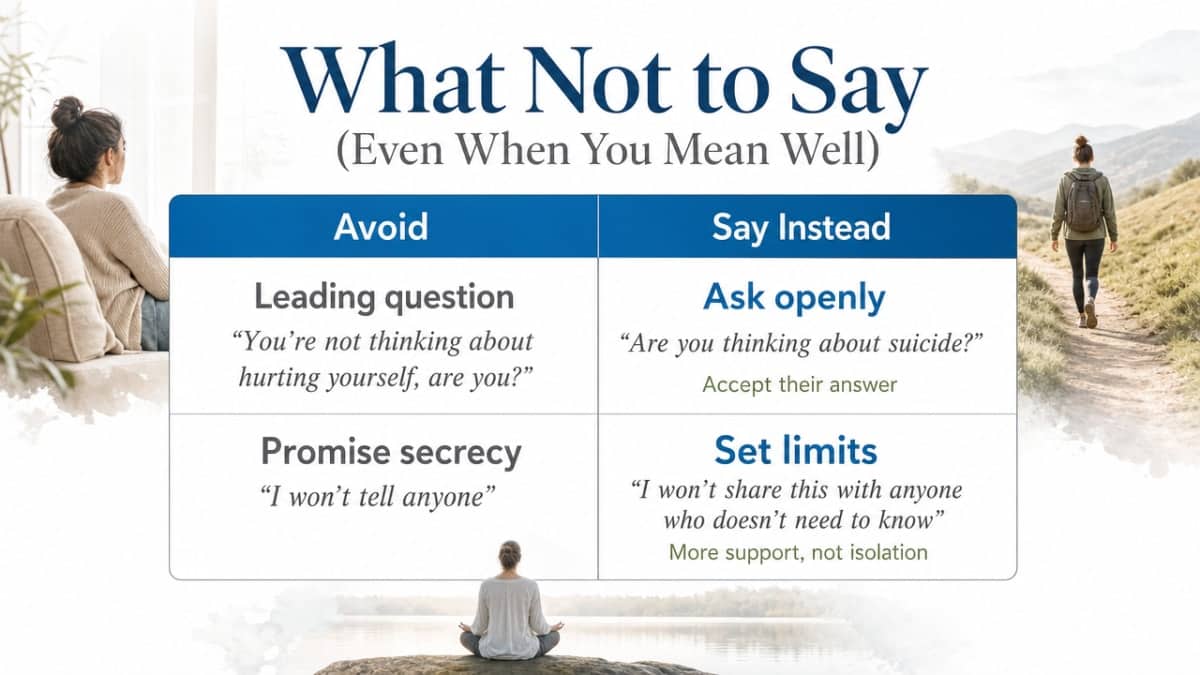
What Not to Say (Even When You Mean Well)
The natural instinct to comfort can sometimes lead to unhelpful responses. Here’s a list of what to avoid and what to say instead.1,10
Don’t ask leading questions. “You’re not thinking about hurting yourself, are you?” is often a request for reassurance for yourself, not a genuine question. The CDC’s communication guide advises against questions that pressure someone to deny their feelings; instead, ask openly and factually. Say “Are you thinking about suicide?” and accept their answer.
Don’t promise to keep it a secret. When someone confides in you about suicidal thoughts, the urge to say “I won’t tell anyone” is strong. Resist this. IHS guidance explicitly states not to promise secrecy. Such a promise isolates you at a time when the person needs more support. Instead, say: “I won’t share this with anyone who doesn’t need to know to help you.” This is honest and allows for involving a 988 counselor, a therapist, or another trusted family member.
Don’t guilt-trip, even gently. Phrases like “Think about what this would do to your kids” or “Your mom would be devastated” may sound loving, but to someone in pain, they add another burden. Avoid them.
Don’t minimize or compare. Statements such as “Other people have it worse,” “You have so much to live for,” or “I felt like that once and it passed” do not open a dialogue; they shut it down.
Don’t leave. Do not leave to give them space or because it’s late. Stay, or ensure someone else is present. Your presence is paramount.
If the Person You’re Worried About Is a Coworker
Most guidance on this topic assumes the person you’re concerned about is a close family member. However, sometimes it’s a coworker—someone whose camera has been off for weeks, who used to share memes but now gives one-word replies, or who mentioned feeling “done” during a team call. While you may not be their family or therapist, you still noticed, and your concern matters.
Approach them privately—not in a group chat or public channel. A direct message asking to grab coffee or have a quick call works. When you’re one-on-one, state your observations as you would with anyone else: “You’ve seemed really quiet lately, and what you said on Tuesday’s call stayed with me. I wanted to check in genuinely. Are you thinking about suicide?” The direct question is no more awkward in a professional setting than at home; the CDC’s guidance on asking openly and factually applies here too.10
If they open up, listen. Avoid involving HR without their consent first, as this can severely damage trust. Offer to help them find care. Text them the 988 number. If they prefer an outpatient therapist, offer to sit with them while they book an appointment. Follow up the next day, and the day after. Your observation was significant for a reason.11
After the Conversation: Handing Off to Ongoing Care
The conversation you just had is not the end goal; it’s the beginning. Once the immediate crisis subsides—the tears slow, the crisis line call concludes, safety measures are in place—you both enter a new phase. The focus shifts from “how do I get through tonight” to “what does the next month look like.”
This is where outpatient care provides the support you cannot. A licensed counselor can help your loved one develop a comprehensive safety plan, identifying their warning signs, coping strategies, and support contacts for when difficult thoughts return. A psychiatric provider can assess if underlying issues like depression or trauma are contributing to their pain and determine if medication is appropriate. SAMHSA’s guidance on care transitions emphasizes involving trusted family, educating them about suicidality, and connecting the individual to a provider specializing in suicide care after an acute episode. This is the work for the coming weeks.12
Your role will also evolve, and that’s perfectly normal. You become the person who drives them to their first appointment, who asks about it without pressure, and who gently inquires if they stop attending. You are not their therapist; you are the reason they found one.
Mind Body Optimization’s counseling and psychiatry team supports families during this critical period—the days and weeks following a difficult conversation, when sustainable outpatient care is needed. If you are in Texas, Tennessee, Oklahoma, or Missouri and need assistance with the next steps, our team can explain the intake process, what to expect from a first counseling session, and how virtual visits can bridge the gap if getting to a clinic feels overwhelming. You initiated the crucial conversation; we can help with what comes next.
Get support for the conversations that matter
Connect with a professional who can guide you through tough conversations about suicide and mental health.
Frequently Asked Questions
Will asking about suicide put the idea in their head?
No. This common fear often prevents people from speaking up, but research consistently shows it’s unfounded. The NIMH clearly states that asking about suicidal thoughts does not cause or increase them 3. For individuals already struggling, openly discussing it can even bring relief. Your question doesn’t plant an idea; it opens a door for a conversation they may already be seeking.
What exact words should I use to ask?
Use clear, direct language: “Are you thinking about suicide?” or “Are you thinking about killing yourself?” Both are effective. The CDC’s communication guide emphasizes that direct questions are more beneficial than leading ones that might prompt denial. Avoid phrases like “You’re not thinking about doing anything, right?” as this seeks reassurance for yourself rather than a genuine answer. Ask the direct question, then remain silent and allow them to respond.10
What do I do if they say yes, they are thinking about suicide?
Thank them for sharing. Stay with them. Gently ask if they have a plan. Then, work together on three immediate steps: call or text 988 to connect with a trained counselor, reduce access to any means they might use (like medications or firearms), and ensure they are not left alone tonight. Your goal isn’t to resolve their pain in one night, but to help them get through to the morning and connect with professional support.11,2
Should I promise to keep it a secret if they ask me to?
No. IHS guidance explicitly advises against promising secrecy 1. While it may feel like an act of loyalty, it isolates you and the person struggling, when more support is needed. Instead, offer an honest statement: “I won’t share this with anyone who doesn’t need to know to help you.” This maintains trust while allowing for the involvement of a 988 counselor, a therapist, or another trusted individual.
What if they deny it but I still feel something is wrong?
Trust your intuition and keep the lines of communication open. Sometimes, individuals aren’t ready to disclose their struggles the first time they’re asked. Tell them you care, that you’ll continue to check in, and that you’re not going anywhere. Then, follow through—send a text the next day, visit later in the week. Share the specific observations that prompted your concern so they understand it’s not a random question. The invitation for them to open up remains, even if their initial answer is no.10
When should I call 988 or 911 instead of handling it myself?
Call or text 988 anytime you need guidance from a trained professional; you don’t have to wait for an emergency, and you can call for advice about someone else. Call 911 if the person has already taken action, has a weapon, or describes a specific plan and intent to act on it immediately. When in doubt, make the call. You will not be overreacting; you will be following SAMHSA’s recommendations for loved ones.11
References
- How to Talk About Suicide | Suicide Prevention and Care. https://www.ihs.gov/suicideprevention/howtotalk/
- 5 Action Steps to Help Someone Having Thoughts of Suicide. https://www.nimh.nih.gov/health/publications/5-action-steps-to-help-someone-having-thoughts-of-suicide
- Frequently Asked Questions About Suicide. https://www.nimh.nih.gov/health/publications/suicide-faq
- Suicide: How You Can Make a Difference. https://www.nimh.nih.gov/news/science-updates/2019/suicide-how-you-can-make-a-difference
- Helping Your Loved One Who is Suicidal: A Guide for Family and Friends. https://store.samhsa.gov/product/helping-your-loved-one-who-suicidal-guide-family-and-friends/pep20-01-03-001
- Does asking about suicide and related behaviours induce suicidal ideation?. https://pubmed.ncbi.nlm.nih.gov/24998511/
- What’s the harm in asking? A systematic review and meta-analysis on the risks of asking about suicide-related behavior. https://pubmed.ncbi.nlm.nih.gov/32715986/
- Suicidal Ideation – StatPearls – NCBI Bookshelf. https://www.ncbi.nlm.nih.gov/books/NBK565877/
- Suicide Prevention (CDC). https://www.cdc.gov/suicide/prevention/index.html
- The Data (CDC suicide prevention communication guide). https://stacks.cdc.gov/view/cdc/140176/cdc_140176_DS1.pdf
- Suicide Prevention (SAMHSA). https://www.samhsa.gov/mental-health/suicidal-behavior/prevention
- Best Practices in Care Transitions for Individuals with Suicide Risk. https://www.samhsa.gov/sites/default/files/suicide-risk-practices-in-care-transitions-11192019.pdf