

Key Takeaways
- Hormone imbalances across thyroid, cortisol, estrogen, progesterone, testosterone, and insulin can drive symptoms that feel like anxiety, depression, or burnout because the brain directly responds to endocrine signals.1,8
- Symptom timing offers real clues: cyclical low mood, postpartum crashes, midlife shifts in your late thirties or forties, and wired-but-tired stress patterns often trace back to measurable hormone changes.18,12,5
- A label of treatment-resistant depression often reflects an under-investigated case, since untreated thyroid, adrenal, reproductive, or metabolic issues can quietly limit how well SSRIs and therapy work.2,17,24
- A targeted panel—thyroid (TSH, free T4, free T3), reproductive hormones, cortisol, HbA1c or fasting glucose, and vitamin D—can either rule out endocrine drivers or reshape a care plan.1,3,4,16
When Therapy, Sleep, and SSRIs Stop Explaining How You Feel
You’ve done the work. You show up to therapy. You take the medication your psychiatrist prescribed. You track your sleep, cut back on caffeine, and moved your workouts to the morning like every wellness podcast told you to. And still, something feels off. The fatigue doesn’t lift. The 2 p.m. brain fog rolls in like clockwork. Your anxiety spikes for reasons you can’t name, or your mood dips right before your period in a way that used to feel manageable and now doesn’t.
If you’re reading this, you probably already suspect what a lot of clinicians are starting to say out loud: mental health symptoms don’t always start in the mind. Thyroid hormones, cortisol, estrogen, progesterone, testosterone, and insulin all shape how your brain feels, thinks, and regulates emotion. When those systems drift, so does everything downstream.1,8
That doesn’t mean therapy failed you. It doesn’t mean your SSRI was a mistake. It means the picture might be bigger than what a symptom checklist can capture. Persistent low mood, unexplained anxiety, and cognitive slowing can all be tied to hormone shifts that a standard mental health intake doesn’t screen for.2,3
This article is for you if you’re a busy professional who’s tired of guessing. The goal isn’t to add another thing to your list. It’s to help you recognize a pattern, ask a sharper question at your next appointment, and consider whether hormone and lab testing belongs in your care plan.
Why Your Brain Is an Endocrine Organ
Here’s the part that doesn’t get said enough in a standard mental health appointment: your brain runs on hormones. Not metaphorically. Literally. Estrogen shapes serotonin activity. Thyroid hormone sets the pace at which your neurons burn energy. Cortisol tells your hippocampus how much memory bandwidth to allocate. Insulin helps your brain cells use glucose to think clearly. When any of those signals drift out of range, the effects show up as symptoms you might call “anxiety,” “depression,” or “burnout”—because that’s what they feel like from the inside.
Research backs this up in ways that should change how you think about your own symptoms:
- Both an underactive and overactive thyroid can produce measurable deficits in attention, memory, and executive function—the exact cognitive skills your job depends on.3
- Sustained high cortisol from chronic stress is associated with poorer memory performance and structural changes in the hippocampus, the brain region that helps you learn and recall.5
- Shifts in ovarian hormones influence emotional perception, mood regulation, and the stress response itself.20
- Brain insulin resistance can quietly impair how neurons use energy, contributing to mood changes and cognitive slowing.4
None of this means your feelings aren’t real, or that a life stressor isn’t also part of the picture. It means the brain isn’t a sealed system. It’s an organ that listens to every hormone in your bloodstream—and when the signals get noisy, so does everything you think and feel.
Symptom Patterns That Point Toward Hormones
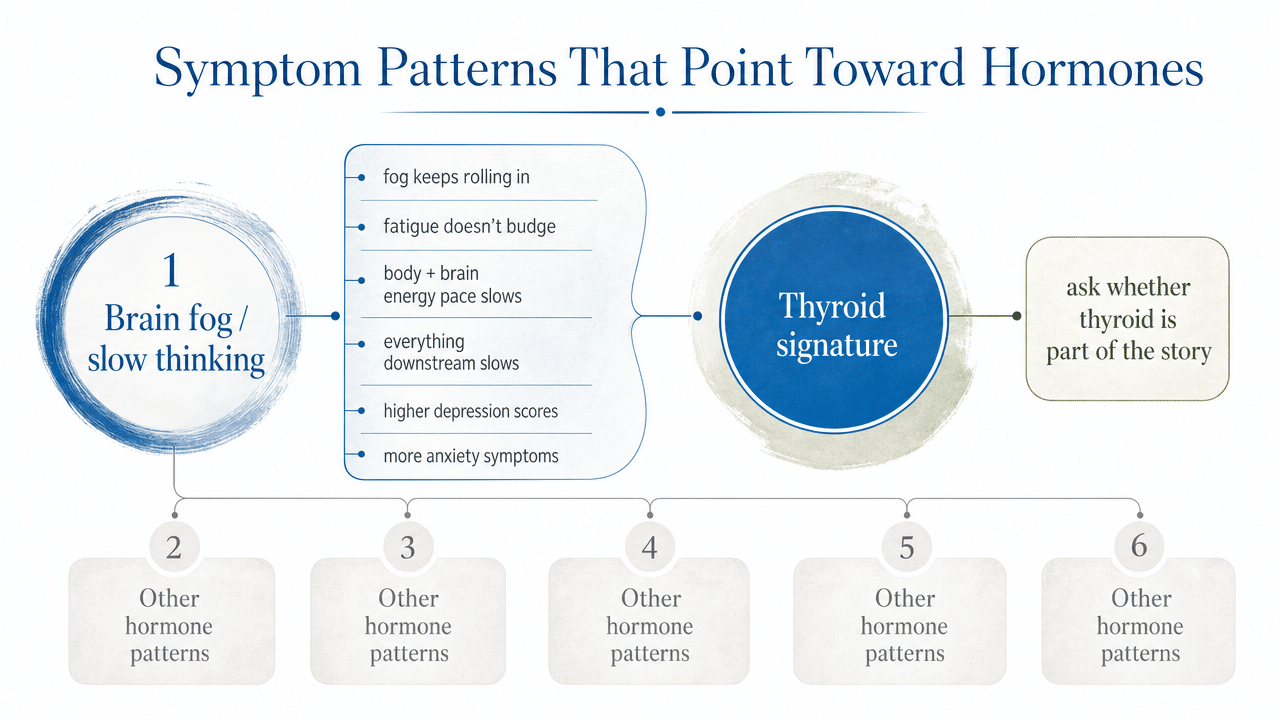
Brain Fog, Slow Thinking, and the Thyroid Signature
You know the feeling. You’re in a meeting, someone asks a question you should be able to answer in your sleep, and there’s a pause where your brain used to have a sentence. Later, you’ll blame the poor night’s sleep, or the second coffee, or the fact that you’ve been running hard for months. But if the fog keeps rolling in, and the fatigue underneath it doesn’t budge, it’s worth asking whether your thyroid is part of the story.
The thyroid sets the pace at which your body and brain burn energy. When it runs slow, everything downstream slows with it. Untreated hypothyroidism is linked with higher scores on standard depression measures like the Beck Depression Inventory-II, along with more anxiety symptoms compared with people whose thyroid levels are in range. The presentation tends to feel heavy: fatigue that sleep doesn’t fix, low mood, weight that creeps up, and thinking that feels like it’s happening a beat behind everyone else.2
An overactive thyroid produces almost the opposite picture, and it’s the one that most often gets misread as pure anxiety. Hyperthyroidism is associated with restlessness, irritability, insomnia, racing thoughts, and trouble concentrating. If your GAD symptoms came on suddenly, or your heart rate is unusually high, or you’re losing weight without trying, that’s a pattern worth flagging.14
What ties both directions together is what they do to cognition. Systematic reviews of thyroid disorders and cognition find measurable deficits in attention, memory, and executive function across both hypo- and hyperthyroid states. That is the exact skill set your job runs on. So when you describe your symptoms as “brain fog” or “I just can’t think straight anymore,” you’re not being vague. You’re describing something that shows up on neuropsychological testing and often responds when the underlying thyroid issue is treated.3
Wired-But-Tired: Cortisol and the Stress Axis
There’s a specific kind of exhaustion that comes from being too activated for too long. You’re tired at 10 a.m. and buzzing at 11 p.m. You can’t focus during the day, but your mind won’t stop when you finally lie down. Your resting heart rate is up. You’ve been snapping at people you love. If therapy has helped you understand why you’re stressed but hasn’t changed how your body feels, cortisol may be part of what you’re up against.
Cortisol is your main stress hormone, and it’s designed to spike in short bursts and then come back down. When the stress axis stays switched on for months or years, that rhythm gets noisy. Sustained high cortisol is associated with poorer memory performance and structural changes in the hippocampus, the brain area you rely on to learn and recall. That’s part of why chronic stress doesn’t just feel bad; it measurably changes how your brain works.5
The pattern shows up across several conditions in ways that matter clinically:6,15,17
- In bipolar disorder, meta-analytic data show significantly elevated basal and post-dexamethasone cortisol and ACTH, particularly during manic phases, which is one reason mood stability can be so hard to reach without addressing the underlying stress physiology.
- In PTSD, cortisol secretion is altered and stress-response feedback is disrupted, which helps explain the hyperarousal, sleep disruption, and concentration problems that don’t lift with talk therapy alone.
- In adrenal disorders like Cushing’s syndrome, cortisol excess produces depression, irritability, and cognitive impairment at rates that shouldn’t be missed.
The takeaway isn’t that everyone with anxiety has a cortisol problem. It’s that when your nervous system stays stuck in an activated state despite the work you’re doing, the stress axis is a reasonable thing to actually measure.
Cyclical Low Mood, PMDD, and the Postpartum Crash
If your mood follows a calendar, that’s information. Some of the most predictable, and most under-treated, hormone-mental health patterns show up on a cycle. A week of dread before your period that lifts the day it starts. A postpartum stretch that doesn’t feel like the baby blues everyone described. These aren’t personality quirks. They’re patterns your biology is drawing for you.
Premenstrual dysphoric disorder is the severe end of premenstrual symptoms, marked by low mood, irritability, food cravings, and cognitive changes concentrated in the luteal phase. Estradiol acts on multiple neurotransmitter systems involved in mood, cognition, sleep, and eating, which is why PMDD shows up as more than “feeling irritable before your period”. Underneath that presentation is a specific neurosteroid story: allopregnanolone, a metabolite of progesterone, modulates GABA signaling in ways that affect anxiety and mood, and fluctuations in allopregnanolone have been directly implicated in PMDD. If your worst weeks always land in the same phase, that’s not a coincidence you should have to power through.11,21
The postpartum window has its own biology. After childbirth, estrogen, progesterone, and neurosteroids drop off rapidly, and that abrupt withdrawal is one of the key biological factors in postpartum depression susceptibility. This is also why brexanolone, an allopregnanolone-based treatment, was developed specifically for severe postpartum depression—it targets the same neurosteroid pathway that shifted after delivery. If your postpartum experience felt more like a chemical crash than a slow adjustment, there’s a mechanism behind that.12
The point isn’t to reduce cyclical or postpartum mood changes to hormones alone. Sleep loss, identity shifts, and psychosocial stress all matter. But when the timing of your symptoms is that predictable, hormone-aware evaluation gives you options that a generic depression treatment plan usually doesn’t.12
Midlife Mood Shifts and the Perimenopause Window
You may be reading this in your late thirties or early forties, wondering why the strategies that used to work stopped working. Your sleep is lighter. Your mood dips harder. You lose a word mid-sentence and it rattles you. Nothing in your life has changed dramatically, but everything feels harder to carry. If that’s you, the timing is not random.
Perimenopause—the transition years before menopause—brings fluctuating estrogen and progesterone, and those shifts show up in mental health in ways researchers can measure. A systematic review and meta-analysis of cognition and mood in perimenopause found that perimenopausal and postmenopausal women are significantly more likely to have significant depressive symptoms compared with premenopausal women, along with measurable decreases in delayed verbal memory. Follow-up work has replicated that elevated depression risk across peri- and postmenopausal stages. So if you’ve never had depression before and you’re suddenly struggling with it in your forties, you are not an outlier.18,22
The mechanism isn’t just “low estrogen.” Estrogen modulates emotional perception, mood regulation, stress response, and cognition, and the perimenopause is a period of fluctuation, not simple decline. That fluctuation, layered on top of psychosocial stress, sleep disruption, and vasomotor symptoms like hot flashes, is what makes midlife such a high-risk window for new-onset or recurrent depression. Recent work also suggests that sleep problems, vasomotor symptoms, and reproductive hormone levels are all associated with cognition specifically during perimenopause, which is why the memory complaints often can’t be pinned to any single cause.9,20,23
You may not be near menopause on paper. Perimenopause can start years earlier than most people expect. If your symptoms started in your late thirties and don’t quite fit a standard depression or anxiety picture, hormone-aware evaluation is worth asking about now, not later.
PCOS, Insulin, and the Metabolic-Mood Overlap
If you have polycystic ovary syndrome, you already know the physical picture: irregular cycles, insulin issues, possible weight and skin changes. What sometimes gets left out of the conversation is what PCOS does to mood, and how often the mental health piece gets treated in isolation from the endocrine piece.
The data are clear enough at this point to change the standard of care. A meta-analysis of women with PCOS found significantly increased odds of both depression and anxiety compared with women without PCOS. A 2025 overview synthesizing multiple systematic reviews reached the same conclusion: women with PCOS have a higher risk of anxiety disorders and depressive symptoms than women without the condition. That risk shows up whether or not the person meets criteria for a formal psychiatric diagnosis.7,25
The proposed mechanisms are worth knowing because they hint at what a treatment plan should actually address. Androgen excess, insulin resistance, inflammation, and the psychosocial weight of living with PCOS all get implicated. The insulin piece matters beyond metabolism: brain insulin resistance can impair how neurons use energy and has been linked with mood changes and cognitive slowing. That’s part of why the classic PCOS symptom cluster—fatigue, low motivation, foggy thinking, low mood—can look identical to depression on the surface and stay stuck when treated as depression alone.4,7
If you have PCOS and you’ve been told your mood symptoms are separate, they may not be. Screening for mood alongside hormone and metabolic labs is more useful than treating either in isolation. That’s the point of an integrated approach: pattern recognition across systems that talk to each other, whether or not your clinicians do.
When ‘Treatment-Resistant’ Might Mean ‘Under-Investigated’
Here’s a quiet pattern that shows up in mental health care more often than it should: someone gets labeled treatment-resistant after two or three medication trials, and no one ever ran a full hormone and metabolic workup. The label sticks. The next step becomes another SSRI, a switch to an SNRI, maybe augmentation. What doesn’t happen is a step back to ask whether the depression was ever purely a serotonin problem in the first place.
That gap matters because the biology is well-documented. Untreated hypothyroidism is associated with higher depression scores and more anxiety, and thyroid screening is one of the more established recommendations for depression that isn’t responding as expected. In women with persistent low mood, testosterone levels show a significant association with depression, particularly in postmenopausal presentations, which suggests hormone panels have real diagnostic value beyond a standard psychiatric intake. And in PTSD, altered cortisol secretion and disrupted stress-response feedback help explain why some symptoms—hyperarousal, sleep disruption, concentration problems—don’t fully respond to talk therapy or first-line medications.17,2,24
None of this makes your antidepressant wrong. SSRIs help millions of people, and the evidence base is real. What it does mean is that if you’ve been on medication for months and something still feels off, “the drug isn’t working” might not be the right frame. “We haven’t checked what else could be driving this” is the more honest version. Reproductive hormone shifts, thyroid function, adrenal patterns, and metabolic markers can all shape how well any given treatment lands.8,15
You are not being difficult by asking for a broader workup. You’re asking for the standard of care a busy professional deserves—one that looks at the whole system before deciding your brain is the problem that won’t cooperate.
What a Hormone and Lab Panel Actually Measures
You don’t need to become an endocrinologist to advocate for yourself. You just need a rough map of what’s on the menu. A hormone-aware panel isn’t a mystery test; it’s a set of specific measurements that can either rule things out or point somewhere useful.
- Thyroid function is usually the first stop. That typically means TSH along with free T4 and free T3, since thyroid dysfunction is one of the most established endocrine contributors to depression, anxiety, and cognitive complaints. If the fatigue-and-slowness picture or the wired-anxious picture fits, this is the place to start.1,3
- Reproductive hormones come next when the pattern warrants them. Estradiol, progesterone, and testosterone can be relevant if your symptoms cycle with your period, started in your late thirties or forties, followed a pregnancy, or shifted after a change in hormonal contraception. In women with persistent low mood, testosterone levels have shown a significant association with depression, particularly in postmenopausal presentations.8,13,24
- Adrenal and metabolic markers round out the picture. Cortisol patterns matter when the stress axis stays stuck on, especially in PTSD, treatment-resistant depression, or suspected adrenal disorders. HbA1c and fasting glucose are worth checking when the symptom cluster looks metabolic—fatigue, foggy thinking, low motivation—since insulin signaling shapes how the brain uses energy. Vitamin D often gets added; low levels are modestly associated with depression risk, though supplementation isn’t a cure on its own.4,15,16,17
You don’t need every test. You need the right ones for your pattern.
How to Bring This Up With a Clinician Without Derailing Your Week
“My mood, energy, and focus haven’t fully responded to what we’ve tried. Can we run a hormone and lab panel to rule out an endocrine cause?”
That single sentence does more work than an hour of explaining.
Before you go in, write down three things:
- Your top two or three symptoms in plain language—fatigue that sleep doesn’t fix, cyclical low mood, wired-but-tired evenings, foggy thinking in meetings.
- The timing pattern if there is one—monthly, postpartum, since your late thirties, since a medication change.
- What you’ve already tried.
Clinicians move faster when they can see the shape of the problem, and hormone-aware evaluation is more useful when symptoms are tied to a pattern the labs can actually check.1,8
If you’re already an MBO client, ask your psychiatrist or counselor about hormone and lab testing directly. Integrated care means your therapist, prescriber, and lab results can sit in the same conversation instead of three disconnected ones. If you’re not, telehealth appointments make this a 30-minute conversation you can take between calls—not a day off work.
You’re not being difficult. You’re being specific.
Take the Next Step Toward Balanced Mental Health
Get support that addresses both hormone balance and your mental well-being, all with your busy schedule in mind.
Frequently Asked Questions
How do I know if my anxiety or depression is hormonal?
Should I ask for hormone testing if my antidepressant isn’t working?
What hormones and labs are typically checked when mood symptoms don’t respond to treatment?
Can perimenopause cause depression even if I’ve never had it before?
Does hormonal birth control affect mood?
Do I need to stop therapy or medication to explore a hormonal cause?
References
- Thyroid function and depression: An updated review. https://pmc.ncbi.nlm.nih.gov/articles/PMC6527055/
- Hypothyroidism and Depression: A Narrative Review. https://pmc.ncbi.nlm.nih.gov/articles/PMC9392461/
- Thyroid disorders and cognitive function: A systematic review. https://pmc.ncbi.nlm.nih.gov/articles/PMC8896582/
- Brain insulin resistance in type 2 diabetes and Alzheimer disease. https://pmc.ncbi.nlm.nih.gov/articles/PMC6098968/
- Cortisol and cognition: A review of human studies. https://pmc.ncbi.nlm.nih.gov/articles/PMC3616000/
- The HPA axis in bipolar disorder: Systematic review and meta-analysis. https://pubmed.ncbi.nlm.nih.gov/26547798/
- Mood disorders in women with polycystic ovary syndrome: A systematic review and meta-analysis. https://pmc.ncbi.nlm.nih.gov/articles/PMC9202140/
- Reproductive hormones and mental health in women. https://pmc.ncbi.nlm.nih.gov/articles/PMC4147468/
- Perimenopausal depression: A review of the evidence and recommendations for practice. https://pmc.ncbi.nlm.nih.gov/articles/PMC6390372/
- Testosterone and mood in women: A review. https://pmc.ncbi.nlm.nih.gov/articles/PMC4270383/
- Neurosteroids and mood disorders: The role of allopregnanolone. https://pmc.ncbi.nlm.nih.gov/articles/PMC3684266/
- Postpartum depression: Biology, treatment, and emerging therapeutics. https://pmc.ncbi.nlm.nih.gov/articles/PMC7028455/
- Hormonal contraception and mood disorders. https://pmc.ncbi.nlm.nih.gov/articles/PMC4536579/
- Hyperthyroidism and psychiatric manifestations. https://pmc.ncbi.nlm.nih.gov/articles/PMC3796948/
- Adrenal disorders and psychiatric symptoms. https://pmc.ncbi.nlm.nih.gov/articles/PMC3881434/
- Vitamin D and depression: A systematic review and meta-analysis. https://pmc.ncbi.nlm.nih.gov/articles/PMC5871649/
- The HPA axis in posttraumatic stress disorder: A review. https://pmc.ncbi.nlm.nih.gov/articles/PMC6520750/
- Cognition and mood in perimenopause: A systematic review and meta-analysis. https://pmc.ncbi.nlm.nih.gov/articles/PMC3830624/
- Hormones, cognition, and aging: A review of sex steroid effects on the brain. https://pmc.ncbi.nlm.nih.gov/articles/PMC10447767/
- Estrogen, Stress, and Depression: Cognitive and Biological Interactions. https://pmc.ncbi.nlm.nih.gov/articles/PMC9673602/
- Premenstrual Dysphoric Disorder: Epidemiology and Treatment. https://pmc.ncbi.nlm.nih.gov/articles/PMC4890701/
- Cognition and mood in perimenopause: A systematic review and meta-analysis. https://www.ncbi.nlm.nih.gov/pmc/articles/PMC3830624/
- Menopause-Related Symptoms. https://pmc.ncbi.nlm.nih.gov/articles/PMC10842974/
- Testosterone in Female Depression: A Meta-Analysis and Review. https://pmc.ncbi.nlm.nih.gov/articles/PMC7999217/
- The prevalence and risk of anxiety and depression in polycystic ovary syndrome: an overview of systematic reviews with meta-analysis. https://pubmed.ncbi.nlm.nih.gov/39453529/