

Key Takeaways
- The clearest split is scope: burnout stays tied to work and eases when pressure lifts, while depression is context-free and follows you into weekends, vacations, and relationships.3
- Burnout shows a three-part signature — emotional exhaustion, cynicism about work, and reduced professional efficacy — that stays tethered to the job rather than spreading across life.7
- Guilt, worthlessness, hopelessness, anhedonia across life domains, and any suicidal thinking are not typical burnout symptoms and signal depression territory that warrants a clinician now.5
- Burnout and depression can coexist, and untreated burnout may increase depression risk, so treating only one condition often leaves the other running underneath.5,2
- Self-quizzes can’t run a real differential against thyroid issues, anxiety, adjustment disorder, or depression — sorting the overlapping symptoms takes a comprehensive clinical assessment, not another checklist.10
The Saturday Morning Test: Where Burnout and Depression Actually Split
Here’s a question that cuts through most of the noise: on Saturday morning, when your laptop is closed and no one needs anything from you, does the fog lift even a little?
If the answer is yes — if a real weekend, a Friday night with friends, or the first three days of a vacation actually change how you feel — you’re probably looking at burnout vs depression. If the answer is no, if the heaviness follows you into the parts of life that used to feel like yours, that’s a signal worth taking seriously. Researchers describe this split cleanly: burnout is “work related and situation specific, whereas depression is context free and pervasive”.3
That single distinction does more work than any symptom checklist. Both conditions can leave you drained, unfocused, and short on motivation. Both can wreck your sleep and your patience. But burnout has an off-switch, however rusty — remove the chronic work stressor, and the picture starts to shift. Depression doesn’t respect the boundary between work and everything else.
You’re reading this because something feels off, and you’ve probably already tried the obvious fixes. A weekend that didn’t help. A vacation that felt like relief for three days and then evaporated. A promotion or a project change that should have mattered and didn’t. Noticing that pattern is not overreacting — it’s data.
The rest of this piece gives you a symptom-by-symptom way to tell the two apart, the warning signs that push a burnout picture into depression territory, and what an actual clinical assessment does that a quiz can’t. You don’t have to keep guessing.
What Burnout Actually Is (And What It Isn’t)
The Occupational Phenomenon, Not a Diagnosis
Here’s something that surprises most professionals: burnout isn’t actually a medical diagnosis. Not in the way depression is. The World Health Organization classifies burnout in ICD-11 as an occupational phenomenon — a syndrome that results from chronic workplace stress that hasn’t been successfully managed. It sits in the section about factors influencing health, not in the section about mental disorders.9
That distinction matters more than it sounds. When you tell a friend “I think I’m burned out,” you’re describing a pattern connected specifically to your job — the deadlines, the meetings that could have been emails, the Slack pings that follow you into dinner. You’re not naming a clinical illness. Depression, by contrast, is a diagnosable condition with formal criteria that a clinician can assess and treat.
Here’s the honest complication: the science around burnout is still contested. One 2023 review concluded that “no clear evidence exists” that burnout is primarily caused by work-related stress and questioned whether a valid diagnosis has been established at all.1
What this means for you: if something feels wrong, you don’t need to first prove you’re “really burned out” before you deserve to look closer. The label is less important than what’s actually happening in your life — and whether it’s the kind of pattern a real assessment can sort out.
The Three-Part Signature: Exhaustion, Cynicism, Reduced Efficacy
Even with the diagnostic debate, researchers do agree on a working shape for burnout. It shows up as three linked experiences: emotional exhaustion, cynicism about your work, and a sinking sense that you’re not effective anymore. Psychiatric reviews of the ICD-11 framing describe the same triad — fatigue, cynicism, and reduced professional efficacy.7,9
Emotional exhaustion is the one people notice first. It’s not the ordinary tired you feel after a big week. It’s the tired that sleep doesn’t fully repair, the kind where you wake up already spent. Then comes cynicism, which is quieter and often disguised as pragmatism. You start distancing yourself from the work — mocking it privately, treating clients or colleagues as tasks, feeling irritated by projects you used to care about.
The third piece is the one that hits high-performers hardest: reduced professional efficacy. Work that used to feel doable now feels like pushing a boulder. You second-guess emails you’d have sent in ten minutes a year ago. You look at your output and think, quietly, “I used to be better than this.”
If you’re recognizing yourself in all three, that’s a real pattern — and it’s worth taking seriously. It’s also worth noticing that these three markers stay tethered to work. When they start showing up in your relationships, hobbies, and weekends too, the picture may be shifting into something else.
What Depression Looks Like When It’s Hiding Behind Your Job
Depression is sneaky when your life is already busy. It borrows the same clothes burnout wears — the exhaustion, the flat mornings, the shortened patience — and lets you blame everything on your calendar. If you’ve been telling yourself “it’s just this quarter,” for six quarters running, it’s worth looking closer at what’s actually happening.
The clearest tell is scope. Depression involves negative thoughts “about all areas of life,” not just your job. Burnout keeps its complaints localized: the boss, the project, the endless meetings. Depression widens the lens. You start feeling flat about the people you love, the hobbies that used to reset you, the show you’d been excited to watch. The takeout you ordered because it used to feel like a treat now tastes like nothing in particular.5
Then there’s a specific cluster of symptoms researchers flag as not typical of burnout at all: low self-esteem, persistent guilt, hopelessness, and suicidal thoughts. These aren’t “bad day” thoughts. They sound like I’m the problem, or nothing will actually change, or my family would be fine without me. If any version of that has shown up — even quietly, even once — that’s a clinical tripwire, not a mood.5
Anhedonia is another one worth naming. That’s the technical word for losing pleasure in things that used to bring it. With burnout, a real weekend or a long walk still moves the needle a little. With depression, the needle doesn’t move. The dinner with friends happens, and you observe yourself from a small distance, wondering why you feel nothing.
Depression also doesn’t check your schedule. It shows up on the Tuesday you had off, the vacation you saved for, the quiet Sunday when nothing was asked of you. If the heaviness ignores whether you’re working, that’s information — and it’s the kind of information a real clinical assessment is built to sort out, not a self-quiz at midnight.
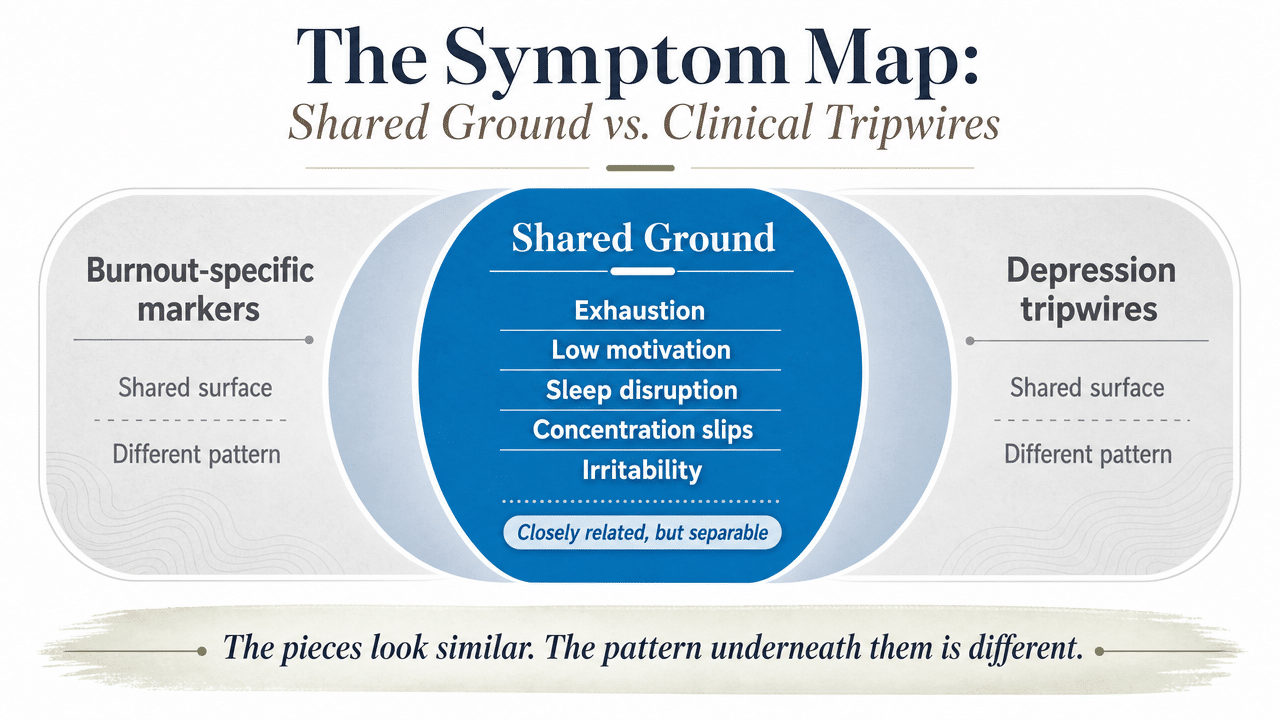
The Symptom Map: Shared Ground vs. Clinical Tripwires
Here’s where the confusion lives: burnout and depression share enough surface symptoms that pattern-matching from your own head is almost impossible. Let’s separate what overlaps from what doesn’t.
The shared ground. Both burnout and depression can hand you the same daily experience. Exhaustion that sleep doesn’t fully fix. Low motivation for things you know you should care about. Sleep that either won’t come or won’t hold. Concentration that slips — the meeting where you realize you’ve been reading the same sentence in a document for four minutes, the email you’ve rewritten five times. Irritability with people who don’t deserve it. This overlap is exactly why researchers describe burnout and depression as “closely related” but empirically separable phenomena. The pieces look similar. The pattern underneath them is different.2
What points toward burnout. Three markers, working together: emotional exhaustion, cynicism about your work specifically, and a sinking sense of reduced professional efficacy. Notice the last two words — professional efficacy. Burnout’s cynicism targets the job, the clients, the meetings, the mission statement you used to half-believe in. And crucially, the symptoms track your work life. They loosen their grip when the work pressure genuinely lifts, because burnout is “work related and situation specific”.3,7
What points toward depression. This is the tripwire list, and it matters. Persistent low self-esteem. Guilt that doesn’t match the situation — the kind where a small mistake feels like proof of something larger about who you are. Hopelessness about the future in general, not just this quarter. Anhedonia that spreads across life domains: the friends, the food, the music, the weekend plans that used to actually help. And any version of suicidal thinking. Researchers are explicit that these are not typical burnout symptoms. If they’ve entered the picture, the picture has changed.5
One more distinction worth naming: scope. Burnout keeps its complaints localized to work. Depression widens the frame until nothing in your life looks quite right — the relationships, the hobbies, the parts of yourself you used to like. Same fatigue on the surface. Different reach underneath.5
Reading this list against your own week is uncomfortable, and that discomfort is not something to push past alone. It’s the exact information a real clinical assessment is designed to sort through — not to label you, but to tell you which pattern is actually running the show so the next steps stop being guesses.
Four Questions That Reveal Which Pattern Fits You
You don’t need a quiz. You need four honest questions, asked slowly, with the willingness to sit with the answers for a minute before moving on. These aren’t diagnostic — no self-check is. They’re reflection prompts that sharpen what you’ll eventually bring to a real assessment.3,5,6
- Does the feeling lift on weekends and vacations? Think about the last time work pressure actually dropped — a long weekend, a week off, a stretch where deadlines went quiet. Did anything shift? Even a little? Burnout is “work related and situation specific,” which means when the work stressor genuinely eases, the picture starts to change. If Saturday morning felt lighter, even briefly, that’s information pointing toward burnout. If the fog followed you into a real vacation and stayed there, that’s information pointing somewhere else.
- Does it reach into hobbies, relationships, and the parts of life that used to feel like yours? Burnout typically stays localized — the job feels heavy, but the run you take on Saturday still helps, the dinner with your closest friend still lands. When the flatness spreads to the music, the food, the people, the plans you used to look forward to, the scope has widened past what burnout usually explains. Watch for the specific quality of it: not “I’m too tired for this,” but “this doesn’t reach me anymore.”
- Have thoughts of guilt, worthlessness, or hopelessness entered the picture? This is the tripwire question, and it matters more than the other three combined. Persistent guilt that doesn’t match the situation. A low, steady sense that you’re the problem. Hopelessness about the future in general, not just the current project. Any version of suicidal thinking. Research is explicit that these are not typical burnout symptoms. If you’re recognizing any of them in your own head — even quietly, even the softer versions — that’s a signal to talk to a clinician now, not next month.
- Has it stuck around for more than two weeks, regardless of what your workload is doing? Burnout tracks your work. When the pressure changes, the symptoms change with it, even if slowly. If two weeks have passed and the heaviness hasn’t budged whether you were slammed or slow, whether you took time off or worked straight through, the pattern isn’t tracking work anymore. It’s tracking something else.
Sit with your answers. If most of them point toward burnout — the feeling lifts, it stays tied to work, the tripwire thoughts aren’t there — that’s a real starting point, and there’s a lot you can do with it. If any of them point toward depression, especially question three, you don’t need to finish this article before reaching out. Noticing this much is already progress. The next step is letting someone qualified help you sort the rest.
When Burnout and Depression Coexist
Here’s the part most articles skip: you can have both. The two conditions aren’t a menu where you pick one. Burnout and depression can run side by side, and one can quietly feed the other. Patient-education research from NIH notes that burnout may increase the risk of depression — meaning if you leave the work pattern unaddressed long enough, the pervasive version can settle in on top of the situational one.5
The path in usually looks something like this. Chronic work stress grinds down your recovery capacity. Sleep gets thinner, exercise falls off, the small pleasures that used to reset you get squeezed out of the calendar. The cynicism starts leaking past work — into how you talk about your friends, your city, yourself. At some point the flatness stops needing your job as a trigger. It just stays.
When both are present, you don’t get to treat only the one you like better. Taking three weeks off might ease the exhaustion piece, but it won’t touch the guilt or the hopelessness underneath. And white-knuckling your way through depression treatment while returning to the same 70-hour weeks that broke you tends to end where it started. Researchers describe burnout and depression as “closely related” but empirically separable, which is exactly why sorting out how much of each is running the show matters clinically.2
If your gut says both — the work is genuinely too much and something deeper has shifted — trust that. A comprehensive assessment can name both patterns and treat them together, rather than making you pick a story.
Why Self-Diagnosis Keeps Failing You
If you’ve spent an hour on burnout quizzes and come away more confused, that’s not you being bad at self-reflection. The problem is baked into the tools.
Start with the definitional mess. Before researchers landed on a consensus definition of occupational burnout, one review catalogued 88 different definitions in circulation. Eighty-eight. That’s not a field with tidy edges — that’s a field where the quiz you took on Tuesday and the one you took on Thursday may have been measuring different things entirely. Add in the ongoing debate about whether burnout even qualifies as a valid diagnostic entity, with one 2023 review arguing no clear evidence supports the work-stress causal story, and the terrain gets shakier.1,10
Then there’s the deeper problem: burnout and depression share too much surface for a checklist to sort them out. Both include exhaustion, low motivation, disrupted sleep, and slippery focus. Researchers describe them as closely related but empirically separable — separable by careful clinical assessment, not by ten yes/no questions. A quiz can’t tell whether your flatness lifts on real vacations. It can’t ask follow-up questions when you mention guilt. It can’t notice that the exhaustion you’re describing has a thyroid pattern, or an anxiety pattern, or a grief pattern underneath it.2
You aren’t failing the quizzes. The quizzes are asking the wrong questions. That’s what a comprehensive assessment is built to do differently.
What a Clinician Actually Rules Out
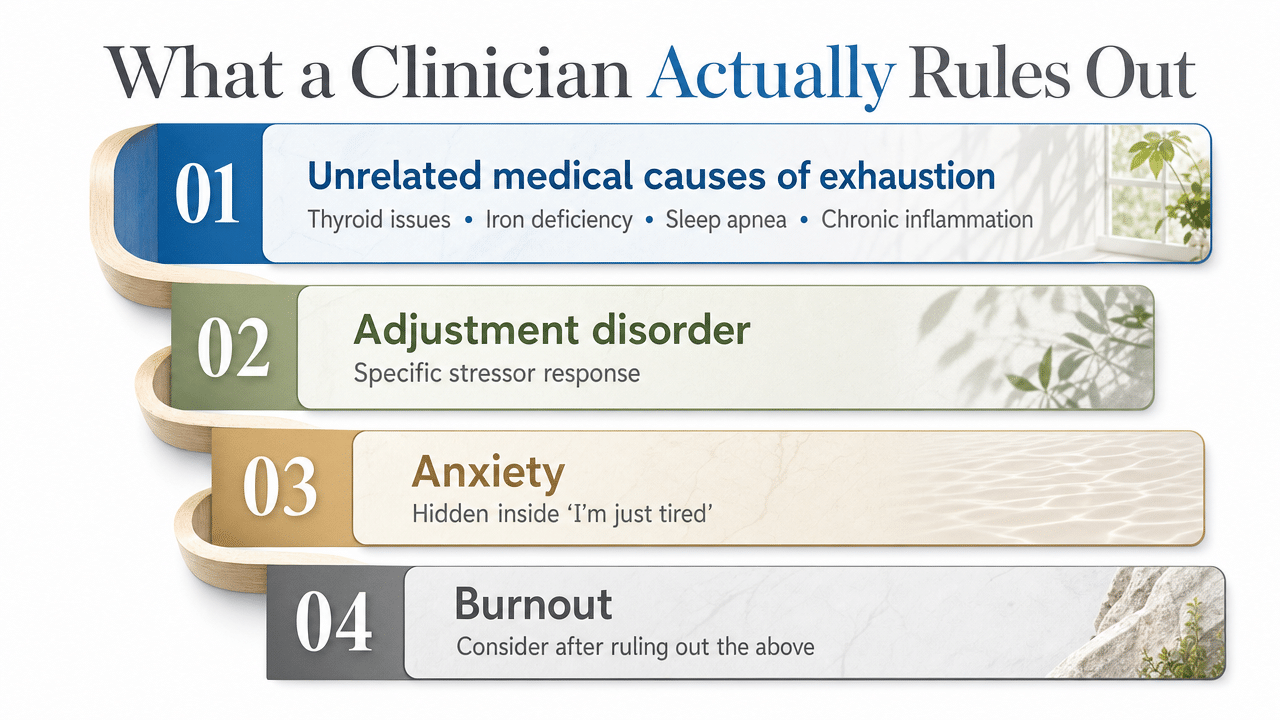
When you walk into a real assessment saying “I think I’m burned out,” a good clinician doesn’t just nod and hand you a stress-management pamphlet. They start working through a list — a differential diagnosis — because the exhaustion you’re describing could be several very different things, and treating the wrong one costs you time you don’t have.
Here’s what actually gets ruled out. First, unrelated medical causes of exhaustion. Thyroid issues, iron deficiency, sleep apnea, chronic inflammation — the kinds of things that will look like burnout forever if no one thinks to check. Then adjustment disorder, which is the mind’s response to a specific stressor (a promotion, a move, a loss) and behaves differently than burnout even when the exhaustion looks identical. Then anxiety, which loves to hide inside “I’m just tired” because chronic hypervigilance is genuinely draining. Then depression, the big one, assessed against the full symptom picture, not just the mood question. And then two conditions most people have never heard of but clinicians know well: prolonged exhaustion states and alexithymia, a difficulty identifying and describing your own emotions that can mimic burnout’s flatness.4,8
Only after that ladder is worked through does “burnout” become the honest answer — and even then, a careful clinician will name what version, how severe, and what else is quietly running alongside it.
This is the piece a self-quiz cannot do. A quiz can’t order a thyroid panel. It can’t ask follow-up questions about your sleep architecture, your caffeine load, your grief from six months ago, or the anxiety pattern you’ve had since college. It can’t hold the full picture and check it against real diagnostic criteria. What looks like one problem from your end usually has two or three moving parts underneath, and sorting them out is the difference between a plan that works and a year of trying things that don’t.
You’ve been carrying this on your own long enough. Letting someone qualified take the sorting off your plate is not weakness — it’s the efficient move.
Your Next Step: A Real Assessment, Not Another Quiz
If you’ve read this far, you already know more about your own pattern than you did an hour ago. That counts. Noticing the difference between “this eases when work eases” and “this follows me everywhere” is genuinely progress, and it’s the exact information that makes a first appointment useful instead of exploratory.
Here’s what a comprehensive assessment with a Mind Body Optimization clinician actually does. It works the full differential — the medical causes, the anxiety pattern, the depression picture, the burnout piece, the dual-diagnosis possibilities — instead of asking you to pick a story before anyone has looked closely. It considers your sleep, your history, the timing of when the heaviness started, and whether more than one thing is running at once. And it produces a plan built around your schedule, whether that means in-person visits at one of our Texas, Tennessee, Oklahoma, or Missouri locations or telehealth sessions that fit between meetings.
You’ve been carrying the guessing for a while. Schedule an assessment and let a clinician do the sorting. That’s the fastest way out of the loop you’re in.
Find clarity between burnout and depression today
Get a personalized assessment to understand your symptoms and start moving forward with confidence.Frequently Asked Questions
Can burnout turn into depression if I ignore it?
Yes, and this is one reason not to sit with it too long. Patient-education research notes that burnout may increase the risk of depression when the underlying work stress goes unaddressed. The situational exhaustion can settle into something more pervasive over time. If the heaviness is already spreading past your job, that’s the signal to get a real assessment.5
Is burnout an official medical diagnosis?
No. The World Health Organization classifies burnout in ICD-11 as an occupational phenomenon tied to chronic workplace stress, not a medical illness. Depression, by contrast, is a formal clinical diagnosis. That distinction matters for treatment — a clinician can diagnose and treat depression directly, while burnout is addressed by changing the work pattern driving it.9
How long should I wait before seeking a professional assessment?
Two weeks is a reasonable ceiling if the heaviness isn’t tracking your workload anymore. Don’t wait at all if guilt, hopelessness, worthlessness, or any suicidal thinking has entered the picture — those aren’t typical burnout symptoms and warrant a clinician now. Otherwise, if a genuine break didn’t move the needle, that’s your cue to schedule an assessment rather than trying another fix on your own.5
Will taking a vacation tell me whether it’s burnout or depression?
It’s a useful data point, not a diagnosis. Because burnout is “work related and situation specific,” symptoms typically ease when the work pressure genuinely lifts. If a real vacation moves the needle even a little, that supports a burnout picture. If the flatness follows you into the trip and stays there, the pattern may not be tied to your job — and that’s worth having a clinician sort through.3
Can I have both burnout and depression at the same time?
Yes, and it’s common enough that clinicians assess for it directly. Research describes burnout and depression as closely related but empirically separable — meaning both can run at once, each needing its own attention. Treating only one usually leaves the other in place. A comprehensive assessment names how much of each is present so the plan actually matches what’s happening.2
Why aren’t online burnout quizzes enough to tell the difference?
Because the terrain underneath them is unsettled. Before a consensus definition of burnout emerged, researchers catalogued 88 different definitions in use. A ten-question quiz can’t work a real differential — it can’t rule out thyroid issues, anxiety, adjustment disorder, or depression, and it can’t ask follow-up questions when you mention guilt or hopelessness. Sorting that out is what a comprehensive clinical assessment is built to do.10
References
- Examining the evidence base for burnout. https://pmc.ncbi.nlm.nih.gov/articles/PMC10630726/
- Burnout or Depression? Investigating Conceptual and Empirical …. https://pmc.ncbi.nlm.nih.gov/articles/PMC12194649/
- The Relationship Between Burnout, Depression, and Anxiety. https://pmc.ncbi.nlm.nih.gov/articles/PMC6424886/
- Burnout phenomenon: neurophysiological factors, clinical features, and recovery. https://pmc.ncbi.nlm.nih.gov/articles/PMC9478693/
- Depression: Learn More – What is burnout?. https://www.ncbi.nlm.nih.gov/books/NBK279286/
- Understanding the burnout experience: recent research and evidence. https://pmc.ncbi.nlm.nih.gov/articles/PMC4911781/
- Differentiating Burnout from Depression: Personality Matters!. https://pmc.ncbi.nlm.nih.gov/articles/PMC4534781/
- Differential diagnostic of the burnout syndrome. https://pubmed.ncbi.nlm.nih.gov/21289882/
- ICD-11 Burnout for the psychiatrist: Meaning of the concept …. https://pmc.ncbi.nlm.nih.gov/articles/PMC11863005/
- Background. https://www.ncbi.nlm.nih.gov/books/NBK602881/