

Key Takeaways
- Cognitive behavioral therapy carries the strongest evidence for adult ADHD across 32 reviewed studies, interrupting avoidance loops and shame spirals through 12 to 16 structured sessions.8
- Skills and organizational training closes the gap between knowing and doing by externalizing systems for time, planning, and materials rather than relying on willpower.12
- ADHD coaching works as recurring weekly accountability, with a review of 19 studies showing improvements in symptoms and executive functioning, though sample sizes remain small.5
- Psychoeducation lowers psychological stress and shame while raising self-efficacy, making it a strong first step after diagnosis and a foundation for harder interventions.7
- Mindfulness training builds the noticing muscle for drifting attention and rising emotion, with promising but smaller trials supporting it as reinforcement rather than foundation.9,11
- Exercise improves executive functioning across all types, with aerobic and open-skill activities offering particular benefit for inattention and hyperactivity in 20-minute doses.10
- Sleep interventions, especially morning bright light therapy, shift circadian rhythm and daytime functioning, providing the floor every other ADHD strategy depends on.4
- Digital CBT apps show moderate to significant effectiveness for core symptoms and therapy adherence, working best as daily reinforcement paired with clinician-guided care.6
Why Non-Medication Treatment Deserves a Real Plan, Not a Wellness List
If you’ve landed here, you’re probably tired. Tired of half-finished projects, missed deadlines, and the loop of telling yourself that tomorrow you’ll finally get organized. Maybe you’ve tried stimulants and hated how they made you feel. Maybe you can’t take them. Maybe you just want to know what else actually works before you decide. Whatever brought you here, you deserve a straight answer instead of another list telling you to drink more water and try a bullet journal.
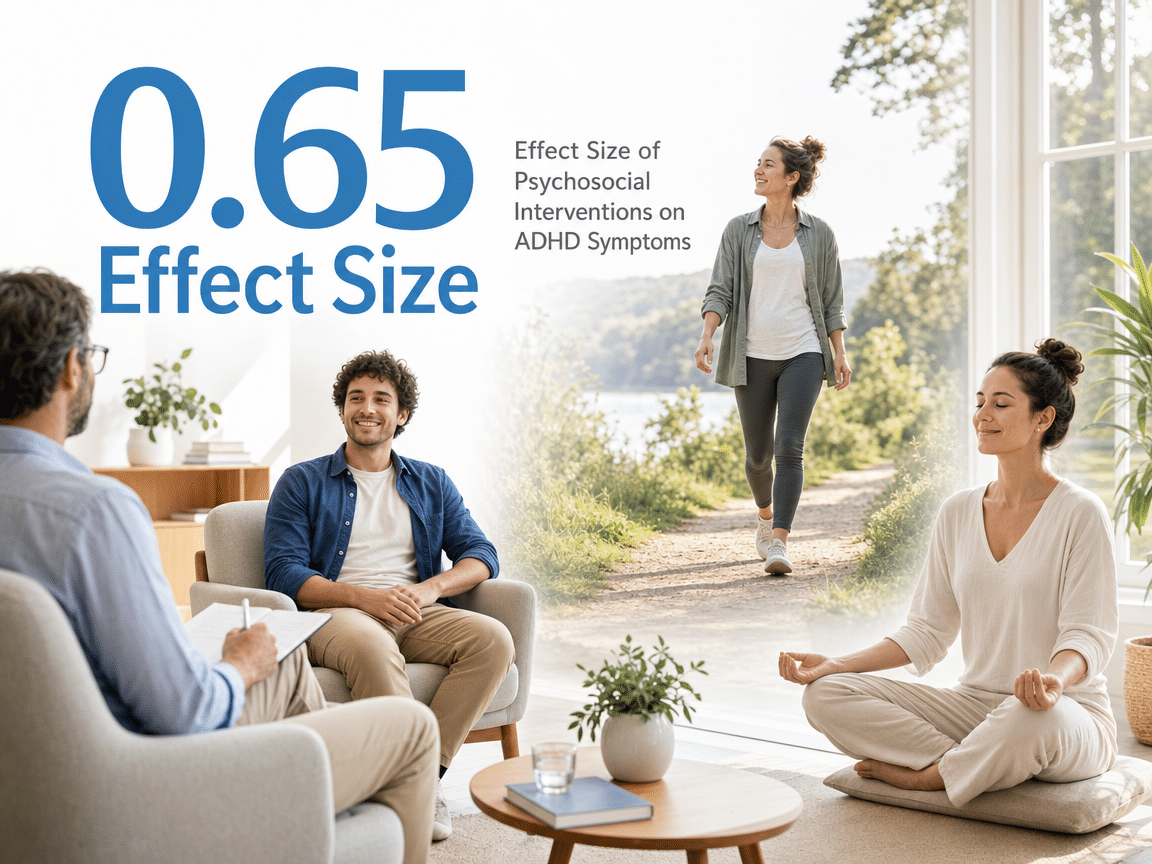
Here is the answer that matters most: non-medication treatment for adult ADHD is not a softer alternative or a consolation prize. A 2022 systematic review and meta-analysis of psychosocial interventions across the lifespan found a pooled effect size of 0.65 on core ADHD symptoms, a moderate effect that holds up across multiple study types. The review pooled different intervention formats and populations, so the number is a benchmark, not a guarantee for any one person. Still, it tells you something real. Talk therapy, structured skills work, and behavioral approaches move the needle.2
The seven strategies ahead are ranked by how much evidence stands behind them, not by how trendy they sound. You’ll see where cognitive behavioral therapy and skills training carry the strongest research, where coaching and psychoeducation provide scaffolding, and where sleep, exercise, mindfulness, and digital tools fit as daily reinforcement. Guidelines from groups like NICE already recommend psychological treatment as part of comprehensive ADHD care. You’re not stepping outside the science. You’re stepping into the part of it most articles skip.1
The Seven Strategies, Ranked by Evidence
Cognitive Behavioral Therapy: The Structural Core
If you only have the energy to commit to one thing, this is the one to commit to. Among 32 studies of non-pharmacologic treatments for adult ADHD, CBT is the most studied modality and the one with the strongest signal for improving core symptoms. That matters because adult ADHD is not just attention. It is the avoidance loop that builds around a task you keep failing at, the shame spiral after a missed deadline, the way one bad morning rewrites the rest of your week. CBT is built to interrupt those loops.8
What you’ll actually do in sessions is not what most people picture. You won’t lie on a couch describing your childhood. You’ll map a specific problem, like the two-hour gap between sitting down at your desk and starting actual work, and you’ll learn to identify the thought that runs in that gap. Then you’ll test smaller behavioral experiments against it. A randomized controlled study of CBT for adults with ADHD measured exactly this kind of work and tracked changes in attention, executive functioning, and emotional symptoms. The trial design assumed adults with ADHD need help across all three at once, not just the inattention piece.3
Here is the honest part. CBT takes time you don’t feel like you have, usually 12 to 16 weekly sessions, and the first three or four can feel like they’re going nowhere. Generalizing gains outside the therapy room is the hard step, and studies acknowledge that maintaining progress after treatment ends takes ongoing effort. If you start, plan for the dip in week three. That’s the week most people quit. Staying past it is where the change actually starts.3
Skills and Organizational Training: Where Intention Becomes Routine
You already know what you should do. You should write things down. You should use one calendar. You should break big projects into smaller pieces. The gap between knowing and doing is the entire ADHD experience, and skills training is the intervention designed for that gap.
Structured skills programs target organization of materials, time management, and planning, and research shows they produce significant improvements in those exact areas, with some evidence that better organization leads to reductions in ADHD symptoms themselves. The shift is from willpower-based systems, the ones that collapse the first bad week, to externalized systems that hold the structure for you. A wall calendar you cannot avoid seeing. A single inbox instead of seven. A weekly review that takes 20 minutes and prevents the Sunday-night dread.12
The catch is that most of the strongest organizational skills research comes from child and adolescent samples, with adult evidence following the same principles but on a smaller base. What that means for you practically: the techniques are sound, but you may need to translate them. A homework folder becomes a project folder. A teacher checking in becomes a partner, a coach, or a Friday calendar block where you check yourself.12
Start with one system, not five. Pick the friction point that costs you the most, usually starting tasks or remembering appointments, and build a single repeatable routine around it. You opened the planner today. That counts. Two weeks of opening it counts more.
ADHD Coaching: A Second Brain You Talk To Every Week
Coaching is the strategy people are most skeptical about, and the one that often surprises them. A descriptive review of 19 coaching studies found that every one of them showed improvements in ADHD symptoms and executive functioning, with many participants reporting sustained gains and high satisfaction. A separate study of coaching specifically with adults concluded it had a positive impact on quality of life and ADHD-related outcomes.5,13
The reason coaching works is mechanical, not magical. A coach is a recurring external accountability structure, usually weekly, sometimes with mid-week check-ins by text. You talk about what you said you’d do last week, what you actually did, what got in the way, and what the plan is for the next seven days. That structure does the executive-function work your brain has trouble doing on its own. It picks the next action, holds the timeline, and notices when you’re avoiding something.
Coaching is not therapy. A coach is not going to work through the grief underneath your procrastination or the trauma response that shows up when your manager emails you on a Friday. Coaching is forward-facing and behavioral. If the emotional layer is heavy, you’ll need therapy underneath it.
The honest limit is that the research base is uneven. Many coaching studies have small samples and varied methods, and the field still needs larger controlled trials. What that means in practice: vet your coach. Ask about training, format, and how they measure progress. A coach who tracks your goals against your own baseline is more useful than one who delivers motivation by the hour.5
Psychoeducation: The Underused First Step
Psychoeducation sounds like a pamphlet. It is not. A 2025 controlled study of a psychoeducational group program for adults with ADHD found that participants reported decreased psychological stress, decreased ADHD symptoms, and increased knowledge and self-efficacy compared with controls. That is three meaningful outcomes from an intervention most adults with ADHD have never been offered.7
The reason it works is that most of what you’ve heard about ADHD is wrong, partial, or aimed at parents of children. Sitting in a structured group, hearing how the diagnosis actually shows up in adults, learning why your brain handles deadlines the way it does, and recognizing your own patterns in other people’s stories reduces the shame load. Lower shame means lower stress. Lower stress means more bandwidth for the harder work, like CBT or skills training, that comes next.
This is the strategy to start with if you were recently diagnosed, or if you’ve been diagnosed for years but never had a clear picture of what you’re working with. It’s low-risk, scalable, and often available through community mental health programs, ADHD nonprofits, or group telehealth.
The researchers note one important limit. Psychoeducation alone may not be enough if your impairment is significant, and it works best as a foundation that other interventions build on. Treat it as the first floor of the house, not the whole house.7
Mindfulness Training: Attention and Emotion Regulation, Slowly
Mindfulness sits in an awkward place on this list. The mechanism makes sense and the early evidence is promising, but the trials are smaller and the effect sizes less certain than CBT or skills training. A pilot trial of mindfulness meditation training for adults with ADHD showed effects on core symptoms, executive functioning, and emotional regulation. A narrative review across age groups concluded mindfulness-based training has promising preliminary empirical support and is increasingly used in clinical settings.9,11
What mindfulness actually trains is the noticing muscle. Catching the moment your attention slips. Catching the rising heat of frustration before it becomes a slammed laptop. The goal is not a quiet mind, which is the misconception that makes most adults with ADHD quit in week one. The goal is the catch itself. You drift, you notice, you return. That is the rep.
Start small enough that it is impossible to fail. Five minutes a day, same time, ideally tied to something you already do, like the first sip of coffee. The trials with the most encouraging results used structured programs over several weeks, not occasional app sessions, so consistency matters more than length. The honest limit: small trials, sometimes without active control groups, mean the field still needs larger studies before claiming a firm effect size. It is a worthwhile reinforcement layer, not a foundation.9,11
Exercise: The Biological Floor for Executive Function
You knew this one was coming. You also probably hate that you knew. Exercise is one of the few interventions that directly targets the brain systems involved in attention, and a network meta-analysis of physical exercise in ADHD found that all types of exercise improved executive functioning, with aerobic and closed-skill activities showing particular benefit for inattention and hyperactivity. The study was conducted in children and adolescents, and the authors note that adult-specific research is still catching up, but the mechanisms, dopamine, norepinephrine, and prefrontal activation, do not change at age 18.10
The dose that matters is smaller than you think. A 20-minute walk at a pace that makes conversation slightly harder. Three or four times a week. Outside if you can manage it, on a treadmill if you cannot. The point is not fitness culture. The point is the 30 to 90 minutes of cognitive lift you get afterward, which is when you should schedule the hardest task of your day if your schedule allows.
Open-skill activities, like tennis, martial arts, or dance, layered cognitive demand on top of movement and may offer additional executive-function benefit. If a treadmill feels like punishment, try something with a ball or a partner. The best exercise for your ADHD is the one you will actually do this week.10
Sleep Interventions: The Foundation You Probably Skipped
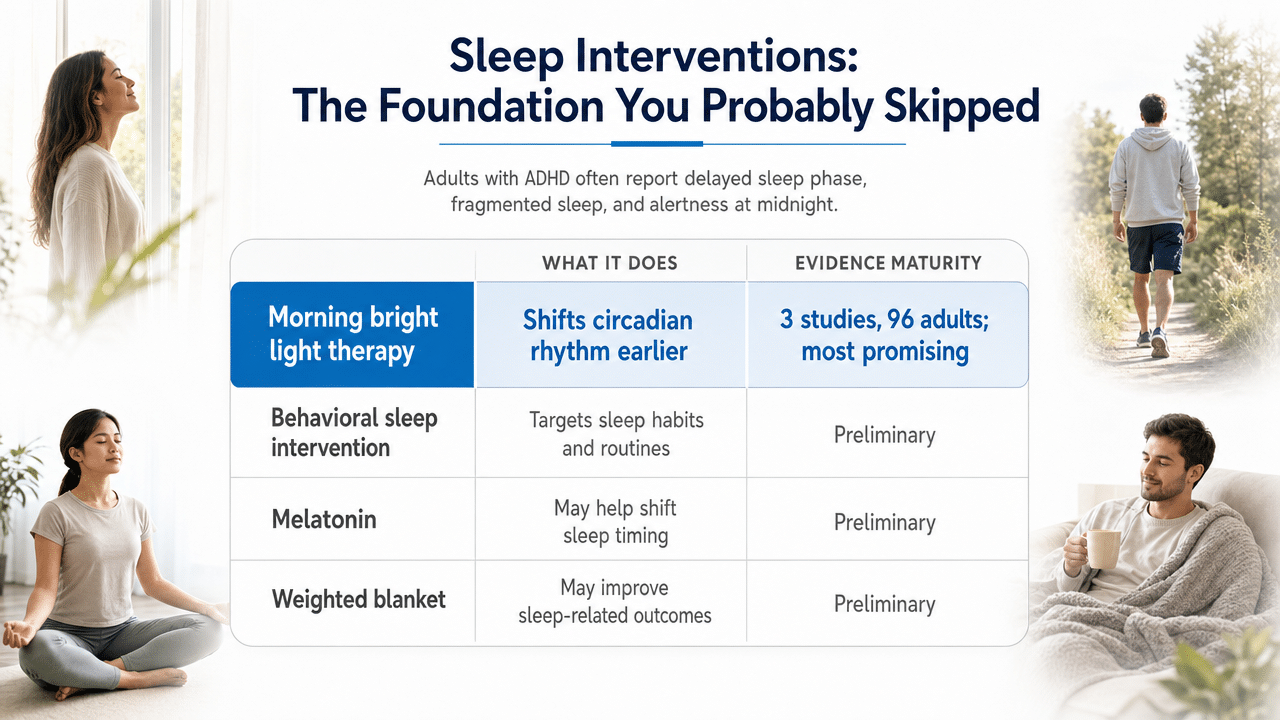
If your sleep is broken, every other strategy on this list works harder than it should. Adults with ADHD have higher rates of sleep problems, including delayed sleep phase, fragmented sleep, and the familiar pattern of being exhausted all day and then suddenly alert at midnight. A review of sleep in adults with ADHD reports preliminary evidence that several targeted interventions can shift sleep and improve daytime functioning, with morning bright light therapy showing some of the more promising signals across three studies involving 96 adults.4
Here is how the four most-studied options compare on what the research actually shows:4
| Sleep intervention | What it does | Evidence maturity |
|---|---|---|
| Morning bright light therapy | Shifts circadian rhythm earlier; supported by 3 studies, 96 adults | Preliminary, most promising of the four |
| Behavioral sleep interventions | Structured sleep schedule, stimulus control, wind-down routines | Preliminary, mechanism well-established outside ADHD |
| Melatonin | Helps with sleep onset, especially in delayed sleep phase | Preliminary, dose and timing matter |
| Weighted blankets | May reduce sleep-onset arousal | Preliminary, smallest evidence base of the four |
The review’s own caveat is that many commonly used sleep tools in ADHD remain unstudied, and the evidence base is still limited and heterogeneous. Translation: these are reasonable places to start, not guarantees. If you try only one this month, the morning light has the most data behind it. Ten to twenty minutes of bright light within an hour of waking, ideally outdoors. If that’s not possible, a 10,000-lux light box at your desk during breakfast. Pair it with a consistent wake time, even on weekends, and you’ve built the floor the rest of this plan stands on.4
Digital CBT Apps: The 2025 Layer Worth Adding
You probably have a graveyard of half-used apps on your phone right now. So the idea that another one could help feels like a setup for disappointment. Worth knowing anyway: a 2025 review of digital CBT applications for ADHD concluded that these tools show moderate to significant effectiveness in reducing core symptoms and improving adherence to therapy, especially for adults who struggle to access or stick with in-person care.6
What makes a digital CBT app different from a generic productivity tool is the underlying structure. Real digital CBT walks you through the same kinds of exercises a therapist would, identifying thought patterns, breaking tasks into smaller steps, planning around your specific friction points, and tracking progress over weeks instead of days. It is not a focus timer with a logo. The 2025 review notes the strongest results come when app use is paired with clinician-guided care, not used as a full replacement. Think of it as homework between sessions, or a bridge while you’re on a therapy waitlist.6
The limits are real. Engagement drops fast after the first two weeks, personalization is still uneven, and head-to-head comparisons with in-person CBT are scarce. Use it as daily reinforcement on top of the structural work, not as the structure itself. Ten minutes a day, same time, same trigger. That’s the rep.6
Sequencing: What to Start, What to Add, What to Skip This Month
Here is where most ADHD plans collapse. You read a list like this one, get excited, and try to start seven things at once. By week two, you’ve abandoned six of them and you’re convinced you’re the problem. You’re not. The problem is the sequence.
Pick one structural intervention and one biological one. That’s it for month one. The structural choice is either CBT or skills training, whichever you can actually access this week. CBT has the deepest evidence base for adult ADHD across 32 reviewed studies, but if there’s a three-month waitlist and your insurance is a maze, structured skills work targeting organization, time management, and planning produces real gains and you can start sooner. Done beats perfect.8,12
The biological choice is sleep. Not exercise, not yet. If you’re sleeping badly, exercise will feel like punishment and you’ll quit. Morning bright light within an hour of waking, paired with a fixed wake time seven days a week, is the smallest change with the most leverage.4
Month two is when you add coaching or psychoeducation as scaffolding around the structural work, and a 20-minute walk three or four times a week. Month three is mindfulness and a digital CBT app as daily reinforcement. Skip nothing permanently. Sequence everything.5,6,7,10
Where Non-Medication Treatment Falls Short—And Honest Limits to Name
You deserve the full picture, not just the encouraging half. Non-medication treatment helps a lot of adults, and for some it is enough. For others, it is not. Pretending otherwise sets you up to blame yourself when the plan does not carry you as far as you hoped.
Here is what the research actually says when you read the limits sections instead of the abstracts. Most non-pharmacologic trials in adults carry small sample sizes and elevated risk of bias, and the strongest signal across 32 studies is still CBT, not the softer interventions that get more airtime. Guidelines from NICE list medication as first-line for adult ADHD and psychological treatment as part of comprehensive care, not as a replacement for it. If your impairment is severe, if you are losing jobs or relationships, the non-medication path alone may not move you fast enough. That is information, not failure.1,8
If you try this plan honestly for three months and your core symptoms have not budged, that is a signal to revisit medication with a clinician, not a verdict on you.
Building the Plan You’ll Actually Follow
The plan you’ll follow is not the plan that looks best on paper. It is the one you can start this week with what you already have. Open a single document. Write down the one structural intervention you’re committing to, either a CBT consult call or the first organizational skills routine targeting your worst friction point. Write the wake time you’ll hold seven days a week, and the morning light source you’ll use. That’s the whole plan for now.4,8,12
Next to each item, write the day and time. Not the week. The day. Tuesday at 9 a.m. you call about CBT. Wednesday at 6:45 a.m. the curtains open. The specificity is the intervention. Vagueness is what your ADHD has been working with for years, and it has not served you.
One last thing. If you miss a day, you have not failed the plan. You have done what every adult building this does. Start again the next morning. That is the actual practice.
Ready for tailored support beyond medication?
Get expert guidance to navigate ADHD with strategies that fit your life and professional goals.
Frequently Asked Questions
Can adults really manage ADHD without medication?
Which non-medication treatment has the strongest evidence for adult ADHD?
How long does it take to see results from CBT, coaching, or skills training?
Do ADHD coaching and therapy do the same thing?
Are digital CBT apps a real treatment or just a productivity tool?
What should I start with if I can only commit to one change this month?
References
- Pharmacological and non-pharmacological treatment of adults with ADHD. https://pmc.ncbi.nlm.nih.gov/articles/PMC10699262/
- Psychosocial interventions for attention deficit/hyperactivity disorder: a systematic review and meta-analysis. https://pmc.ncbi.nlm.nih.gov/articles/PMC9776776/
- A Randomized Controlled Study of Cognitive Behavioral Therapy for Adults with ADHD. https://clinicaltrials.gov/study/NCT02062411
- Managing Sleep in Adults with ADHD: From Science to Pragmatic Approaches. https://pmc.ncbi.nlm.nih.gov/articles/PMC8534229/
- A Descriptive Review of ADHD Coaching Research. https://files.eric.ed.gov/fulltext/EJ1182373.pdf
- Digital Cognitive Behavioral Therapy (CBT) Apps for ADHD. https://pmc.ncbi.nlm.nih.gov/articles/PMC12436941/
- Effects of a psychoeducational group intervention for adults with ADHD. https://pmc.ncbi.nlm.nih.gov/articles/PMC12522325/
- Non-pharmacological interventions for adult ADHD. https://pubmed.ncbi.nlm.nih.gov/32036811/
- Mindfulness-based interventions for adults with ADHD. https://pmc.ncbi.nlm.nih.gov/articles/PMC12440486/
- Comparative effectiveness of various physical exercise interventions on executive functions in children and adolescents with ADHD: A network meta-analysis. https://pubmed.ncbi.nlm.nih.gov/37033046/
- Mindfulness Meditation Training for Attention-Deficit/Hyperactivity Disorder: A Narrative Review. https://pubmed.ncbi.nlm.nih.gov/25908900/
- Organizational-skills interventions in the treatment of ADHD. https://pubmed.ncbi.nlm.nih.gov/18928347/
- Efficacy of ADHD coaching for adults with ADHD. https://pubmed.ncbi.nlm.nih.gov/19276311/