

Key Takeaways
- Connections collapse on hard weeks because they run on spontaneous energy; a support system has to be built like a structure that holds up when you are tired.
- Support is not one feeling but six distinct jobs — attachment, integration, nurturance, reassurance, guidance, and reliable alliance — so name which slots are empty instead of chasing more friends 18.
- Aim for at least four supportive people, with four to six as a healthy range and six or more considered ideal for long-term well-being 14.
- Build four layers on purpose: an inner circle who knows the real week, calendar-based routine anchors, community rooms where you are a regular, and professional care that steadies the rest.
- Recruit slowly by letting one true sentence into conversations you were already having, and by becoming a familiar face in recurring rooms rather than auditioning people 1.
- When a relationship brings overprotection or stigma, shrink its role instead of cutting the person off, and fill the vacated slot with someone — or a clinician — who can carry the weight 22.
- Outpatient counseling and psychiatry do jobs friendships cannot, and pairing supportive relationships with adaptive coping strategies moves symptoms more than either piece alone 21.
Why Your Connections Keep Collapsing on Busy Weeks
You already know connection matters. That is not the problem. The problem is that by Thursday of a hard week, texting a friend back feels like drafting a memo, and calling your mom feels like scheduling a meeting you cannot afford. So you don’t. You tell yourself you’ll catch up this weekend. Then the weekend gets eaten by laundry, a work email you couldn’t ignore, and sleep you desperately needed.
This is the quiet failure mode for high-functioning people in their late twenties and thirties. Your support system isn’t missing. It’s just running on spontaneous energy you don’t have on the weeks you need it most.
Here is what the research keeps saying, in plain terms: social connection is not a nice extra. It is a protective factor for your mental health, on the same tier as sleep and access to care. The CDC frames upstream factors like relationships, routines, and community as the things that prevent distress before it becomes a crisis 16. A broader review of the evidence describes social connection as playing a vital role in preventing mental health problems and supporting recovery when they show up anyway 13.
So if the goal is a support system that survives your busiest quarter, it cannot depend on how you feel on a Tuesday night. It has to be built like a structure. Load-bearing. Boring on purpose. The rest of this guide walks you through how to do that, one layer at a time.
A Support System Is a Structure, Not a Feeling
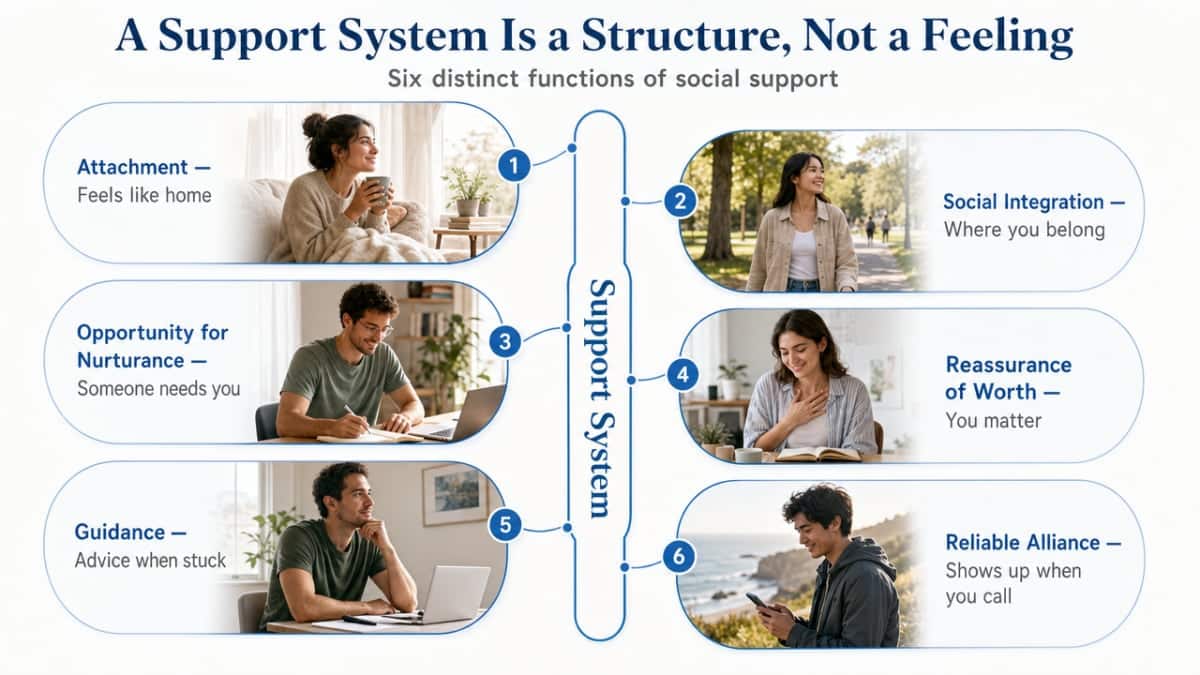
Here is the shift most articles skip: your support system is not a mood or a group of people who “get” you. It is a set of specific jobs that different people do for you, sometimes on purpose, sometimes without knowing it. When you can name the jobs, you stop expecting one person to do all of them, and you stop feeling vaguely unsupported when the truth is that one particular slot is empty.
Research on social support breaks it into six distinct functions: attachment, social integration, opportunity for nurturance, reassurance of worth, guidance, and reliable alliance 18. In plain terms, that means you need at least one person who feels like home, a group where you belong, someone who needs something from you, people who remind you that you matter, someone who can advise you when you are stuck, and someone who will show up when you call. Different people. Different jobs.
Think about your last hard month. The friend who let you vent at midnight was doing attachment work. Your running group was social integration. Your younger sibling asking for career advice was giving you nurturance, which sounds backwards but is protective for you, not just for them. Your manager telling you the project was salvageable was reassurance of worth. Your therapist was guidance. The one friend who drove over when you asked was reliable alliance.
When people say they feel unsupported despite “having friends,” what they usually mean is that three or four of those jobs are unfilled. The friends are real. The functions are missing. That is fixable, and it is a different problem than needing more people.
This is why the coming sections matter. You are not going to build one big blob of “connection.” You are going to look at these six roles, notice which are covered, and gently recruit for the ones that are not. Some slots will be filled by the same person. Some will be filled by a professional, which is exactly what professional care is for. None of it depends on you feeling warm and social on a hard Tuesday.
How Many People You Actually Need
You do not need a giant network. You need a small, reliable one. That distinction matters, because “build a support system” sounds like homework you will never finish, and a specific number turns it into something you can actually check against your life.
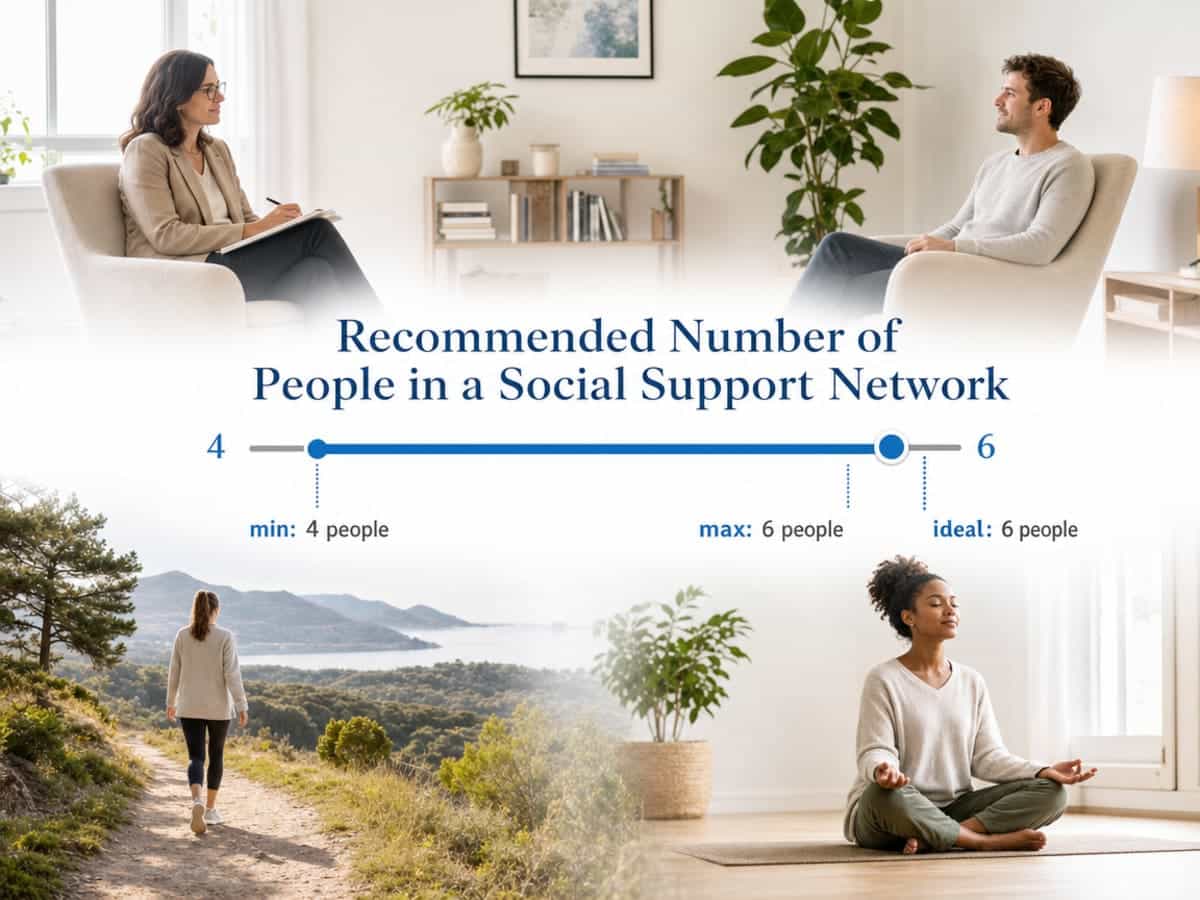
Researchers behind the Midlife in the United States study have proposed evidence-based National Health Guidelines for Social Connection, and their suggested target is refreshingly concrete: aim for at least 4 supportive people in your network, with 4–6 recommended, and 6 or more considered ideal for long-term health 14. Not thousands of followers. Not a bustling group chat. Four to six people who actually know what is going on with you.
That number probably feels smaller than you expected. Good. It means the goal is reachable, even during a quarter when your calendar looks hostile.
Here is how to size your own list. Open your notes app and write down every person you have leaned on in the last six months. Not people you could call — people you actually did, or who checked on you without being asked. Include the sibling who texts memes on bad days. Include the coworker who knows your project is unraveling. Include your therapist if you have one.
Now count. If you are at four or above, your job is maintenance, not recruitment. If you are at two or three, you have a gap worth naming, and the next layers of this guide are how you close it. If you are at zero or one, that is not a personal failure — it is the most common shape of a life that moved for work, went remote, or got quiet during a hard stretch. It is also the exact situation where professional care becomes especially useful as a starting anchor while the other layers grow.
One caution: the number is a floor, not a scoreboard. Six shallow contacts do not beat three people who actually pick up. Quality still decides whether the structure holds. Use the target to notice gaps, not to shame yourself for being human on a hard year.
The Four Layers That Hold the System Up
Inner Circle: The People Who Know the Real Week
Your inner circle is small on purpose. These are the two or three people who know what your actual week looked like, not the LinkedIn version. They know the client is being difficult, that you slept badly on Sunday, that your sister is going through something. You do not have to catch them up before you can be honest with them.
In the social support taxonomy, these people mostly carry attachment and reliable alliance — the sense that someone is close to you, and that they will show up when you call 18. Family often fills this slot, and research shows family support in particular buffers anxiety and depression symptoms 10. But it does not have to be family. A college friend you talk to every other Sunday counts. A coworker who has become a real friend counts.
The test is not affection. The test is friction. Can you text this person “bad day, can we talk later” without rehearsing the message for ten minutes? If yes, they are inner circle. If you would rather not bother them, they are one layer out — which is fine, they just do a different job.
Protect these relationships like you protect sleep. Return the texts, remember the details, show up when they are the one having the hard week. The inner circle stays strong through reciprocity, not intensity.
Routine Anchors: Calendar Beats Willpower
Here is the honest problem: on the days you most need connection, you have the least energy to initiate it. Reaching out becomes another task on a list that already broke you. So the answer is not to try harder. The answer is to remove the decision entirely.
Routine anchors are recurring, low-effort contact points that happen because they are already on the calendar, not because you felt like it. NIMH’s own stress guidance is direct about this: reach out to friends or family members who help you cope in positive ways 4. Their broader mental health guidance pairs that with keeping regular routines and staying connected as daily protective habits 2. When you turn those two ideas into recurring events, the system stops depending on your Tuesday-night motivation.
A working version looks boring, which is the point:
- One standing 20-minute call with your sibling every Sunday at 4 p.m.
- One Wednesday walk with a neighbor after work.
- One text thread with two friends where someone posts something small every day and nobody keeps score.
- One therapy appointment on the same day each week.
That is four contact points, and none of them require you to draft a message or wonder if you are bothering anyone.
The first two weeks feel forced. That is normal. By week four, you notice you talked to your sibling three times about nothing, and once about something real, and you would not have had that conversation without the standing call. That is the whole mechanism. You are not scheduling connection; you are scheduling the container it happens inside.
One more tip: put these anchors in the same calendar you use for work. They are appointments with your mental health, and they need the same weight as a client meeting. When something must move, reschedule it — do not delete it.
Community and Peers: Wider Than Your Roommate
The inner circle keeps you known. The community layer keeps you from being invisible. This is where social integration lives — the sense that you belong to a group, that people would notice if you stopped showing up 18.
For a lot of anxious young professionals, this layer collapsed at some point in the last five years. You moved for a job. Your team went remote. Your gym class ended. Whatever loose ties you had thinned out, and now your social world is basically work, one partner or roommate, and a group chat. That is a fragile shape, and it puts too much load on the inner circle.
Rebuilding this layer does not require finding new best friends. It requires finding recurring rooms where you are a regular. A running club that meets Saturday mornings. A volunteer shift once a month. A book group. A recreational league. The University at Buffalo School of Social Work’s guide is refreshingly practical here — it names volunteering, community organizations, and professional groups as concrete ways adults expand their networks 15.
Peer support groups belong in this layer too, especially if you are managing anxiety, depression, or a dual diagnosis. Talking to people who are working through something similar is a different kind of relief than talking to friends who love you but do not know the terrain. You do not have to explain the baseline. You can skip to the actual thing.
Professional Care: The Layer That Steadies the Others
Professional care is not the layer you turn to when the others fail. It is the layer that keeps the others from having to carry more than they can. Your best friend is not supposed to be your therapist. Your partner is not supposed to be your psychiatrist. When those roles blur, the relationships strain, and the person doing the emotional heavy lifting eventually burns out too.
In the social support framework, clinicians primarily carry guidance and, in the case of psychiatry, a specific form of reliable alliance that includes safety planning 18. NIMH’s overview of psychotherapies describes this well: evidence-based therapies help you build coping skills, examine how you interact with others, and provide supportive counseling that can include planning who to contact if things get worse 3. That is a different job than what a friend can do, even a very good one.
There are two practical pieces here. First, a therapist gives you a place to say the things you cannot say to the people in your life — including things about the people in your life. Second, a psychiatric provider handles the medication and diagnostic work that friends and family are not trained for and should not be guessing at, especially for anxiety, depression, PTSD, ADHD, bipolar disorder, or co-occurring substance use.
For a working professional, the friction that usually stops this layer from forming is scheduling. This is where outpatient telehealth counseling and psychiatry actually matter — not as a marketing feature, but as the mechanism that lets a 45-minute appointment fit between a 2 p.m. meeting and a 4 p.m. one. Mind Body Optimization operates this layer for readers across Texas, Tennessee, Oklahoma, and Missouri, in-person and virtually, so professional care can hold its slot without becoming another logistics problem.

How to Recruit People Without Making It Weird
The word “recruit” sounds clinical, but you already know what it feels like when someone slowly moves closer in your life. It usually happens through small, repeated moves — not one big vulnerable conversation. That is the model to copy.
Start with people who are already nearby. The Michigan Medicine patient handout is practical about this: express interest in people, share small pieces of what is going on with you, and let the relationship deepen through reciprocity rather than one dramatic ask 1. In real life, that looks like texting a coworker you like after a meeting — “that call was rough, hope your afternoon is easier” — and seeing what comes back. It looks like telling your college friend you had a hard week on the standing Sunday call, instead of defaulting to “good, you?”
You do not have to announce that you are building a support system. Nobody does that, and it would in fact be weird. You just have to let one more true sentence into conversations you were already having.
For new people, go where regulars go. The University at Buffalo guide points to volunteering, community groups, and professional organizations as reliable places to become a familiar face without forcing intimacy 15. Familiarity is the prerequisite for friendship. Show up to the same room four or five times and something usually starts.
One warning: do not audition people. If someone does not text back quickly or cannot go deep on the first coffee, that is information, not rejection. Keep watering the ones who water back. The system fills in slower than you want and faster than you expect.
What to Do When Your Support System Is Doing Harm
Not every supportive relationship supports you. Sometimes the people closest to you mean well and still make things harder — and naming that out loud is one of the hardest parts of this work.
Two patterns show up most often. The first is overprotection: a parent, partner, or friend who manages your life for you, doubts your ability to handle things, or treats your diagnosis as fragile. It feels like care. Over time it erodes the sense that you can trust yourself. The second is stigma inside the family — the relative who calls your medication a crutch, the sibling who thinks therapy is self-indulgent, the parent who wants you to stop talking about it. Research on recovery notes that some people encounter exactly this: stigma or overprotection within families that complicates support and often requires professional guidance to work through 22.
A few honest signals that a relationship in your system is costing more than it gives:
- You feel worse after most conversations with this person.
- You hide parts of your treatment from them.
- You find yourself managing their reaction to your bad days instead of having a bad day.
You do not have to cut people off. You can shrink the role. Move the person from inner circle to outer ring. Stop bringing them the hard stuff and keep them for the lighter conversations they can actually hold. Fill the vacated slot with someone — or something, like a therapist or peer group — that can carry the weight. A support system is allowed to change shape as you learn what each person can and cannot do.
Where Outpatient Psychiatry and Counseling Fit In
By the time most people call a clinic, they have already tried harder friendships, better sleep, a running habit, and an app or two. Those things matter. They are also not designed to do what outpatient psychiatry and counseling do, which is why the professional layer earns its own place in the structure instead of getting bolted on when everything else fails.
A counselor gives you a weekly hour where the whole agenda is your life. Not a friend’s turn to talk next, not a partner who is also tired, not a coworker who will file it away. That hour is where you can rehearse the conversation you need to have with your family, unpack the panic attack from Wednesday, or work on the coping strategies that make the rest of the system usable. Research consistently finds that pairing supportive relationships with adaptive coping — the kind therapy teaches — is what actually moves symptoms, not either piece alone 21.
A psychiatric provider handles a different job: diagnosis, medication, and the medical questions your friends should not be answering. If you are managing anxiety, depression, PTSD, ADHD, bipolar disorder, or anxiety alongside substance use, this is not a layer to improvise.
For a working professional, the practical barrier is almost always the calendar. Mind Body Optimization runs outpatient counseling and psychiatry across Texas, Tennessee, Oklahoma, and Missouri, in-person and by telehealth, so a session can sit between meetings instead of costing you a half day. That is the whole point of this layer — it holds its slot in a real week, and it keeps the rest of your support system from being asked to do work it was never built for.
Take a Confident Step Toward Real Support
Connect with a professional ally who understands your unique challenges and schedule.
Frequently Asked Questions
How many people should be in my mental health support system?
Aim for at least four supportive people, with four to six as a healthy range and six or more considered ideal for long-term well-being 14. These are people who actually know what is going on with you, not everyone in your contacts. If you are currently at one or two, that is a starting point, not a verdict — the goal is to gently add one relationship at a time, including a professional if that slot is empty.
What if I don’t have close family or friends nearby?
You are not starting from zero — you are starting from a different shape. Focus first on becoming a regular somewhere: a volunteer shift, a class, a professional group, or a peer support meeting 15. Familiarity comes before friendship. In the meantime, a therapist or psychiatric provider can hold the professional layer of your support system while the others grow, and telehealth makes that possible without a commute.
How do I ask someone to be part of my support system without making it awkward?
You do not have to ask formally. Deepen the relationship one true sentence at a time — share a small piece of what is going on, express real interest in their life, and let reciprocity do the work 1. “This week has been rough” is a full sentence. See who leans in. The people who become part of your support system usually earn the role gradually, not through one big conversation.
Do I still need a therapist if I have strong friendships?
Friendships and therapy do different jobs. A therapist helps you build coping skills, work through patterns, and plan for hard moments in ways a friend is not trained to do 3. Research also shows that combining supportive relationships with adaptive coping strategies produces better outcomes than either alone 21. Strong friendships are protective — they are also not a substitute for professional care when anxiety, depression, or trauma are shaping your weeks.
How do I keep a support system going during busy work seasons?
Do not rely on how you feel on Tuesday night. Put recurring, low-effort contact points on your calendar — a standing Sunday call, a weekly walk, a therapy appointment on the same day each week — and treat them like work meetings 2. When something must move, reschedule instead of canceling. The system holds because it is on the calendar, not because you had energy to reach out that day.
What are signs that my support system is actually making things worse?
You feel worse after most conversations with a particular person. You hide parts of your treatment from them. You spend bad days managing their reaction instead of having your own feelings. Overprotection and stigma inside families are documented patterns that can complicate recovery and often need professional guidance to work through 22. You do not have to cut anyone off — you can shrink their role and fill that slot with someone who can carry the weight.
References
- 9C Adult Psychiatry – Building a Support System. https://med.umich.edu/1libr/psych/9C/SupportSystem.pdf
- Caring for Your Mental Health. https://www.nimh.nih.gov/health/topics/caring-for-your-mental-health
- Psychotherapies. https://www.nimh.nih.gov/health/topics/psychotherapies
- I’m So Stressed Out! Fact Sheet. https://www.nimh.nih.gov/health/publications/so-stressed-out-fact-sheet
- Social Connection. https://www.cdc.gov/social-connectedness/about/index.html
- Social Connection – The Surgeon General’s Framework for a National Strategy to Advance Social Connection. https://www.hhs.gov/surgeongeneral/reports-and-publications/connection/index.html
- Social network interventions in mental healthcare: a protocol for an umbrella review. https://bmjopen.bmj.com/content/11/12/e052831
- Social Support Protects Against Symptoms of Anxiety and Depression. https://pmc.ncbi.nlm.nih.gov/articles/PMC8356640/
- Risk and Protective Factors for Symptoms of Depression and Anxiety among American Indian Adults. https://pmc.ncbi.nlm.nih.gov/articles/PMC7814695/
- What’s the role of perceived social support and coping styles in depression and anxiety? A cross-sectional study. https://pmc.ncbi.nlm.nih.gov/articles/PMC4274570/
- Social Support, Activities, and Recovery from Serious Mental Illness. https://pmc.ncbi.nlm.nih.gov/articles/PMC2682629/
- Caregiver Support in Mental Health Recovery: A Critical Realist Qualitative Research. https://pmc.ncbi.nlm.nih.gov/articles/PMC8579328/
- Social connection as a critical factor for mental and physical health. https://pmc.ncbi.nlm.nih.gov/articles/PMC11403199/
- National Health Guidelines for Social Connection – MIDUS Study. https://www.midus.wisc.edu/findings/pdfs/2665.pdf
- Developing Your Support System. https://socialwork.buffalo.edu/resources/self-care-starter-kit/additional-self-care-resources/developing-your-support-system.html
- Protecting the Nation’s Mental Health. https://www.cdc.gov/mental-health/about/what-cdc-is-doing.html
- Social connectedness, mindfulness, and coping as protective factors in the mental health of U.S. adults during COVID-19. https://pmc.ncbi.nlm.nih.gov/articles/PMC9347863/
- Social Support. https://www.ncbi.nlm.nih.gov/books/NBK585650/
- Social connectedness as a determinant of mental health. https://pmc.ncbi.nlm.nih.gov/articles/PMC9560615/
- Social Support and Resilience in Mental Health. https://pmc.ncbi.nlm.nih.gov/articles/PMC7781140/
- Social Support, Coping Strategies, and Mental Health Outcomes in Adults with Depression and Anxiety. https://pmc.ncbi.nlm.nih.gov/articles/PMC8325934/
- The Role of Social Support in Recovery from Mental Illness. https://pmc.ncbi.nlm.nih.gov/articles/PMC10944063/