

Key Takeaways
- Tennessee funds a statewide Problem Gambling Program through The Gambling Clinic, offering free telehealth and in-person care in Memphis, Nashville, and Johnson City regardless of insurance 1.
- Gambling disorder is the only behavioral addiction formally recognized in the DSM-5, while compulsive gaming, shopping, and screen use are treated as co-occurring patterns alongside anxiety, depression, or trauma 9.
- TennCare, commercial insurance parity, and the TDMHSAS Behavioral Health Safety Net cover outpatient therapy and psychiatry for Tennesseans, with telehealth and evening slots making care fit around demanding jobs 8.
- Save the Tennessee REDLINE at 800-889-9789 for confidential 24/7 referrals, then book one outpatient or telehealth session through the pathway that matches your coverage 2.
When a Habit Starts Running Your Week
It’s Thursday night, you’ve told yourself you’d log off by ten, and somehow it’s past midnight and you’re still scrolling, still betting, still adding things to a cart, still refreshing something. The next morning you’re tired, a little ashamed, and quietly certain that this time you’ll cut back. By Sunday, the loop starts again.
If you’re reading this in Chattanooga, Franklin, Knoxville, or anywhere else in Tennessee, and you’ve been wondering whether your habit has stopped feeling like a choice, that question alone is worth taking seriously. It doesn’t mean you’re broken. It means something in your week has started running you instead of the other way around.
Behavioral health researchers describe this pattern as a process addiction, sometimes called a behavioral addiction. It shares real features with substance use disorders, including compulsive engagement, loss of control, and continued behavior despite mounting consequences 3. Addiction, in the clinical sense, is understood as a treatable condition tied to how the brain handles reward and stress, not a failure of willpower or character 5.
This page is a map, not a lecture. You’ll get an honest look at what a process addiction is, what Tennessee actually offers, and a small, specific step you can take this week.
What Counts as a Process Addiction (and What Doesn’t Yet)
Here’s the honest answer, because you deserve one: the science hasn’t drawn every line yet, and that ambiguity can actually make things harder when you’re trying to figure out what’s happening to you.
Gambling disorder is currently the only behavioral addiction officially recognized in the DSM-5, the diagnostic manual clinicians use in the United States 9. That means if your compulsive pattern is around sports betting, casino apps, daily fantasy, scratch-offs, or online poker, there is a formal diagnosis, a research base, and in Tennessee, dedicated free services built around it.
Other patterns you might be worried about, like compulsive gaming, non-stop shopping, hours lost to short-form video, or compulsive sexual behavior, sit in a different category. Researchers actively study them as behavioral addictions, and they share real clinical and neurobiological features with substance use disorders, including loss of control and and continued engagement despite consequences 3. But they aren’t yet classified as standalone disorders in the DSM-5 9. Internet gaming disorder is listed as a condition needing further study. Compulsive buying and problematic internet use are debated as impulse-control issues, obsessive-compulsive-spectrum conditions, or emerging addictions 9.
What this means for you is practical, not philosophical. If your pattern is gambling, you have a named door to walk through. If your pattern is gaming, shopping, screens, or something else, you can still get real help, usually through outpatient counseling and psychiatric care that treats the compulsive behavior alongside the anxiety, depression, or trauma often tangled up with it.
You don’t need a perfect diagnostic label to deserve support. You need someone who takes the pattern seriously and knows how to help you interrupt it.
How the Pattern Shows Up in a Working Professional’s Day
You probably look fine from the outside. You hit your deadlines, you show up to standups, you answer the group chat. That’s part of what makes this so disorienting. The pattern doesn’t tank your career on a Tuesday afternoon. It just quietly eats the edges of your life until there aren’t many edges left.
See if any of this feels familiar. Behaviorally, you’ve tried to cut back and it hasn’t held. You set a limit on the app, and you’re back on it by Wednesday. You promised yourself last month was the last deposit, and there was another one last night. You clear the cart, and it refills. Researchers describe this exact pattern, the compulsive engagement and loss of control that continues even when you can see it’s costing you, as a defining feature of behavioral addictions, sharing real ground with substance use disorders 3.
Emotionally, the behavior has started doing a job. It quiets the anxiety after a hard meeting. It fills the gap on a lonely Sunday. It gives you something to look forward to when the week feels flat. Then, later, it leaves you flatter. This is why process addictions so often show up tangled with anxiety, depression, or unprocessed trauma, and why treating just the behavior without treating the mood underneath tends to fall apart 3.
At work and at home, the small tells add up. You’re distracted in the 2 p.m. meeting because you’re thinking about tonight. You’re short with your partner because you slept four hours. Your credit card statement has a rhythm you don’t want to explain. You’ve started lying, even by omission, about how much time or money is really going into this.
None of this makes you weak. It makes you someone whose brain has learned a very effective, very costly way to cope. Naming it is not the same as being defined by it. And naming it is the first thing that has to happen before anything else can change.
Why It Feels So Hard to Stop on Your Own
If willpower were the fix, you’d already be fine. You’re smart, you’re capable, you’ve white-knuckled your way through harder things. So when the same behavior keeps winning, it’s easy to conclude something is wrong with you. Something isn’t. Something is wrong with the setup.
Compulsive behaviors change how your brain handles reward. Over time, the same circuits that respond to food, connection, and accomplishment get recruited by the app, the bet, the cart, the scroll. Researchers who study gambling disorder have found significant overlap with substance use disorders in the brain’s reward and control systems, which is part of why the pull feels physical, not just psychological 7. Addiction, in the clinical sense, is understood as a chronic, treatable condition, not a lapse in discipline 5.
There’s a second layer, and it’s the one most working professionals miss. The behavior is doing a job. It’s regulating something, usually anxiety, low mood, loneliness, or the aftermath of a long day you didn’t get to feel. Take the behavior away without addressing what it’s regulating, and your nervous system will look for another exit. That’s why so many people cycle: quit for a week, white-knuckle it, then relapse harder.
Tennessee’s Actual Map of Support
The State-Funded Gambling Program in Memphis, Nashville, and Johnson City
Here’s something most Tennesseans don’t know: if your pattern is gambling, the state has already paid for your care. The Tennessee Department of Mental Health and Substance Abuse Services runs a Problem Gambling Program delivered through The Gambling Clinic, and the services are free for people of all ages 1. That’s not a sliding scale. That’s not a copay. Free.
The program offers a telehealth option along with in-person clinics in Memphis, Nashville, and Johnson City 1. If you’re in Chattanooga, Franklin, Knoxville, or a small town two hours from any of those cities, telehealth means you can meet with a clinician from your living room after work. You don’t have to explain a two-hour drive to your team. You don’t have to burn a PTO day.
This matters for a specific reason. Cost and logistics are the two most common excuses your brain will hand you for putting off the call. “I can’t afford it right now.” “I don’t have time to drive to a clinic.” With this program, both of those are off the table. What’s left is the harder, more honest thing: picking up the phone.
If gambling is what’s been running your week, this is the door built for you. You don’t have to hit rock bottom to walk through it.
REDLINE: The 24/7 Door Most People Don’t Know Exists
When you’re not sure what you have or where to start, the Tennessee REDLINE is the number to keep in your phone. Call or text 800-889-9789. It’s confidential, it’s staffed around the clock, and it’s been the state’s referral hub since 1989 2.
The REDLINE handles referrals for both substance use and problem gambling, and the people on the other end are trained to help you find state-funded or free options based on where you live and what you’re dealing with 2. You don’t need a diagnosis. You don’t need to have decided anything. You can text at 11 p.m. on a Sunday from your couch and ask a real question.
Saving that number in your contacts right now, even if you don’t use it tonight, counts as a step. It’s one less decision your future self has to make at a moment when making decisions is going to feel impossible.
How Tennessee Routes People Into Care
If you’re wondering whether Tennessee’s referral system actually connects people to treatment or just hands out phone numbers, there’s real data on this. Tennessee Recovery Navigators, a statewide hospital-based recovery support program, served 5,740 people in FY25 and connected 3,998 of them to treatment or a recovery resource, a 70% placement rate 12. The program is designed for people showing up in emergency departments with overdose, withdrawal, or substance use concerns, so it isn’t a direct match for process addictions. But it tells you something important about how the state’s linkage infrastructure actually performs.
Seventy percent is not perfect. It means roughly three out of ten people who encountered a Navigator didn’t make it into care, and that gap is real. It also means that when a Tennessean in crisis meets a trained peer who knows the local system, most of them do get routed somewhere useful 12. That’s a much better rate than trying to figure out the system alone at 2 a.m. with a browser tab open.
The practical takeaway for you is this: the state has spent years building the connective tissue between crisis and care. Whether that first contact is REDLINE, an ED social worker, a primary care doctor, or an outpatient clinic, you are far more likely to end up in the right place if you use the routing than if you don’t.
Paying for Care: TennCare, Commercial Insurance, and the Safety Net
Let’s talk about money, because it’s usually the second question after “is this even a real problem?” and it deserves a straight answer.
If you have TennCare, behavioral health is a covered benefit. That includes outpatient therapy, psychiatric evaluation, medication management, and crisis support 8. Process addictions aren’t always listed by name in benefit summaries, but the compulsive behavior rarely travels alone. Anxiety, depression, PTSD, and substance use are all covered diagnoses, and a good outpatient clinician will treat the pattern in that context. If your TennCare card is in your wallet, you already have a door.
If you have commercial insurance through your employer, mental health parity laws mean your plan generally has to cover behavioral health at the same level it covers physical health. Call the member number on the back of your card and ask two questions: what’s my copay for outpatient behavioral health, and do I have telehealth coverage. Most young professionals in Tennessee are surprised by how much is already covered.
If you’re uninsured, you have more options than you think. The TDMHSAS Behavioral Health Safety Net exists specifically for uninsured Tennesseans who need mental health or substance use support 8. Tennessee also runs an Uninsured Adult Healthcare Safety Net serving residents ages 19 to 64 through community providers and local health departments 13. And if gambling is the pattern, the state’s Problem Gambling Program is free regardless of insurance status 1.
Cost is a real barrier. It’s just not the barrier your anxiety wants you to believe it is. Before you decide you can’t afford help, spend fifteen minutes on the phone and find out what you actually qualify for.
Comparing Four Tennessee Access Pathways
You don’t need to master the whole system. You just need to pick the door that fits your situation and walk through it. Here’s how the four main pathways in Tennessee compare on the things that actually matter when you’re deciding tonight.
| Pathway | Best fit for | Cost | How to start |
|---|---|---|---|
| TDMHSAS Problem Gambling Program (via The Gambling Clinic) | You’re worried the pattern is gambling: sports betting, casino apps, poker, scratch-offs 1 | Free, all ages, regardless of insurance 1 | Telehealth statewide; in-person in Memphis, Nashville, Johnson City 1 |
| Tennessee REDLINE | You’re not sure what you have or where to start; you want to talk to a person before committing 2 | Free, confidential, 24/7 | Call or text 800-889-9789 2 |
| TennCare behavioral health benefits | You have TennCare and the pattern is tangled with anxiety, depression, PTSD, or substance use 8 | Covered benefit; standard TennCare cost-sharing | Ask your PCP for a referral or search the TennCare provider directory 8 |
| Commercial insurance or telehealth outpatient | You have employer coverage and want evening or virtual sessions that fit your calendar | Copay varies; parity laws apply to behavioral health | Call the member number on your card; ask about outpatient behavioral health and telehealth |
If you’re uninsured and the pattern isn’t gambling, the TDMHSAS Behavioral Health Safety Net is the pathway to ask about 8. The doors overlap on purpose. Picking the wrong one first isn’t a mistake, it’s just a shorter conversation before you get pointed to the right one.
What Evidence-Based Treatment Actually Looks Like
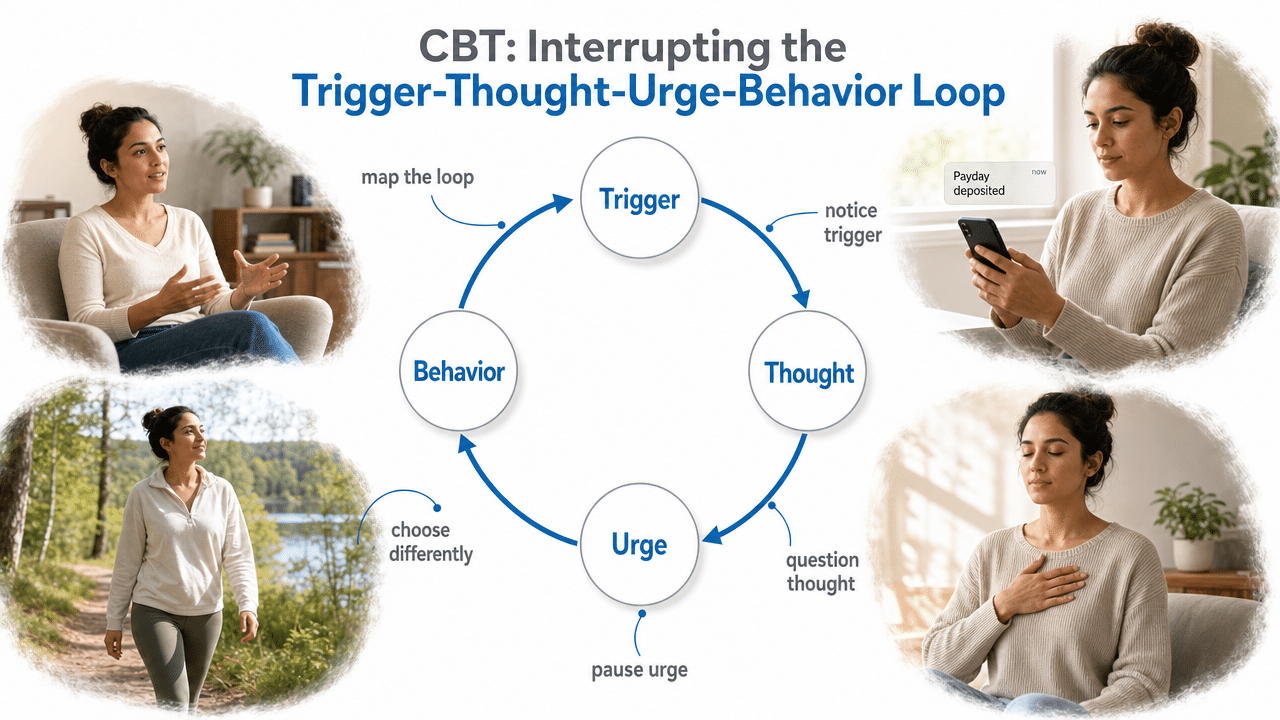
CBT: Interrupting the Trigger-Thought-Urge-Behavior Loop
Cognitive-behavioral therapy is the most studied treatment for behavioral addictions, and for gambling specifically it has the strongest evidence base among psychosocial approaches, with medium to large effect sizes across randomized trials 6. For other compulsive behaviors like gaming, shopping, and problematic internet use, CBT has strong support for gambling and emerging support elsewhere, and it’s the framework most Tennessee outpatient clinicians will use to help you work through what’s happening 10.
Here’s what CBT actually does in a session, minus the jargon. You and your therapist map the loop: the trigger (a rough meeting, a Friday night alone, a payday notification), the thought that follows (“just one bet to unwind,” “I earned this”), the urge that builds, and the behavior that closes it. Then you learn to interrupt the loop at each point. You catch the thought and check it against what you actually know. You build a different response to the trigger. You practice tolerating the urge without acting on it, which gets easier faster than you’d expect.
CBT for gambling specifically targets the cognitive distortions that keep the pattern alive, things like the near-miss feeling or the sense that you’re “due” for a win 6. Naming those thoughts out loud with someone trained to hear them takes a surprising amount of power out of them.
Motivational Interviewing, Family Involvement, and Medication for Co-Occurring Conditions
CBT rarely does the whole job on its own, and a good outpatient clinician won’t try to make it. Motivational interviewing is often layered in early, especially when part of you still isn’t sure you want to stop. It’s a conversational approach that helps you talk through your own reasons for change without being lectured or pushed, and it has support alongside CBT for gambling and other behavioral addictions 3.
Family involvement matters more than most working professionals expect. The pattern usually has ripples, a partner who’s been quietly counting deposits, a sibling who noticed you’ve gone quiet. Bringing one trusted person into a session, even once, can shift the isolation that keeps the behavior running.
And then there’s the piece that gets missed most often: the anxiety, depression, PTSD, or substance use sitting underneath. Behavioral addictions frequently travel with mood and anxiety conditions 3. Treating the compulsive behavior without treating what it’s regulating is why so many attempts don’t hold. A psychiatric evaluation, medication management when it’s warranted, and counseling that addresses both sides at once is the integrated approach that gives you a real chance. In Tennessee, that combined care is available through TennCare, commercial insurance, and outpatient providers offering telehealth.
Fitting Treatment Around a Demanding Job
You have a calendar that’s already full. That’s part of why you’ve put this off. So let’s talk about what treatment actually costs you in hours, and where the flexibility lives.
Telehealth is the biggest unlock for people in your situation. The state’s Problem Gambling Program offers telehealth statewide, so you don’t have to live in Memphis, Nashville, or Johnson City to use it 1. Most outpatient providers in Tennessee now offer virtual sessions through TennCare and commercial insurance too 8. A 45-minute session from your car during lunch, or from your kitchen at 6 p.m., is a real option, not a compromise.
Evening and early-morning slots exist, and they fill up fast. When you call to schedule, ask specifically for after-5 or before-8 availability. If the first clinic can’t offer that, the second one probably can. Franklin, Chattanooga, and Knoxville all have outpatient practices, including Mind Body Optimization, that keep evening hours and offer telehealth psychiatry and counseling for the anxiety and depression that so often sit underneath a compulsive pattern.
One evening a week, on your couch, with someone trained to help. That’s what fitting this into your life actually looks like.
A Concrete Next Step You Can Take This Week
You’ve read a lot. Here’s the smallest useful thing you can do before Sunday.
Save 800-889-9789 in your phone as “REDLINE” 2. That takes twenty seconds. It puts a real door in your pocket for the next hard night.
Then pick one of these, based on what fits:
- If gambling is the pattern, text or call REDLINE and ask about The Gambling Clinic’s telehealth intake. The services are free 1.
- If the pattern is something else and you have TennCare or commercial insurance, call the member line on your card and ask for an outpatient behavioral health referral with evening or telehealth availability 8.
- If you’re uninsured, ask REDLINE about the TDMHSAS Behavioral Health Safety Net 8.
One call. One text. One booked session. That’s the whole step. You noticed the pattern, which was the hardest part. The next move is smaller than it feels.
Take the First Step Toward Lasting Balance
Get support that fits your schedule and helps you move forward, one step at a time.
Frequently Asked Questions
Is a process addiction a real diagnosis, or am I overreacting?
You’re not overreacting. Gambling disorder is formally recognized in the DSM-5, and researchers describe other compulsive patterns like gaming, shopping, and internet use as behavioral addictions that share real features with substance use disorders, even though they aren’t yet standalone diagnoses 9. If the pattern is running your week, that’s enough reason to get support.
What Tennessee resources can I contact today if I’m not ready to commit to therapy?
Save the Tennessee REDLINE in your phone: call or text 800-889-9789. It’s free, confidential, and staffed 24/7 for both substance use and problem gambling referrals 2. You don’t need a diagnosis or a plan. You can ask one question at 11 p.m. on a Sunday and get pointed toward a real next step without committing to anything.
Does TennCare or commercial insurance cover treatment for compulsive behaviors?
Yes. TennCare covers outpatient therapy, psychiatric evaluation, and medication management under its behavioral health benefit 8. Commercial plans typically cover the same services under mental health parity. If gambling is your pattern, the state’s Problem Gambling Program is free regardless of insurance 1. Call the member number on your card and ask about outpatient behavioral health and telehealth.
Can I get help without taking time off work or telling my employer?
Yes. Behavioral health care is protected health information, and using your insurance doesn’t notify HR. Tennessee’s Problem Gambling Program offers telehealth statewide, and most outpatient providers now offer evening and virtual sessions through TennCare and commercial insurance 1, 8. A 45-minute session from your kitchen at 6 p.m. is a real option, not a compromise.
What type of therapy actually works for behavioral addictions?
Cognitive-behavioral therapy has the strongest evidence base for gambling disorder, with medium to large effect sizes across randomized trials, and emerging support for other compulsive behaviors 6, 10. Motivational interviewing is often layered in when part of you isn’t sure you want to stop 3. A good outpatient clinician combines both and treats the anxiety or depression underneath.
What if my compulsive behavior is tied to anxiety, depression, or past trauma?
That’s the rule, not the exception. Behavioral addictions frequently travel with mood, anxiety, and trauma-related conditions, and treating the behavior without addressing what it’s regulating is why so many attempts don’t hold 3. Look for outpatient care that combines counseling with psychiatric evaluation and medication management when warranted, so both sides get treated at once.
References
- Problem Gambling Programs. https://www.tn.gov/behavioral-health/substance-abuse-services/treatment/problem-gambling-programs.html
- Tennessee REDLINE. https://www.tn.gov/behavioral-health/substance-abuse-services/prevention/tennessee-redline.html
- Gambling Disorder and Other Behavioral Addictions. https://pmc.ncbi.nlm.nih.gov/articles/PMC4458066/
- SAMHSA’s National Helpline. https://www.samhsa.gov/find-help/national-helpline
- Drug Misuse and Addiction. https://nida.nih.gov/publications/brochures-fact-sheets/drug-misuse-addiction
- Cognitive-Behavioral Therapy for Pathological Gambling and Problem Gambling. https://www.ncbi.nlm.nih.gov/pmc/articles/PMC3654499/
- A Review of Neurobiological and Genetic Factors in Gambling Disorder. https://www.ncbi.nlm.nih.gov/pmc/articles/PMC5574174/
- Behavioral Health Services. https://www.tn.gov/tenncare/members-applicants/benefits-services/behavioral-health-services.html
- Behavioral Addictions: Where to Draw the Lines?. https://www.ncbi.nlm.nih.gov/pmc/articles/PMC5575616/
- Cognitive-Behavioral Therapy for Behavioral Addictions. https://www.ncbi.nlm.nih.gov/pmc/articles/PMC5574210/
- 2024-2026 State Health Plan. https://www.tn.gov/content/dam/tn/health/program-areas/state-health-plan/2024-2026TNStateHealthPlan.pdf
- FY25 Annual Report. https://www.tn.gov/content/dam/tn/mentalhealth/documents/TN_Recovery_Navigator_FY25_Report.pdf
- Uninsured Adult Healthcare Safety Net 2023 Annual Report. https://www.tn.gov/content/dam/tn/health/division-of-health-disparities/Safety%20Net%20Annual%20Report%202023_FINAL.pdf
- TennCare Increases Health Care Benefits for Pregnant and Postpartum Women. https://www.tn.gov/tenncare/news/2022/3/31/tenncare-increases-health-care-benefits-for-pregnant-and-postpartum-women.html
- Fast Facts Portal. https://www.tn.gov/behavioral-health/research/fast-facts