

Key Takeaways
- Move to a safer room, bring your phone, and contact 988 by call, text, or chat—counselors guide the conversation and rarely dispatch emergency services 1.
- Use simple scripts to reach 988, 911, or a trusted person; if calling 911, state it is a mental health crisis and request a CIT officer 1.
- Put physical distance between yourself and any means of harm, since lethal-means counseling buys time for the most intense moments to pass 10.
- Decide only what happens tonight: stay put with check-ins, go to someone’s home, or go to the ED if safety cannot be ensured 10.
- Learn the three parts of the crisis system—someone to contact, someone to respond, and a safe place—all reachable through 988 7.
- When supporting someone else, ask directly about suicide without judgment, since direct questioning is protective rather than harmful 10.
- Stay physically present with the person in crisis, help remove access to lethal means, and call 988 or 911 together when needed 1.
- Treat the 24–72 hours after a crisis as high-risk: keep means secured, sleep near someone, and schedule prompt outpatient follow-up 2, 5.
If You’re Reading This Right Now
If you’re reading this right now, you’ve already taken a crucial step. You reached for your phone and sought information. This guide is designed to help you navigate the next hour, minute by minute, using guidance from Harvard Health, SAMHSA, and emergency medicine research. You don’t need to plan for the long term right now, just focus on getting through the next 60 minutes.
If you are experiencing a crisis yourself, focus on the sections marked “if this is you.” If you are supporting a loved one, friend, or coworker, read the parts marked “if you’re with someone else.” You can revisit the other sections later.
The First Hour, Minute by Minute
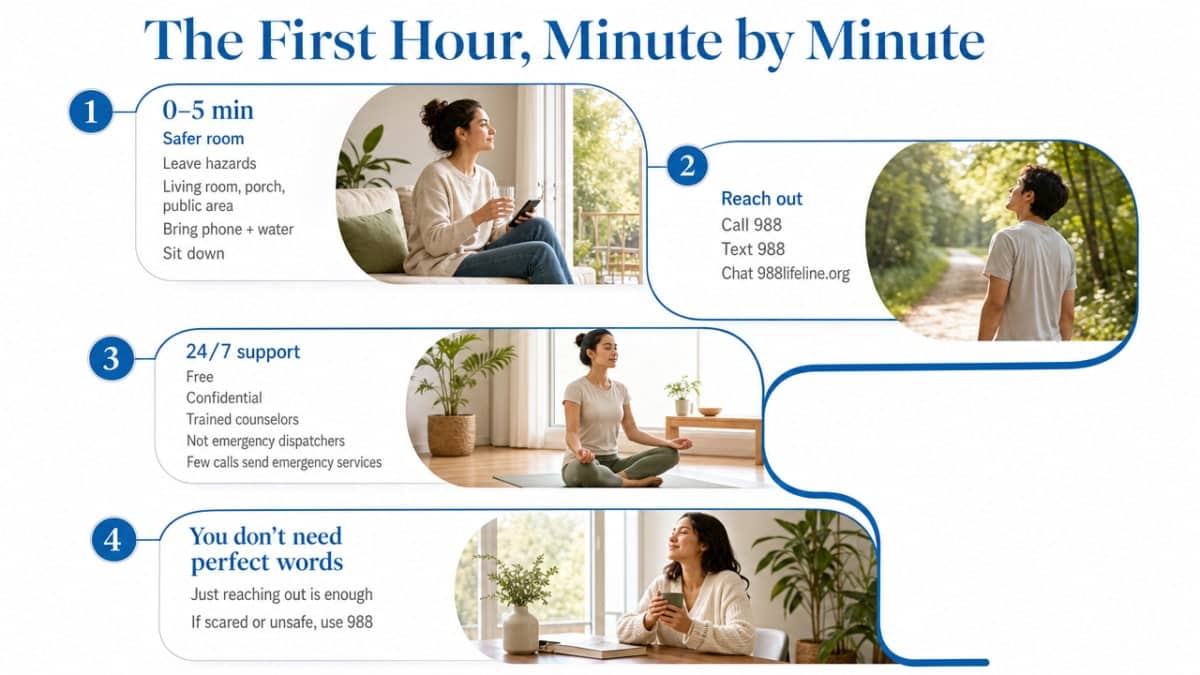
Minute 0-5: Get to a Safer Room and Reach for a Phone
Prioritize your physical safety. If you are in a room with anything that could be used to harm yourself, leave it. Move to a space with fewer potential hazards, such as the living room, a front porch, or a public area where others might be present. Bring your phone and, if possible, a bottle of water. Sit down, as your legs may be unsteady.
Help is readily available through the 988 Suicide & Crisis Lifeline. This service offers free, confidential, 24/7 support via call, text, or chat. It’s staffed by trained counselors, not emergency dispatchers, and very few calls result in emergency services being sent 1. You don’t need to articulate everything perfectly; simply reaching out is enough. If you’re feeling scared or unsafe, dial 9-8-8, text 988, or use the chat feature on 988lifeline.org. Choose the method that feels easiest in this moment 11, 12.
Minute 5-20: Say the Words Out Loud (Scripts for 988, 911, and a Trusted Person)
Once connected, you don’t need to recount your entire life story. Just begin.
If you’re calling 988 and struggling to find words: “Hi. I’m not safe right now. I don’t really know what to say.” This is sufficient; the counselor will guide the conversation. If speaking is too difficult, text the same message.
If you’re calling 911 due to an immediate medical emergency—such as an overdose, significant bleeding, or being in a dangerous location—state clearly and slowly: “This call is about a mental health crisis. My address is ___. I need help. Please send a crisis intervention team officer if one is available” 1. Specifying a mental health crisis and requesting a CIT-trained officer can influence the type of response you receive.
If you’re texting a trusted person—a close friend, family member, or supportive colleague—keep your message concise: “I’m having a really bad night and I don’t want to be alone. Can you come over, or can I come to you?” Your goal is not for them to solve your problems, but to provide companionship.
If your first contact doesn’t respond, reach out to the next person on your list, then consider 988. SAMHSA emphasizes the importance of direct communication: asking someone if they are thinking about suicide does not put the idea in their head 10. For the next few minutes, your primary goal is to ensure someone knows your situation and how to reach you. This forms the foundation for the rest of the hour.
Minute 20-40: Put Distance Between You and the Method
This step is crucial and often overlooked. Whatever specific means your mind has considered for self-harm, create physical distance from it, even if only temporarily for tonight.
For example, if it’s medication, give it to a friend, secure it in a locked car, or leave it with a neighbor. If it’s a firearm, ask someone to hold it, use temporary storage at a range, or lock it where you don’t have the key. If it’s alcohol, pour it out or move it to a car trunk. If a balcony is a concern, close the door, place a chair against it, and stay in another room.
This practice, known as lethal-means counseling, is a core component of suicide prevention, according to SAMHSA 10. It works because crises are temporary. Most intense moments pass within hours if you can create a barrier between an impulse and the means to act on it. This extra step buys you valuable time.
If you cannot do this alone, inform the person you’re speaking with. Saying, “There’s a bottle in the bathroom I don’t trust myself with. Can you come get it, or can we call someone who can?” is a sign of strength, not weakness. This action helps keep you safe until the next stage of the hour.
Minute 40-60: Decide What Happens Next Tonight
By this point, you’ve accomplished a great deal. Someone is aware of your situation, and the most dangerous items are out of reach. Your heart rate may still be elevated, but you’ve moved past the initial intense period.
The final twenty minutes of this hour are about planning for tonight, not your entire future.
Ask your counselor or trusted contact one honest question: “Can I stay where I am tonight, with someone checking on me, or do I need to go somewhere else?” There are three valid responses, none of which signify failure:
- Stay put with a check-in plan. This could involve someone staying with you, texting you hourly, or sleeping on your couch. Keep 988 accessible and try to rest.
- Go to a friend or family member’s home. Pack essential items like a phone charger, necessary medications, and one comfort item. Leave other belongings behind.
- Go to the emergency department. If you have attempted self-harm, ingested something harmful, or genuinely cannot ensure your safety for the night, the ED is the appropriate choice. SAMHSA advises calling 911 or going to the nearest ER if danger is imminent 8, 10. You will receive care without judgment.
You don’t need to know what tomorrow holds, only what the next few hours entail. The first hour is complete.
The Three Parts of the Crisis System You Can Actually Use
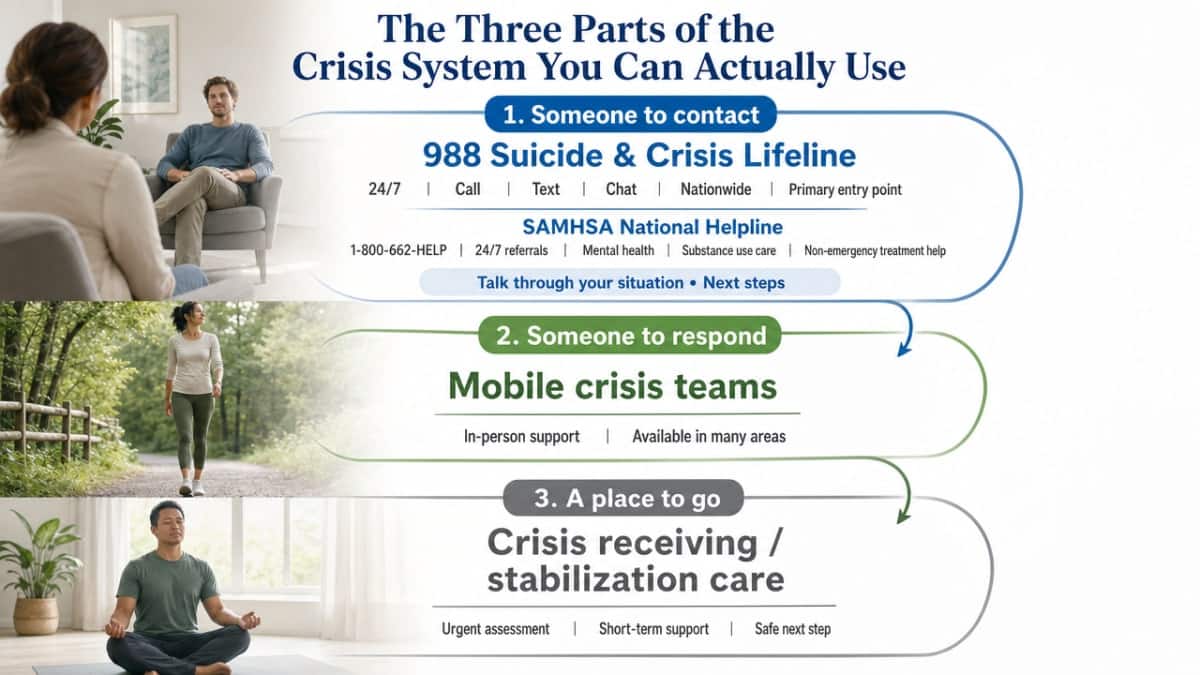
Many people are unaware of the existing crisis support system until they desperately need it. SAMHSA outlines a coordinated behavioral health crisis system with three key components, which you can specifically request by name 7.
- Someone to contact. The 988 Suicide & Crisis Lifeline serves as the primary entry point, available 24/7 via call, text, or chat nationwide 11. For non-emergency assistance in finding treatment after a crisis, SAMHSA’s National Helpline at 1-800-662-HELP provides 24/7 referrals for mental health and substance use care 9. These resources allow you to talk through your situation and determine your next steps.
- Someone to respond. If a conversation isn’t sufficient and you require in-person support, mobile crisis teams are available in many areas. These teams typically consist of a counselor and a peer specialist, not law enforcement 7. You can ask the 988 counselor if a mobile team operates in your zip code. For medically dangerous situations, 911 remains the correct number, and you can specifically request a crisis intervention team officer 1.
- A safe place for help. Emergency departments, crisis stabilization units, and 23-hour observation facilities offer safe environments when your home is not. The specific options available will vary by location, but a 988 counselor can inform you of local resources 7.
These three components are accessible through a single number.
When It’s Someone Else in Crisis, Not You
Asking the Direct Question Without Making It Worse
If a loved one’s behavior concerns you, it’s appropriate and often necessary to ask direct questions about their well-being.
A common misconception is that asking about suicide might plant the idea in someone’s mind. However, SAMHSA clearly states that directly asking if someone is considering suicide does not introduce the idea and is, in fact, one of the most protective actions you can take 10.
Ask plainly, avoiding judgmental phrasing like “you’re not thinking of doing something stupid, are you?” Instead, try: “Are you thinking about hurting yourself or ending your life? I’m asking because I care and I want to know.” Then, allow silence for them to respond.
If they answer yes, do not argue or offer reasons why they should live. Simply respond with: “Thank you for telling me. I’m not going anywhere. Let’s figure out the next hour together.” This response creates a foundation for providing immediate support.
Staying With a Partner, Friend, or Coworker Until Help Arrives
Once they’ve confided in you, your role is not to act as a counselor, but to remain present.
Sit down with them. If you’re on the phone, assure them you won’t hang up. If you’re in an office setting, move to a private room or your car. Your physical presence, even in silence, is the most important intervention at this moment.
Gently ask: “Is there something in the house or in your car I can help move somewhere else tonight?” Then assist in removing access to any potential means of harm—medication to a locked glove box, a firearm to a neighbor’s safe, or alcohol to a car trunk. SAMHSA identifies removing access to lethal means as a critical step when someone is at risk 10.
Offer to call 988 together on speakerphone. If they are unable to hold the phone, you can do it for them. If they don’t want you to leave to make the call, stay put. If the situation escalates into a medical emergency—such as an overdose, unresponsiveness, or active self-harm—call 911 and explicitly state: “This is a mental health crisis.” Request a crisis intervention team officer 1.
Your role tonight is not to be a therapist, but to be the person who stays and provides support.
The Job, the Insurance, and the Awkward Conversations
It’s understandable to be concerned about your job, insurance, and privacy during a crisis. These are valid concerns for any working adult.
An emergency department visit is processed as a medical claim by your insurer. However, in nearly all cases, your employer will not see the specific diagnosis code. Human Resources typically only sees whether you used Paid Time Off (PTO) or short-term disability. If you require more than a day or two off, companies with over 50 employees are usually covered by the Family and Medical Leave Act (FMLA), which protects your job for up to 12 unpaid weeks for serious health conditions, including mental health. Short-term disability, if you have it, can provide partial income during this period.
You are not obligated to disclose the details of your medical situation to your manager. A simple statement like, “I had a medical issue and I’ll be out through Thursday,” is a complete and appropriate response. If you need accommodations upon your return—such as a reduced workload, a later start time, or remote work—these conversations should be handled privately through HR, not your team lead, and can remain professional and concise.
These logistical concerns do not need to be addressed tonight. Tomorrow is soon enough to send an email.
A Short, Careful Note on Involuntary Holds
Many people fear that seeking help will result in an involuntary hold. This is rarely the case. Involuntary holds are specific legal processes, not the standard outcome of a 988 call or an emergency department visit. For instance, Tennessee law requires a formal certificate of need and clear evidence that a person poses an immediate substantial likelihood of serious harm due to mental illness before involuntary admission can occur 13. While the exact legal language varies by state, the threshold for involuntary commitment is intentionally high.
Understanding this may not eliminate all fear, but it can reduce it enough to encourage reaching out. Most individuals who seek help in a crisis return home the same night.
What Happens After the First Hour: the 24-72 Hour Window
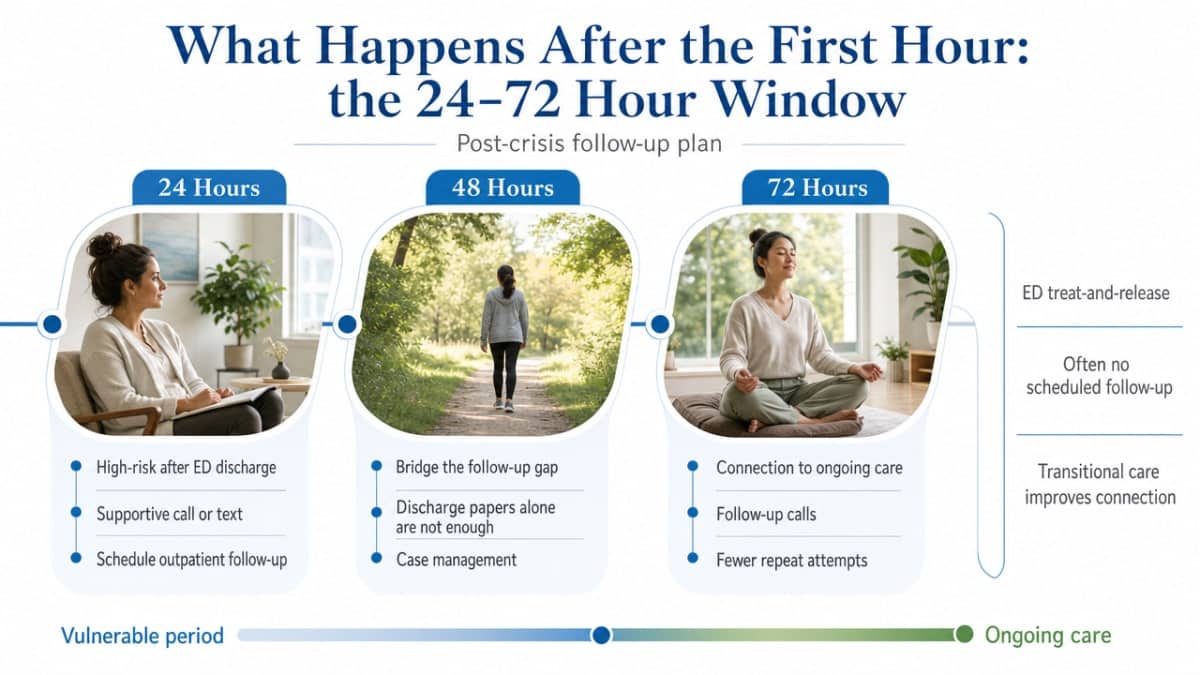
You’ve successfully navigated the first hour, a significant achievement. However, the days immediately following a crisis remain a vulnerable period. Emergency medicine research indicates that the time directly after an emergency department discharge is high-risk, and prompt outpatient follow-up combined with brief supportive contacts (like calls or texts) is linked to fewer repeat attempts 2.
The gap in follow-up care is substantial. CDC WISQARS data from 2020–2021 shows that tens of thousands of young people and adults were treated and released from EDs after intentional self-harm 6. They were sent home with discharge papers, often without a scheduled follow-up. A BMJ Open systematic review found that ED-based transitional care, including case management and follow-up calls, improves connection to ongoing care and reduces repeat ED visits 5. Discharge is not the end; it’s a transition point.
Here’s what the next 72 hours should ideally involve: Within the first 24 hours, sleep in a place where another person is nearby, ensure lethal means remain out of reach, and save a critical phone number to your lock screen. Between 24 and 48 hours, schedule your follow-up appointment, even if it means calling during a break. Between 48 and 72 hours, attend that appointment. This structured approach helps maintain stability. You don’t need to feel completely better yet; you just need to stay connected to someone who expects to hear from you.
Structured Outpatient Follow-Up in TX, TN, OK, and MO
Mind Body Optimization serves as a crucial resource for outpatient follow-up in the 24 to 72 hours after a crisis, complementing crisis lines and emergency services. For individuals in Texas, Tennessee, Oklahoma, or Missouri, MBO provides psychiatric evaluation, medication management, and counseling. These services are available both in-person and via telehealth, which is particularly beneficial when taking more time off work is challenging, but ongoing support is essential.
Telehealth follow-up is a legitimate and effective form of care. Safety Planning Intervention, when delivered via telehealth with brief follow-up calls, is a recognized model used in both emergency and outpatient settings 14. Evidence-based outpatient suicide treatments, such as CAMS, have been adapted for virtual delivery, incorporating collaborative risk assessment and stabilization planning into each session 15. This means a virtual session, even from your car during a lunch break, constitutes genuine treatment, not just a temporary measure.
A typical first appointment includes a psychiatric evaluation to address medication needs, counseling to help formalize a safety plan that might have been difficult to organize in an emergency setting, and a schedule for the next two to four weeks to ensure consistent support. This structured handoff helps ensure that tonight’s crisis is the last “first hour” you experience.
Building the Plan You Wish You’d Had Tonight
Once you feel stable, create a personalized safety plan. This isn’t a mood tracker, but a concise, one-page document you can quickly reference when your mind is overwhelmed.
Include the following: the top two people you would text, in order; the 988 contact information (call and text); your therapist or psychiatrist’s direct line; the address of the nearest emergency room. List your personal warning signs, such as not eating, canceling plans, or sleepless nights. Also, note what genuinely helps you in the first ten minutes of distress, whether it’s a walk, a specific music playlist, or a video call with a loved one. Finally, document where any potential means of harm (medication, alcohol, firearms) are now stored and who has the key.
Keep a copy on your phone’s lock screen and share one with the person you’d call first. This structure mirrors the Safety Planning Intervention used by clinicians and is effective because it’s already prepared when you are unable to think clearly 14. Your plan doesn’t need to be perfect tonight, but it needs to exist by tomorrow.
Take the Next Step Toward Feeling Better
Connect quickly with a professional who can help you move forward after a difficult moment.
Frequently Asked Questions
Will calling 988 automatically send police to my house?
No. When you call, text, or chat 988, you’re connected to a trained crisis counselor, not a dispatcher. Fewer than 2% of 988 contacts result in emergency services being sent to a location 1. The counselor’s primary role is to talk with you and help determine your needs; most calls conclude with a conversation and a plan, not an emergency response.
Should I call 988 or 911 during a mental health crisis?
Call 988 when you need someone to talk to, process thoughts, or help you decide on next steps 11. Call 911 if there is an immediate medical emergency—such as an overdose, unresponsiveness, or active self-harm 10. If you call 911, specify “this is a mental health crisis” and request a crisis intervention team officer 1.
If I go to the emergency department, will my employer or insurance find out?
Your insurer will process the claim like any medical visit. However, your employer typically will not see diagnosis codes; HR usually only tracks PTO or short-term disability usage. You are not required to disclose the specific reason for a medical absence to your manager. “I had a medical issue and I’ll be back Thursday” is a sufficient response. Any necessary accommodation discussions should be handled privately through HR.
How do I ask someone directly if they’re thinking about suicide without making it worse?
Ask directly and then listen. Try: “Are you thinking about hurting yourself or ending your life? I’m asking because I care.” Research confirms that direct questioning does not plant the idea of suicide; it is, in fact, a protective measure 10. If they confirm suicidal thoughts, avoid arguing or listing reasons to live. Instead, express gratitude for their honesty and commit to staying with them.
What should I do in the 24 to 72 hours after a crisis or ED visit?
The period immediately following an ED visit is a recognized high-risk window 2. During these 24 to 72 hours, ensure you are not alone, keep any potential means of harm out of reach, and schedule a follow-up appointment within 48 hours. Transitional care and rapid outpatient follow-up after an ED visit are linked to fewer repeat visits 5. Maintain contact with someone who is expecting to hear from you.
Can I get real crisis follow-up care through telehealth, or do I have to go in person?
Telehealth provides effective follow-up care. Safety Planning Intervention delivered via video, with brief follow-up calls, is a documented model used post-ED visits 14. Evidence-based outpatient suicide treatments like CAMS have been adapted for virtual delivery, incorporating collaborative risk assessment and stabilization planning 15. A telehealth session, even from a parked car, is considered legitimate treatment. Mind Body Optimization offers these services across TX, TN, OK, and MO.
References
- What To Do in a Mental Health Crisis – Mindscape (Harvard Health). https://www.health.harvard.edu/mindscape/for-young-people/getting-help/what-to-do-in-a-mental-health-crisis
- Managing Suicidal Patients in the Emergency Department. https://pmc.ncbi.nlm.nih.gov/articles/PMC4724471/
- National Behavioral Health Crisis Care Guidance (SAMHSA Library). https://library.samhsa.gov/product/national-behavioral-health-crisis-care-guidance/pep24-01-037
- Suicide Prevention in the Emergency Department (Montana DPHHS Toolkit). https://dphhs.mt.gov/suicideprevention/toolkit/emergencydepartment
- Effect of ED-based transitional care interventions by healthcare professionals providing transitional care in the emergency department on clinical, process and service use outcomes: A systematic review. https://bmjopen.bmj.com/content/13/3/e066030
- Web-based Injury Statistics Query and Reporting System (WISQARS). https://www.cdc.gov/injury/wisqars
- National Behavioral Health Crisis Care Guidance. https://www.samhsa.gov/mental-health/national-behavioral-health-crisis-care
- Crisis Help: Suicide, Mental Health, Drug, and Alcohol Issues. https://www.samhsa.gov/find-support/in-crisis
- National Helpline for Mental Health, Drug, Alcohol Issues. https://www.samhsa.gov/find-help/helplines/national-helpline
- Suicide Prevention. https://www.samhsa.gov/mental-health/suicidal-behavior/prevention
- 988 Suicide & Crisis Lifeline. https://www.samhsa.gov/mental-health/988
- Mental Health Resources. https://www.cdc.gov/mental-health/caring/index.html
- Mental Health Law in Tennessee General Sessions Courts. https://www.tncourts.gov/sites/default/files/docs/general_sessions__mental_health_law.pdf
- SPCC Frequently Asked Questions (FAQ). https://www.med.upenn.edu/INSPIRE/spcc-faq.html
- Novel Telehealth Adaptations for Evidence-Based Outpatient Suicide Treatment. https://pmc.ncbi.nlm.nih.gov/articles/PMC10743225/