

Key Takeaways
- Mental health lives on a dual continuum: you can carry a diagnosis and still flourish, or have no diagnosis and languish in the flat middle.1
- Wellness shows up as a mix of feeling good and functioning effectively, mapped through PERMA’s five elements and Ryff’s six dimensions of psychological well-being.10,9,12
- Being well doesn’t erase hard feelings or require perfect habits — sleep, movement, food, relationships, and environment quietly protect your capacity to handle the range.8,5,14
- Use SAMHSA’s four dimensions — health, home, purpose, community — as a check-in, and treat months-long flatness or broken sleep as a signal to seek support.3,17
A Well Tuesday, Not a Perfect One
It’s Tuesday, 2:47 p.m. You just closed a tab you didn’t mean to open, your coffee is cold, and a coworker’s message is sitting in Slack unanswered for eleven minutes. You’re not thriving in a LinkedIn-post kind of way. You’re also, quietly, fine.
You answered the message. You laughed at something dumb at lunch. You felt a small, real satisfaction when you finished the deck. You also felt a flicker of Sunday-night dread that hasn’t fully cleared, and a low hum of pressure about the thing you haven’t started yet.
That’s what mental health actually looks like when you’re well. Not calm. Not curated. Present.
If you came here quietly wondering whether you’re doing okay, this piece is written for you. Not for the version of you who meditates at 5 a.m., but for the you between meetings, running a little tired, scanning for a benchmark that doesn’t feel impossible.
Here’s the reframe worth holding onto: mental health is a positive state of emotional, psychological, and social well-being, not just the absence of a diagnosis or a bad week. Researchers describe it as a real thing you have, build, and maintain, with textures and range.1,2
So we’re going to walk through what “well” actually looks like on a normal weekday. Not a summit to reach. A place on a range you can locate yourself on, right now, coffee going cold and all.
Wellness Is a Range, Not a Summit: The Dual-Continua Model
Why ‘No Diagnosis’ Doesn’t Automatically Mean ‘Well’
For a long time, mental health got framed as a pass/fail test. No diagnosis? You pass. Something on your chart? You fail. That framing is why so many high-functioning people quietly panic when they feel off — they assume any dip means they’ve crossed a line.
Researchers stopped seeing it that way decades ago. The dual-continua model, introduced by sociologist Corey Keyes, treats mental illness and mental health as two related but distinct continua. One line measures the presence or absence of a diagnosable condition. A second line measures how much you’re actually flourishing — the positive feelings and functioning that make a life feel like yours.1
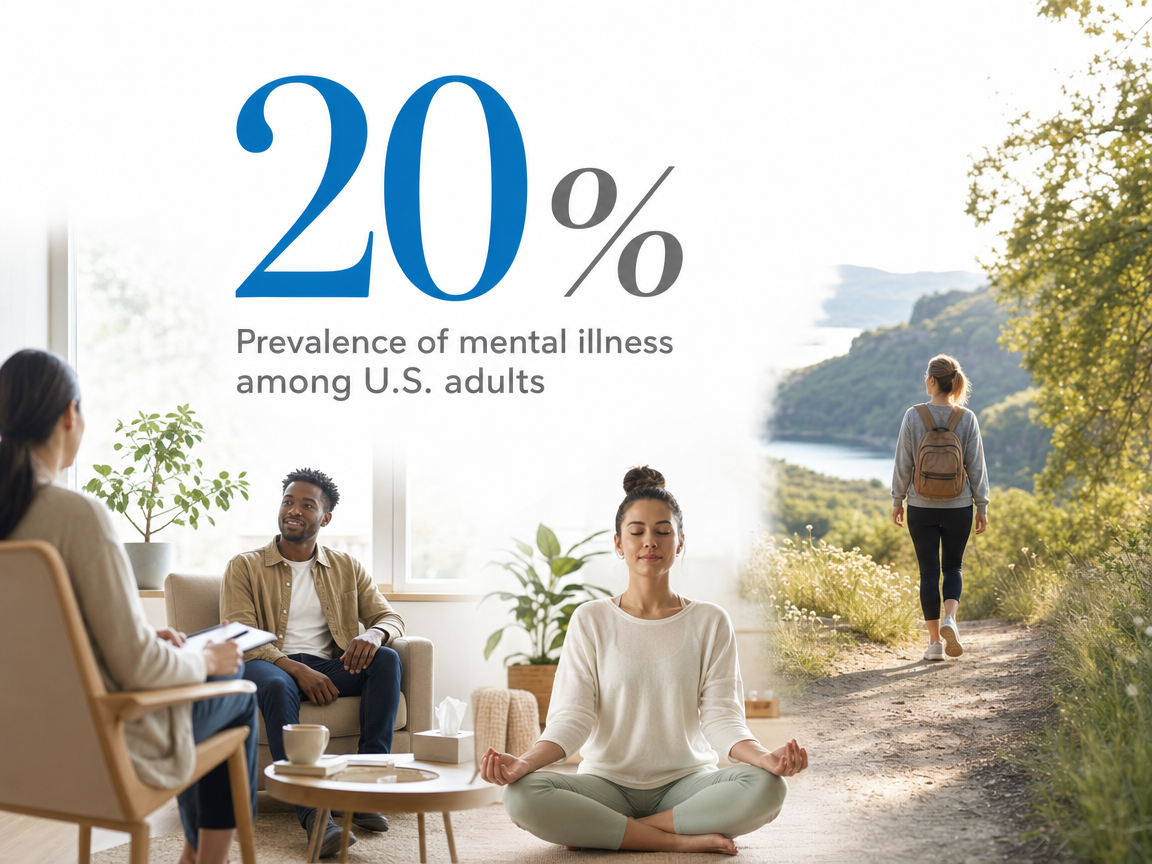
That separation matters because of who it makes room for. Nearly 1 in 5 U.S. adults lives with a mental illness in a given year, according to NIMH. Under the old model, that would mean 20% of adults are automatically “unwell.” Under Keyes’ model, plenty of those adults are flourishing — going to work they care about, showing up for people they love, feeling engaged — while also managing anxiety, depression, or ADHD. And plenty of people with no diagnosis at all are stuck somewhere flat.7
A clean chart is not the finish line. It’s one axis of two.
Languishing: The Meh Middle No One Names
Between flourishing and diagnosable illness, there’s a stretch of experience that a lot of readers know by feel but can’t name. Keyes gave it a word: languishing.1
Languishing is the flat middle. You’re not in crisis. You’re not particularly happy either. Meetings happen. Weekends pass. You scroll longer than you meant to. The book you were excited about sits on the nightstand at page 34. You keep thinking you should feel more — more curious, more connected, more something — and you don’t, quite.
It’s easy to miss because nothing is dramatically wrong. You’re still functioning. You still laugh sometimes. You’d tell a friend you’re “fine, just busy.” But researchers who study flourishing describe it as feeling good and functioning effectively, and languishing is the shape of neither one clicking. You’re doing the tasks without the fuel.12
Here’s the reassuring part: naming this middle state changes what you do with it. If you assume flat equals broken, you either wait it out or spiral. If you recognize languishing as a location on a range — one you can move on from — you start looking for the small things that shift you toward flourishing. A real conversation. A walk that isn’t scheduled. Work that uses more than one of your strengths.
You’re allowed to want more than meh. Wanting it is a good sign.
What ‘Well’ Actually Looks Like on a Weekday
PERMA, Translated Into Tuesday
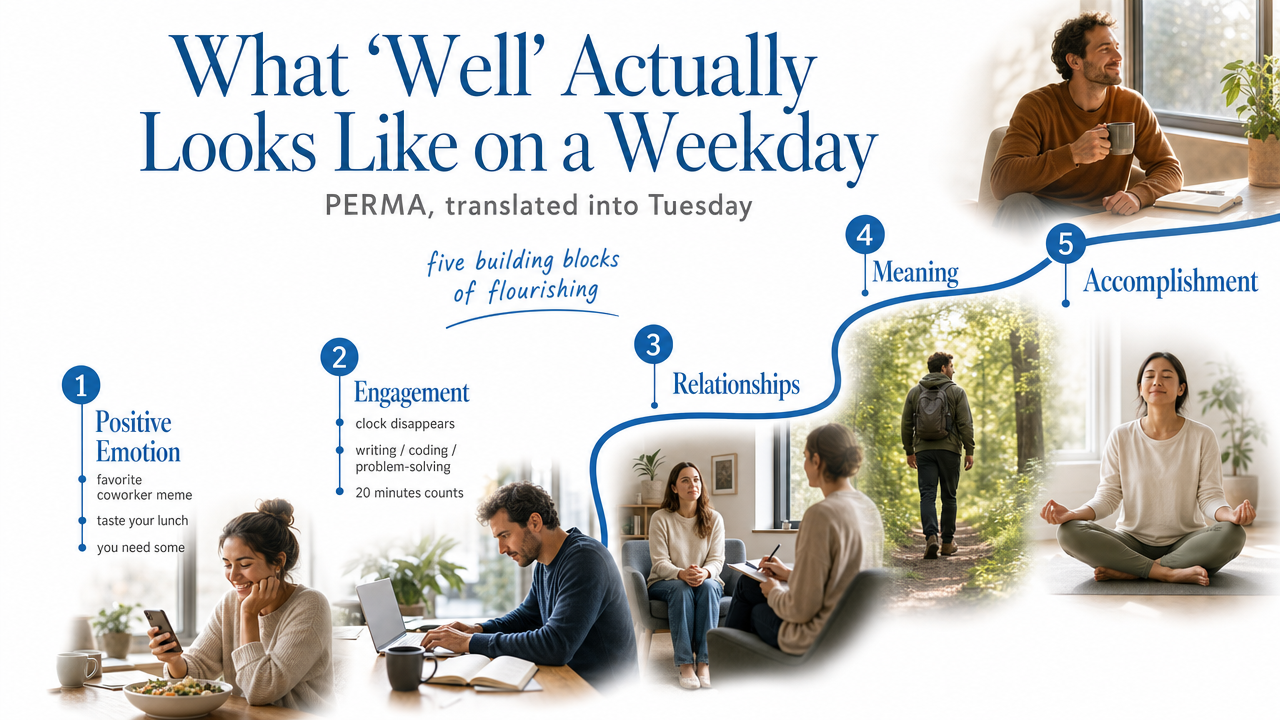
Positive psychology gives us a useful cheat sheet for what wellness looks like in motion. Martin Seligman’s PERMA model names five building blocks of flourishing: Positive Emotion, Engagement, Relationships, Meaning, and Accomplishment. Read on paper, it sounds like an academic acronym. Translated into a Tuesday, it starts to feel familiar.10,11
| PERMA Element | Description |
|---|---|
| Positive Emotion | Positive Emotion isn’t a permanent glow. It’s the small warmth when your favorite coworker sends you a stupid meme, or the two seconds you actually taste your lunch instead of eating it over the keyboard. You don’t need a lot. You need some. |
| Engagement | Engagement is the stretch of time when the clock disappears — an hour of writing, coding, or problem-solving where you’re not checking anything, just in it. If you had even 20 minutes of that today, that’s engagement. That counts. |
| Relationships | Relationships show up in ordinary contact: a quick call with your sister, a real answer to “how are you?” instead of “good, you?”, a partner who knows your Sunday-night pattern and doesn’t take it personally. Depth matters more than volume. |
| Meaning | Meaning is the sense that what you’re doing points somewhere. Not a life purpose speech — more like knowing why you took this job, or why you showed up for the friend who’s going through it. Meaning is often quiet. |
| Accomplishment | Accomplishment is the small closed loop. You sent the email. You did the thing you’d been avoiding for a week. Researchers who apply PERMA describe well-being as a mix of satisfaction, feeling, and meaning — and accomplishment is often what turns a day from a blur into something you can point to. |
On a well Tuesday, you probably hit three or four of these, not all five. That’s the whole point.
Ryff’s Six: The Quieter Signs You’re Functioning Well
PERMA is what wellness feels like. Carol Ryff’s model of psychological well-being is what wellness does — the quieter, structural stuff running underneath. Her six dimensions are worth knowing because they describe the parts of being well that don’t necessarily feel like anything, but show up in how your week actually moves.9
Ryff’s Six |
Description |
|---|---|
| Autonomy | Autonomy is being able to make a choice you disagree with your group about, and still sleep. Not defiance — just having a settled inner opinion. |
| Environmental Mastery | Environmental mastery is knowing how your Wednesday works. You’ve built systems, however scrappy, that let you get through it. You know when to eat, when to close the laptop, and how to answer your boss without spiraling. |
| Personal Growth | Personal growth is the sense that you’re not the exact same person you were two years ago. You’ve learned something. Even the hard year taught you something. |
| Positive Relations | Positive relations is having at least a few people who know the real version of you and stick around anyway. Not a wide network. A real one. |
| Purpose in Life | Purpose in life is a direction, not a destination. You’re moving toward something — a career shift, a family you want to build, a version of yourself you’re becoming — even when the day-to-day feels repetitive. |
| Self-Acceptance | Self-acceptance is the toughest one. It’s being able to look at your whole self, including the parts you’d edit if you could, and not flinch. Ryff describes psychological well-being as striving toward your real potential, not performing perfection. If you’re honest about your flaws and still moving forward, you’re doing more of this than you think. |
Flourishing as Feeling Good and Functioning Effectively
If you’re feeling ambushed by frameworks, here’s the short version. A 2024 review of how researchers actually measure flourishing settled on a definition that fits on a Post-it: flourishing is a combination of feeling good and functioning effectively.12
Feeling good is the emotional half — pockets of positive feeling, not a constant one. Functioning effectively is the doing half — showing up for your responsibilities, your relationships, and yourself in ways that match your values.
Notice what’s not in that definition. It doesn’t say feeling good all the time. It doesn’t say functioning perfectly. It doesn’t say you have to be optimized, unbothered, or off your phone by 9 p.m. It just says both halves show up, more days than not.
That’s why the frameworks matter. PERMA gives you five places to look for the feeling-good half. Ryff gives you six places to look for the functioning-effectively half. You won’t score high everywhere, and you don’t need to. What you’re looking for is enough of both, most weeks, to know your life is still yours.
On a well Tuesday, that’s what you’re actually seeing. Both halves, quietly working.
Wellness Includes the Hard Feelings
A well version of you still gets angry when someone talks over you in a meeting. Still grieves. Still gets bored on a Wednesday afternoon and wonders if this is really it. Still feels the inbox flinch when a certain name pops up. None of that means you’ve slipped off the range.
Contemporary research treats mental health as a holistic state of emotional, psychological, and social well-being — not a mood you have to maintain. Positive psychology, often blamed for the smile-more script, actually studies strengths, meaning, and relationships as part of a flourishing life, not the erasure of hard emotions. The full range is the point.2,4
What changes when you’re well isn’t the presence of hard feelings. It’s your relationship to them. You can feel Sunday dread and still go to bed at a reasonable hour. You can be annoyed with your partner and still ask about their day. You can be scared about a decision and make it anyway.
If you’re reading this while tired, angry, or a little sad, that counts too. Wellness has room for you like this.
The Body Half of the Equation
Sleep, Movement, Food, and Mood
You can do the therapy, read the books, and journal on Sunday nights, and still feel wrecked if you slept four hours and lived on cold brew. The body is not separate from the mind you’re trying to take care of. It’s half the equation.
Start with sleep, because it does the most heavy lifting for the least credit. The NHLBI links chronic sleep deficiency to depression, suicide, and risk-taking behavior, and notes that good sleep supports mood, thinking, and daily functioning. That’s not a productivity tip. That’s your baseline capacity for handling a hard email without spiraling. A well version of you probably isn’t sleeping perfectly. You’re just sleeping enough, most nights, that Tuesday doesn’t feel like Thursday of a bad week.8
Movement and food are the other two legs. A recent review found that rational diet patterns, physical activity, psychobiotics, and antioxidants carry real therapeutic potential for mental well-being. Translation: what you eat and whether you move your body shows up in your mood, not just your labs. This isn’t about a clean routine. It’s a walk between meetings. Eating something that isn’t just caffeine before 2 p.m. Going to bed instead of watching one more episode.5
When you’re well, these aren’t discipline projects. They’re small, boring, protective habits — and they show in physical health too.4
Relationships and Environment as Protective Factors
The other quiet piece of the body half is who’s around you and what your daily environment feels like. Not because people fix you, but because they change what your nervous system has to carry alone.
A 2022 review of risk and protective factors describes positive social relationships as active buffers — they protect against mental health conditions and help you cope in healthier ways when stress hits. That’s a real thing you can feel. The friend who texts back. The coworker who checks in without making it weird. The partner who notices you got quiet at dinner.14
Environment matters the same way. A room you can actually think in. A commute that isn’t ruining your morning. A job that has hard days but not hostile ones. When these are steady, you have more room to feel the range of emotions we talked about earlier without getting knocked over.
If your relationships and environment feel thin right now, that’s information, not a verdict. Being well doesn’t require a big social life or a picture-perfect apartment. It requires a few real connections and a setting that lets you exhale. If you have that, even in a small version, you have more protection than you think — and it’s a piece of wellness you can keep building.
Recovery, Home, Purpose, Community: SAMHSA’s Lived-Experience Map
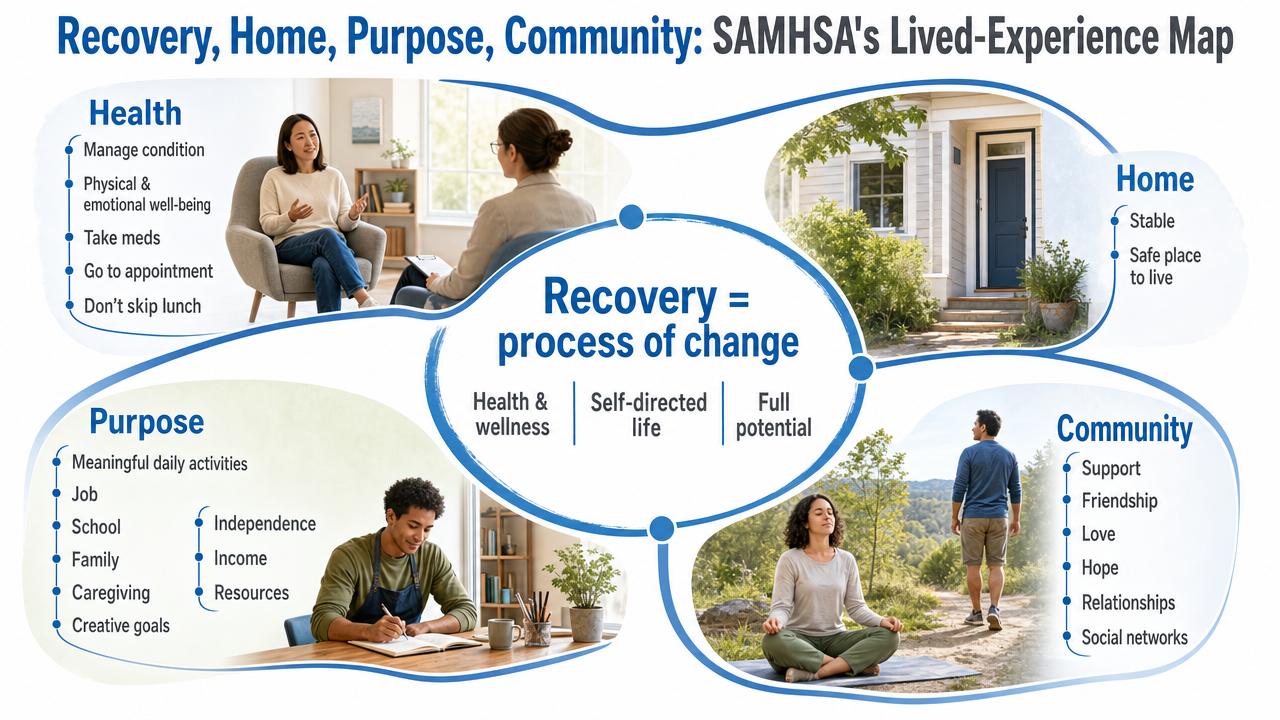
One more framework, then we’ll stop stacking them. SAMHSA — the federal agency that shapes mental health and substance use policy — defines recovery as a process of change through which people improve their health and wellness, live a self-directed life, and strive to reach their full potential. Recovery isn’t just for people leaving a hospital or a treatment program. It’s a working definition of wellness for anyone rebuilding after a hard stretch.3
SAMHSA names four dimensions, and they read less like theory and more like a life audit you can actually do on a Sunday afternoon.3
-
Dimension Description Health Health is managing your condition — diagnosed or not — and making choices that support your physical and emotional well-being. Taking the meds if you take meds. Going to the appointment. Not skipping lunch three days in a row. Home Home is having a stable, safe place to live. A room where you can close the door. A living situation that isn’t quietly costing you sleep. Purpose Purpose is meaningful daily activity — work, school, caregiving, creative projects, volunteering — plus the resources to participate in it. Something to do that you can stand behind. Community Community is relationships and social networks that give you support, friendship, love, and hope. Even a small circle counts.
If three of these are steady, you have more ground under you than the anxious voice suggests.
‘Well’ Doesn’t Look the Same for Everyone
One thing worth saying plainly: there isn’t one universal picture of a well person. Researchers who’ve looked across cultures find at least seven different ways positive mental health gets defined — as strengths, as maturity, as resilience, as subjective well-being, and more. What looks like flourishing in one life can look nothing like flourishing in another.13
Your version might be quieter than your extroverted friend’s. Slower than your ambitious sister’s. Less social than the group-chat regular’s. A well introvert isn’t a broken extrovert. A well 34-year-old rebuilding after a hard year isn’t behind the 34-year-old whose life has been steady.
Being well is measured against your own values, your own relationships, and the life you’re actually living — not the version showing up on someone else’s feed.
A Wellness Month Check-In (Not a Challenge)
Wellness Month has a way of turning into a to-do list. Thirty days, a new habit, a streak to protect. If that works for you, keep going. But there’s a quieter version worth trying: a check-in instead of a challenge.
Here’s what a check-in actually looks like. Sit somewhere you like for ten minutes and ask a few honest questions:1,3,10
- Which of the PERMA elements — positive emotion, engagement, relationships, meaning, accomplishment — showed up this week, even briefly?
- Which of SAMHSA’s four dimensions — health, home, purpose, community — feel steady right now, and which feel thin?
- Where would you place yourself on the range between languishing and flourishing today?
You’re not scoring yourself. You’re noticing. NIMH’s own guidance on caring for your mental health leans this direction: stay connected, move your body, build coping skills, and reach out when you need more. Those aren’t 30-day sprints. They’re small, repeatable ways of showing up for yourself.17
A check-in might tell you you’re doing better than the anxious voice claims. A well Tuesday, three real conversations this week, work that mattered to you for even an hour — that’s real. Name it.
It might also tell you something is thinner than you thought. Sleep is off. You haven’t talked to anyone who knows you in two weeks. That’s information, and it points you toward the next small move, not a verdict on you.
When a Check-In Points Toward Support
Sometimes the check-in turns up more than a thin week. If the flatness has stretched into months, if sleep is broken most nights, if the anxious voice is louder than the rest of you, that’s worth taking seriously. Not because you’ve failed at being well — because you’ve collected real information about what you need next.
Structured support is one of the ways people move back toward flourishing, even while a diagnosis is part of the picture 1. NIMH’s own guidance names professional help as part of caring for your mental health, alongside connection, movement, and coping skills.17
If a check-in this Wellness Month tells you something needs more than a walk and an early bedtime, Mind Body Optimization can help. Integrated psychiatry and counseling, in person or by telehealth, built to fit the Tuesday you’re actually living.
Ready to experience what wellness feels like?
Start building sustainable mental wellness that fits your real life, not just your work schedule.Frequently Asked Questions
Can I be mentally well if I still have anxiety or depression?
Yes. The dual-continua model treats mental illness and mental health as two separate lines, which means you can carry a diagnosis and still be flourishing — going to work that matters, showing up for people, feeling engaged. A well version of you with anxiety isn’t anxiety-free. You just have more tools, more support, and more room to keep moving.1
What’s the difference between languishing and depression?
Languishing is the flat middle — you’re functioning but feel empty, uninspired, quietly running on fumes. Depression is heavier: persistent low mood, loss of interest, sleep and appetite changes, sometimes hopelessness, lasting most days for weeks. Languishing can drift toward depression if ignored, which is why naming the flatness and acting on it early actually matters.1
Does being mentally well mean feeling happy most of the time?
No. Researchers define flourishing as feeling good and functioning effectively — pockets of positive feeling, not a constant one. A well life includes anger, grief, boredom, and doubt. What shifts is your capacity to feel those things without getting knocked over. If you can feel hard emotions and still show up for what matters, you’re doing the work.12
How do I know if I’m actually doing okay?
Look for two halves: feeling good and functioning effectively. Are there small pockets of positive emotion this week? Are your relationships, work, and daily care roughly holding? SAMHSA’s four dimensions — health, home, purpose, community — give you a quick audit. If three feel steady, you’re on more solid ground than the anxious voice suggests.3,12
Do sleep, food, and movement really affect mental wellness that much?
Yes, more than most people want to hear. NHLBI links chronic sleep deficiency to depression, anxiety, and risk-taking behavior. A review on nutrition and mental health found rational diet patterns, physical activity, and antioxidants carry real therapeutic potential for well-being. You don’t need a perfect routine. You need enough sleep, some movement, and food that isn’t just caffeine.5,8
When should a rough patch push me to seek professional support?
When flatness or worry has stretched into months, sleep is broken most nights, or the anxious voice is drowning out the rest of you. NIMH lists professional help alongside connection, movement, and coping skills as part of caring for your mental health. Reaching out isn’t a failure of wellness — it’s one of the smarter moves toward it.17
References
- The mental health continuum: from languishing to flourishing in life. https://pubmed.ncbi.nlm.nih.gov/12096700/
- Mental Health and Well-Being in the Modern Era. https://pmc.ncbi.nlm.nih.gov/articles/PMC11836072/
- SAMHSA’s Working Definition of Recovery. https://library.samhsa.gov/sites/default/files/pep12-recdef.pdf
- Positive Psychology and Physical Health: Research and Applications. https://pmc.ncbi.nlm.nih.gov/articles/PMC6124958/
- Nutrition and mental health: A review of current knowledge about the impact of diet on mental health. https://pmc.ncbi.nlm.nih.gov/articles/PMC9441951/
- Integration of Mental Health and Substance Abuse with Primary Care – Research Protocol. https://effectivehealthcare.ahrq.gov/products/mental-health-substance-abuse-primary-care/research-protocol
- Mental Illness. https://www.nimh.nih.gov/health/statistics/mental-illness
- Sleep Deprivation and Deficiency. https://www.nhlbi.nih.gov/health/sleep-deprivation
- Psychological Well-Being Revisited: Advances in the Science and Practice of Eudaimonia. https://www.ncbi.nlm.nih.gov/pmc/articles/PMC5857325/
- PERMA™ Theory of Well-Being and PERMA™ Workshops. https://ppc.sas.upenn.edu/learn-more/perma-theory-well-being-and-perma-workshops
- Application of the PERMA Model of Well-being in Undergraduate Students. https://pmc.ncbi.nlm.nih.gov/articles/PMC9607835/
- Measurement of flourishing: a scoping review. https://pmc.ncbi.nlm.nih.gov/articles/PMC10867253/
- Positive mental health: is there a cross-cultural definition?. https://pmc.ncbi.nlm.nih.gov/articles/PMC3363378/
- Risk and Protective Factors of Mental Health Conditions. https://pmc.ncbi.nlm.nih.gov/articles/PMC9180102/
- Positive mental health and wellbeing: What’s in it for the GP?. https://pmc.ncbi.nlm.nih.gov/articles/PMC7985035/
- Well-Being Concepts. https://www.cdc.gov/hrqol/wellbeing.htm
- Caring for Your Mental Health. https://www.nimh.nih.gov/health/topics/caring-for-your-mental-health