

Key Takeaways
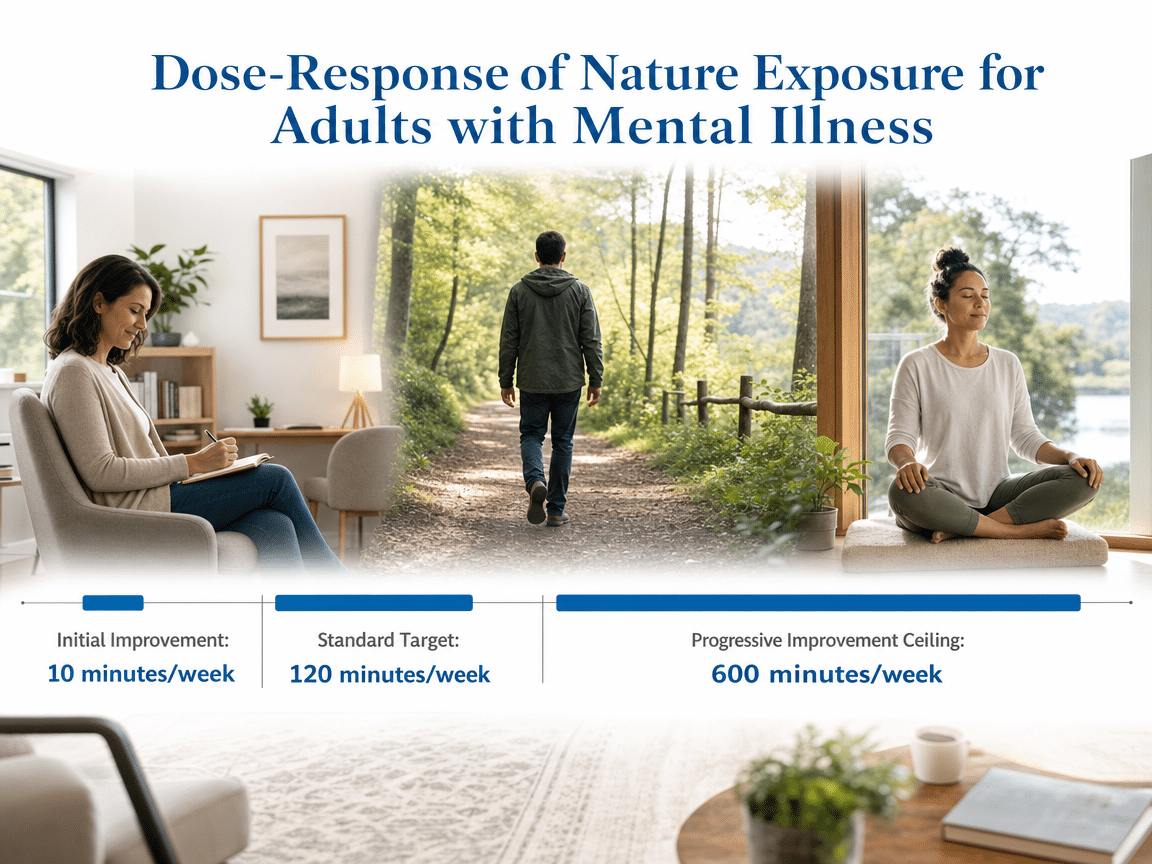
- Ten minutes in a natural setting starts moving mental health measures, roughly 120 minutes per week builds robust benefit, and adults in active treatment keep gaining up to about 600 minutes 5.
- The setting itself matters: natural environments produced significantly lower stress than urban outdoor or indoor exercise settings, so an outdoor loop isn’t interchangeable with the same minutes on a treadmill 6.
- Nature works as adjunctive support, not a substitute for therapy or medication, with structured programs using three one-hour outdoor sessions per week alongside standard care 10.
- A workable Houston pattern is three 20-minute weekday walks plus one 60-minute weekend park visit, protected on the calendar as real appointments with specific locations.
A Number to Build Against: What Ten Minutes Outside Actually Does
You already suspect walks help. What you probably don’t have is a number. So here’s one you can build against.
A 2025 dose-response meta-analysis of adults and outdoor nature exposure found three thresholds worth memorizing. Ten minutes outside in a natural setting is enough to nudge mental health measures in the right direction, even when that setting is urban nature and not a forest. Roughly 120 minutes per week, broken into intervals across the week, is where the benefit becomes robust and consistent. And in adults with a diagnosed mental illness, more time keeps helping, with progressive improvements observed up to about 600 minutes per week 5.
Think of it as a ladder, not a finish line. Ten minutes gets you on it. Two hours a week, split however your calendar allows, is the rung most working adults should aim for. If you’re managing anxiety or depression in active treatment, there’s runway above that where more time keeps paying you back.
That framing matters because it kills two unhelpful ideas at once. The first is that a single “nature day” every few months does the work. It doesn’t. The second is that unless you can escape to Big Bend for a week, why bother. You can bother. A 15-minute loop around a shaded stretch of Buffalo Bayou on your lunch break is not a consolation prize. It’s the actual dose.
Why Your Nervous System Reads a Bayou Differently Than a Treadmill
Direct Effects: Attention Restoration and the Stress Response
Your brain has two attention modes, and one of them is exhausted by 3 p.m. on a Tuesday.
Directed attention is the mode you use to draft the memo, sit through the Zoom, and read the Slack thread you’d rather ignore. It’s finite. When it runs out, you get the fuzzy-headed, irritable, can’t-decide-what-to-eat-for-dinner feeling that most people mistake for laziness. Natural settings pull on a different mode, sometimes called soft fascination. A moving creek, a rustling canopy, a heron picking through the reeds along Buffalo Bayou. Your attention drifts across those inputs without effort, and the directed system gets to recover 1.
The stress side works in parallel. Nature exposure is associated with lower blood pressure, calmer heart rate variability patterns, and reduced self-reported stress, effects reviewers link to reduced activation of the fight-or-flight branch of your nervous system and better engagement of the rest-and-digest side 1. In plain terms: your body reads a shaded trail as safe. It stops bracing.
You don’t need to intellectualize any of this while it’s happening. That’s part of what makes it useful. If you’re the kind of person whose evening walks turn into mental rehearsals of tomorrow’s meetings, the goal isn’t to force calm. It’s to put yourself somewhere your nervous system does the work for you. Ten minutes near water and trees is not a spiritual event. It’s your parasympathetic system finally getting a turn at the wheel.
Indirect Pathways: Movement, Sunlight, Sleep, and People
Direct effects aren’t the whole story. Some of nature’s benefit for your mental health comes from what it makes easier.
Movement is the obvious one. A walk on the Terry Hershey trail is still a walk, and physical activity independently helps with depression and anxiety. Reviews of nature exposure consistently name increased physical activity as one of the main indirect pathways linking green space to mental health outcomes 1. You get a nervous system reset and a cardio bump on the same 30 minutes.
Sunlight follows. Getting outside during daylight anchors your circadian rhythm, which is quietly load-bearing for mood and sleep. Better sleep, in turn, is one of the most reliable levers on next-day anxiety. The same review that maps out the mental health case for nature also flags sleep as one of the outcomes that improves alongside nature exposure 1.
Then there’s the social piece, which matters more than the wellness industry admits. If you moved to Houston for a job and your closest friends are on a group chat two time zones away, the ambient social contact of a park is not nothing. A multi-country study of adults living alone found that more frequent visits to urban green space were associated with better mental well-being and slightly lower odds of using anxiety or depression medication, with relationship and community satisfaction doing much of the mediating work 9.
You don’t have to make friends on the trail. You just have to be around people who are also choosing to be there.
The Setting Itself Matters
Here’s the part that gets flattened in most wellness advice: the setting itself is doing work, separate from the activity.
A 2018 experimental study compared people visiting three types of environments — natural outdoor settings, urban outdoor settings, and indoor exercise facilities. Participants who visited the natural environment reported significantly lower stress than those who spent time in the more urbanized outdoor setting or the indoor gym 6. Same bodies. Similar effort in many cases. Different rooms, essentially, and the natural room won.
This is not an argument against the gym. It’s an argument against treating your outdoor time as interchangeable with any other cardio slot. If your calendar is tight and you have to pick, and if the goal is your mental health rather than a specific fitness target, the outdoor option under a tree canopy is the one worth defending on the calendar.
What the Evidence Actually Shows (and Where It Wobbles)
You deserve the honest version of what the research says, not the wellness-Instagram version. Here’s the honest version.
The strongest signal in the literature is that nature exposure is consistently associated with lower depression and anxiety symptoms, reduced stress, and better self-reported well-being across a range of study designs and populations 1. A systematic review of 34 studies on urban greenspace in higher-income countries found that nearly all of them showed positive associations between accessible parks and both physical activity and mental health, especially lower stress and depressive symptoms 2. That’s a lot of arrows pointing the same direction.
The forest bathing meta-analysis is even more specific. Across 36 studies and 3,554 participants, structured forest bathing sessions produced significant reductions in depression and anxiety and measurable improvements in mood 4. That’s the psychological side of the ledger, and it’s the side that holds up best.
Now the wobble.
An ecotherapy review covering 123 studies noted that about 85% of them are observational rather than randomized controlled trials 3. In plain English: researchers watched what people did and how they felt, but couldn’t always isolate the trees from everything else that comes with going outside — the walking, the sunlight, the break from your inbox, the person you met at the trailhead. Physiological markers like cortisol and blood pressure also don’t move as reliably as the mood scores do 4. Your feelings improve more predictably than your lab values.
None of that is a reason to dismiss what’s here. It’s a reason to hold it correctly. The evidence is strong enough to act on and honest enough to admit it’s not a prescription drug. You are not being sold a miracle. You are being handed a low-risk, low-cost input that most reviewers agree helps most people most of the time — which, in mental health care, is a rare and useful thing.
Houston Green Space as a Working Prescription
Lunch-Hour Protocol: The 20-Minute Walk That Buys You Back an Afternoon
You have a 12:30 meeting. You have a 2:00 you’re already dreading. Between them, you have somewhere between 45 and 75 minutes that usually gets absorbed by a sad desk salad and doomscrolling. Here’s a use for it.
Pick a green space you can reach in under 10 minutes from your office. Downtown workers get Discovery Green almost for free — 12 acres of trees, water features, and grass a block from the convention center. If you’re near the Med Center or Museum District, Hermann Park’s McGovern Centennial Gardens does the job. Energy Corridor and west-side workers have Terry Hershey Park sitting right along the bayou. Buffalo Bayou Park runs through the middle of it all with shaded stretches near Sabine Street and the Water Works.
Leave your headphones out for the first five minutes. That part is not aesthetic. It’s the whole point. Your directed attention has been running the show since 8 a.m., and podcasts keep it working. Let your eyes drift — water, canopy, the guy walking a very determined corgi. Around minute seven, most people notice their shoulders drop. You don’t have to force this.
Walk 10 minutes out, 10 minutes back. That’s 20 minutes, roughly enough to move the needle on stress and mood 1. Eat at your desk when you get back if you have to. The walk was the meal that mattered.
Do this three times a week and you’re already most of the way to a defensible weekly dose without asking your calendar for anything it doesn’t already have.
Bad-Week Protocol: When 120 Minutes Is the Whole Point
Some weeks the lunch walks don’t happen. A launch slips. A parent is in the hospital. Your Sunday-night dread arrives on Thursday and refuses to leave. Those are the weeks the 120-minute target matters most, and also the weeks it feels most impossible.
Here’s how to hit it without pretending you’re a different person.
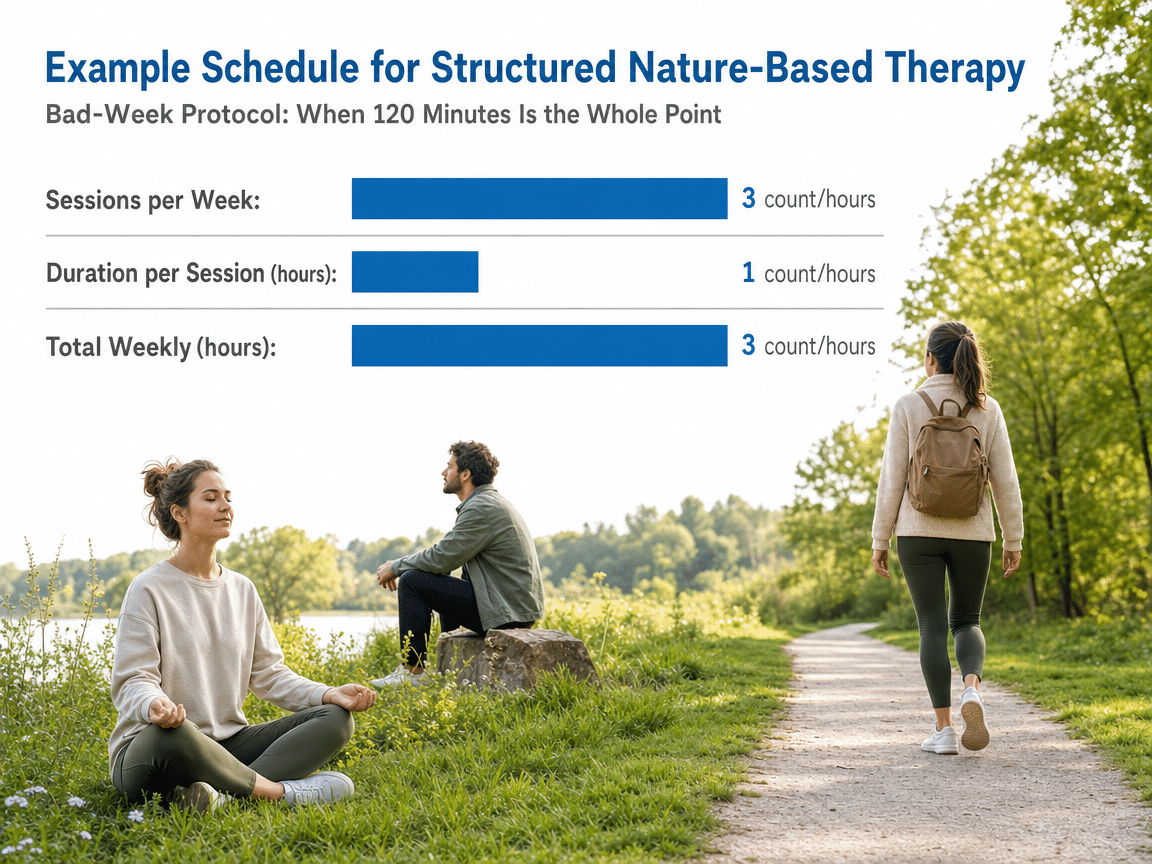
Three 20-minute weekday walks — anywhere with trees and a sidewalk counts — plus one 60-minute weekend visit to a bigger park. That’s 120 minutes, which is the interval-based weekly target the dose-response evidence points to for meaningful mental health benefit in adults 5. The 60-minute block is where you get to be somewhere real: Memorial Park’s Eastern Glades, the Houston Arboretum’s shaded loops, or a longer stretch of Buffalo Bayou from Sabine to Shepherd. A clinically evaluated nature-based therapy program used a similar rhythm — three one-hour outdoor sessions per week — as its actual dosing structure 10.
Put the weekday walks on your calendar as calendar events, not to-dos. Give them a location. “Buffalo Bayou, Sabine footbridge” is a real appointment. “Walk” is not.
On the bad weeks, the temptation is to skip the whole thing because 20 minutes feels laughable against the size of what’s happening. Do it anyway. This is the dose that keeps the floor from dropping. Not a fix. A floor.
Forest Bathing on a Houston Wooded Trail
Forest bathing sounds like something you’d need a passport and a linen wardrobe to do. It isn’t. The Japanese practice of Shinrin-yoku is basically a slow, sensory walk through a wooded area with the phone away and no distance goal. The largest meta-analysis on it, covering 36 studies and 3,554 participants, found significant reductions in depression and anxiety and measurable mood improvements after structured sessions 4.
Houston has the trees for this, even if it doesn’t have the cypress groves. The Houston Arboretum and Nature Center on the west side of Memorial Park has five miles of trails through 155 acres of forest, wetland, and meadow. The Ho Chi Minh Trail at Terry Hershey Park is a shaded singletrack that feels a full order of magnitude quieter than the frontage road 200 yards away. Memorial Park’s Seymour Lieberman Trail has denser tree cover along its northern stretches.
The protocol is simple. Walk at about half your normal pace. Stop every few minutes to notice something specific — the shape of a leaf, the sound layer directly above you, the smell after rain. Do this for 30 to 45 minutes.
You will feel slightly ridiculous the first time. That fades. What replaces it, in most studies and in most people who actually try it, is a version of yourself with a lower resting heart rate and a slightly kinder inner voice. Worth 45 minutes on a Saturday morning.
Nature Alongside Therapy and Medication, Not Instead Of
Here’s where a lot of wellness writing goes off the rails: it starts treating a walk as a substitute for care. It isn’t. If you’re already working with a psychiatrist or a counselor, a bayou trail is not competing with them. It’s feeding the same nervous system they’re helping you regulate from a different angle.
The framing that holds up under scrutiny is adjunctive. Structured ecotherapy programs — the kind evaluated across 123 studies in a 2018 review — consistently report improvements in depression, anxiety, concentration, and self-esteem when layered onto standard mental health care, though the same review is candid that most of that evidence is observational rather than randomized 3. Read that as: promising and low-risk, not curative. A trail is not a replacement for an SSRI that’s finally working. It’s not a replacement for the therapist who taught you to catch a spiraling thought before it becomes a week.
What outdoor time can do is make the rest of your care work harder. A clinically evaluated nature-based therapy program used three one-hour outdoor sessions per week as its actual dosing structure alongside standard treatment for patients managing anxiety, depression, and stress-related conditions, and reported measurable improvements in mental health and well-being 10. That’s a real prescription pattern, not a lifestyle suggestion.
If you’re in treatment, tell your clinician you’re building outdoor time in. They can help you time it — a walk before a therapy session sometimes lands the session better, a walk after can help you sit with what came up. If you’re between providers or on a waitlist, the walks are still worth doing. They’re not the whole plan. They’re the part of the plan you can start today, on your lunch break, without anyone’s approval.
Real Constraints: Heat, Humidity, Safety, and a Full Calendar
Let’s talk about the reasons this plan actually breaks. Not the ones a national wellness blog imagines. The ones that live in a Houston workweek.
Heat is the first. From June through September, a noon walk is a bad idea, not a virtuous one. Move your outdoor time to the edges of the day. A 7 a.m. loop around Hermann Park before your first meeting. A 7:30 p.m. stretch along Buffalo Bayou after the sun drops behind the downtown skyline. Shaded trails do a lot of work here — the Houston Arboretum’s canopy and the tree cover along Terry Hershey stay meaningfully cooler than open turf. Bring water. Skip the guilt about splitting a walk into two ten-minute chunks; short bouts still count toward your weekly total 5.
Safety after dark is real, especially if you’re walking alone. Discovery Green stays lit and populated well into the evening. Buffalo Bayou Park’s central stretches near the Water Works see steady foot traffic. Trail sections that thin out or lose lighting are not where you want to be at 9 p.m. Trust that instinct instead of overriding it.
Then there’s the calendar. If your day is meetings back-to-back, block the walk as a meeting. Give it a location the way you would a coffee. When it collides with something, protect it once a week instead of losing it entirely. A bad week where you got 40 minutes outside is still a week that moved you toward the target, not away from it.
Building the Habit With a Clinician in the Loop
Habits that stick are rarely the ones you white-knuckle alone. They’re the ones someone helps you shape around the life you actually have.
If you’re already working with a psychiatrist or counselor, bring the outdoor piece into the conversation the same way you’d bring up sleep or a medication side effect. Where does a walk fit around a therapy session? Does a morning loop change how you show up to a 10 a.m. appointment? If a med adjustment has you groggy for the first two weeks, what’s a smaller version of the dose you can hold onto?
If you’re not in care yet, this is a good week to change that. Mind Body Optimization’s clinicians work across Texas — including telehealth that reaches Houston from our Plano, Fort Worth, Southlake, San Antonio, Leon Springs, and Waco practices — and can help you build a plan that layers outdoor time onto counseling, psychiatry, or both. A consultation is where you sort out what’s actually going on and what tools fit your calendar, your diagnosis, and your energy this month.
Schedule one. The trail will still be there Saturday. The plan you make this week is the part that changes what Saturday feels like.
Start building your sustainable mental wellness routine
Get support to integrate nature and self-care into your busy daily life.
Frequently Asked Questions
Does time in nature count if I’m just sitting on my apartment balcony or walking a downtown block with a few trees?
Yes, and this is one of the more reassuring findings in the research. Even urban nature — a tree-lined block, a courtyard, a balcony with plants and sky — produces measurable mental health benefit in adults 5. A denser park will do more, but you don’t need wilderness. If your building is near a shaded street, walk that street. It counts.
How do I make this work in Houston heat and humidity without giving up half my summer?
Move to the edges of the day. A 7 a.m. loop before your first meeting or a walk after sunset works when noon doesn’t. Pick shaded trails — the Houston Arboretum, the northern stretch of Seymour Lieberman, tree-covered sections of Terry Hershey. Split your 20 minutes into two ten-minute bouts if you need to. Short intervals still add up toward your weekly total 5.
I’m already on medication and seeing a therapist. Where does outdoor time actually fit in?
Alongside, not instead of. Structured nature-based programs layered onto standard care have shown improvements in depression, anxiety, and stress-related conditions when used as adjunctive support 10. Talk to your clinician about timing — a walk before a therapy session can help you arrive less activated, and a walk after can help you process what came up. Keep the medication and the therapy. Add the walk.
I don’t feel safe walking trails alone, especially after work. What are my options?
Trust that instinct. Stick to well-populated, well-lit spaces — Discovery Green stays busy into the evening, and Buffalo Bayou Park’s central stretches near the Water Works see steady foot traffic. Walk with a coworker or a neighbor when you can. Ambient social contact in green space is itself linked to better mental well-being, especially for people living alone 9. A busy park at dusk beats a quiet trail.
What if I can only manage 10 or 15 minutes some days? Is that still worth doing?
Yes. Ten minutes in a natural setting is enough to nudge adult mental health measures in the right direction 5. On the weeks everything is on fire, the short walks are the ones holding the floor for you. They’re not a failed version of the longer walk. They’re the dose that keeps you connected to the practice so the longer walk is possible again next week.
Is this evidence strong enough to bet on, or is it another wellness trend?
Honest answer: strong enough to act on, not strong enough to oversell. Reviews across urban greenspace and forest bathing consistently link nature exposure to lower depression and anxiety symptoms 2, 4. The main caveat is that much of the ecotherapy literature is observational rather than randomized 3. Read it as a low-risk, low-cost input with real support behind it — not a replacement for clinical care.
References
- Associations between Nature Exposure and Health: A Review of the Evidence. https://pmc.ncbi.nlm.nih.gov/articles/PMC8125471/
- Association between Urban Greenspace and Health: A Systematic Review of Literature. https://pmc.ncbi.nlm.nih.gov/articles/PMC8150317/
- Ecotherapy – A Forgotten Ecosystem Service: A Review. https://pmc.ncbi.nlm.nih.gov/articles/PMC6085576/
- The effects of forest bathing on psychological well-being: A systematic review and meta-analysis. https://pubmed.ncbi.nlm.nih.gov/36864583/
- A Systematic Review and Meta-Analysis on the Effect of Nature Exposure on Adults’ Mental Health. https://pmc.ncbi.nlm.nih.gov/articles/PMC11851813/
- Levels of Nature and Stress Response. https://pmc.ncbi.nlm.nih.gov/articles/PMC5981243/
- Mental health benefits of interactions with nature in children and teenagers: A systematic review. https://jech.bmj.com/content/72/10/958
- Improving child & adolescent mental health through outdoor play and nature-based programming. https://cbey.yale.edu/sites/default/files/2020-10/CBEY_REPORT_HEALTH-NATURE_FINAL.pdf
- Urban Green Space and Mental Health Among People Living Alone: The Mediating Roles of Relational and Collective Restoration. https://natureandhealth.uw.edu/publications/urban-green-space-and-mental-health-among-people-living-alone-the-mediating-roles-of-relational-and-collective-restoration-in-an-18-country-sample/
- Nature-Based Therapy in Individuals with Mental Health Disorders: A Qualitative and Quantitative Evaluation. https://pmc.ncbi.nlm.nih.gov/articles/PMC9914984/