

Key Takeaways
- Loneliness and social isolation are distinct problems: isolation is about how often you see people, while loneliness is about whether that contact registers as real connection.4
- Treat loneliness as a clinical risk factor, not a mood — frequently lonely adults show roughly double the odds of later developing depression, with anxiety often surfacing first.2,9
- Houston’s geography, transplant population, and remote work concentration thin out the ambient social layer, which is why disconnection here reflects the city’s shape, not personal failure.
- A ten-minute assessment sorts situational loneliness from anxiety or early depression, and the format of care — telehealth or in-person — should match what you’ll actually sustain past week four.
The Quiet Version Nobody Talks About
You’re not falling apart. That’s part of what makes this so disorienting. You showed up to work, closed your laptop at a reasonable hour, answered the group text, and made it to the gym twice this week. And still, something feels off in a way you can’t quite name — a low hum of restlessness, a Sunday that stretches too long, an evening where you scroll instead of sleep and can’t remember what you were even looking for.
This is the version of loneliness nobody talks about. It doesn’t look like a crisis. It looks like you.
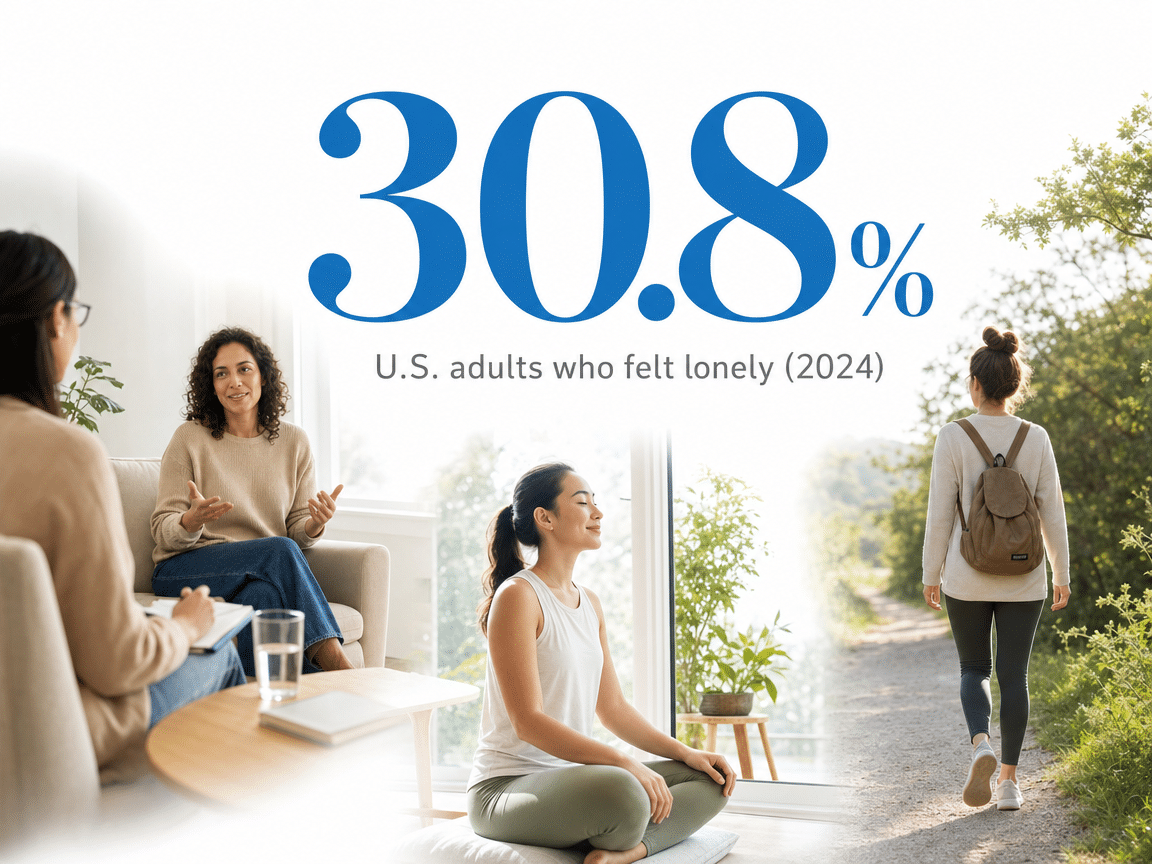
The scale of it is larger than most people realize. According to the most recent CDC data, 30.8% of U.S. adults reported feeling lonely, and about 12% said a physical, mental, or emotional condition made it hard to participate in social activities. Roughly one in three. The person next to you in traffic on 610, the coworker who seems to have it together, the friend who always has plans — a lot of them are quietly running the same numbers you are.3
What follows isn’t a lecture about connection or a list of hobbies to try. It’s an honest look at what loneliness actually does to your mental health, why Houston in particular has made this harder for people in their late twenties and thirties, and what a next step looks like when your calendar already feels full. You get to be a competent adult here. The goal is to give you something useful.
Loneliness Is Not the Same as Being Alone
Here’s a distinction that changes what you do next. Social isolation is objective — how many people you actually see, talk to, exchange something meaningful with in a given week. Loneliness is subjective — how the contact you do have makes you feel. The CDC treats these as two related but separate things, and about one in four adults reports lacking social and emotional support even when other people are technically around.4
That matters because you might be the person with the full calendar who still feels hollow at 9pm. You had lunch with two coworkers, took a call with your parents on the drive home, matched with someone on an app, and none of it registered as connection. That’s not a character flaw or a sign you’re doing life wrong. It’s a specific mismatch between the volume of your contact and the depth of it.
The reverse is also true. You can live alone, work remotely, see three real friends a month, and be genuinely fine — because those friendships carry weight. Living alone is a risk marker, not a diagnosis. The CDC’s own framing is careful about that: it correlates with more depression on average, but it doesn’t cause it in any one person’s case.5
Why this distinction matters for what happens next: if your issue is isolation, the answer involves logistics — putting more human contact on the calendar and protecting it from work creep. If your issue is loneliness inside a full life, the answer is closer to therapy, because what you’re describing is a quality problem, not a quantity one. Most people you know are running some version of both.
Why This Is a Clinical Risk Factor, Not a Mood
Here is the reframe that matters. Loneliness is not a mood you’re supposed to fix with better attitude or a busier weekend. In the research literature, it behaves like a risk factor — the same category of thing as high blood pressure or poor sleep. It measurably raises the odds of specific outcomes, and those odds hold up across large samples, different countries, and different research teams.
The systematic review that most clinicians reference found that adults who were often lonely had roughly double the odds of developing new depression later on, with a pooled adjusted odds ratio of 2.33. That number matters because it comes from following people over time, not asking depressed people whether they also feel lonely on the same day. It’s a directional finding: the loneliness came first, and the depression showed up after.2
The most striking recent number is the one worth sitting with. In a 2025 nationally representative U.S. sample, adults who described themselves as always lonely had a 50.2% predicted probability of depression. For adults who reported never being lonely, that number was 9.7%. That is not a subtle difference. It is a fivefold gap in a single sample, and it holds even after adjusting for the usual demographic variables.7
Two caveats worth naming, because you’re a competent reader and generic hand-waving isn’t useful. First, this is association, not proof of a one-way causal arrow — depression can also make people withdraw, which deepens loneliness, which is part of why the loop is so hard to break from inside it. Second, always lonely is the extreme end of the scale; if you’re somewhere in the middle, your risk sits somewhere in the middle too.
Why Anxiety Often Shows Up Before Depression Does
If you’ve been assuming this all leads to depression eventually, the more recent data suggests you might be watching the wrong symptom. Anxiety tends to show up first, and it tends to show up louder.
A 2024 cross-national study across eight countries measured both outcomes in the same sample and found that loneliness was associated with a 2.82-times higher odds of depression and a 3.89-times higher odds of generalized anxiety. Read that again. The anxiety signal was stronger than the depression signal, in the same people, at the same time. This holds across countries with very different health systems and cultural expectations about social life, which is part of why it’s worth taking seriously.9
What that looks like in practice, if you’re recognizing yourself here: the depression symptoms you’d expect from a mental health blog — the flat mood, the loss of interest, the trouble getting out of bed — often haven’t arrived yet. What’s there instead is:
- the wired-tired feeling at 11pm when you’re too keyed up to sleep but too drained to do anything useful
- the tight chest during otherwise ordinary meetings
- the way you rehearse conversations you already had
- the low-grade dread about Sunday night that starts around 4pm
- the scrolling that isn’t relaxing but doesn’t stop
There’s a plausible reason the anxiety piece leads. Being disconnected from other people is something your nervous system reads as a threat, whether or not your rational brain agrees. Humans didn’t evolve to feel safe alone. So the body runs a low-level alarm — vigilant, restless, scanning — long before the mood system gives up and drops into depression. If depression is what happens when the alarm has been running too long and the tank is empty, anxiety is what happens while the tank still has fuel.
What this means for you specifically: don’t wait for the textbook depression symptoms to show up before you treat this as real. If the anxious version is what you’re living in — restless sleep, tension you can’t quite explain, an internal thermostat that never resets — that’s already the signal. Waiting for it to “get bad enough” usually means waiting for the depression to arrive on top of it, which is a harder problem to unwind than either one alone.
Houston Makes This Harder Than It Needs to Be
You already know what 610 looks like at 6pm. That drive is the reason your closest friend from college, who technically lives eleven miles away, gets seen twice a year. Houston is a city where geography does most of the work of keeping you apart from the people you actually like. The Energy Corridor, Katy, Sugar Land, The Heights, Midtown — these aren’t just addresses, they’re separate weekday realities connected by an hour of traffic in either direction. Casual friendship, the kind that used to happen because you lived four blocks apart in your twenties, requires calendar coordination out here. And calendar coordination is exactly the thing you don’t have bandwidth for.
The second layer is who lives here. Houston keeps growing because people move for jobs — energy, medical, tech-adjacent, finance. If you’re in your late twenties or thirties, there’s a decent chance you’re a transplant, or partnered with one, and the deep bench of childhood friends and family within a fifteen-minute drive isn’t part of your setup. What replaces it is coworkers, a couple of gym acquaintances, and the roommate or partner you already live with. That is a thinner social layer than the one your parents’ generation had at your age, and it’s not because you did anything wrong. It’s the shape of the city.
The third layer is remote work concentration. Post-2020, a lot of Houston professional jobs — especially in the Energy Corridor and West Houston — stayed hybrid or fully remote. Which sounds like a win until you realize the office was doing invisible social work: five-minute hallway conversations, coffee runs, the ambient sense that other humans exist. Take that away and replace it with Slack, and you can go from Monday to Friday without a real conversation that wasn’t transactional.
All of that shows up in one of the more sobering national numbers. CDC data indicates that U.S. adults living alone report depression at 6.4%, compared to 4.1% for adults living with others. That’s a real gap, and it disproportionately catches the exact demographic Houston attracts: single professionals in their late twenties and thirties who moved here without a built-in social layer and are now living solo in a high-rise or a rental in Montrose. Living alone doesn’t cause depression — the CDC is careful about that — but it removes the ambient buffering that other people quietly provide, and the numbers reflect it.5
None of this is a reason to move. It’s a reason to stop treating the disconnection you feel as a personal failure. The city is not neutral terrain. If care has to fit into a Houston professional’s life, it has to account for the fact that a 45-minute one-way drive to a therapist’s office three neighborhoods over is not something you’ll sustain past week four.
The Substitution Trap: Slack, Dating Apps, and Gym Check-Ins
Here’s the trap you probably didn’t notice you were in. You have contact all day. Slack pings, group texts, the trainer at your 6am class who knows your name, the app you opened at lunch and again at midnight, the LinkedIn message you’re drafting in your head. On paper, you’re interacting with more people in a week than your grandparents did in a month. And yet the tank keeps running empty.
What’s happening is a swap you never consciously made. Digital and transactional contact feels like connection while you’re inside it, but it doesn’t do the same thing to your nervous system that a real, in-person, unhurried conversation does. Slack keeps you tethered to work relationships that are functional, not personal. Dating apps generate anticipation and small dopamine hits without the sustained back-and-forth that actually builds a bond. The gym gives you familiar faces, which is genuinely something, but a nod at the squat rack is not the same as being known.
The CDC makes the underlying point in plain language: about one in three adults report feeling lonely, and about one in four say they lack social and emotional support. That gap between how much contact people have and how supported they feel is exactly where the substitution trap lives. You can be responsive, well-liked, always available — and still be short on the specific thing your brain needs.4
The tell is usually this: after a full day of interaction, you feel more drained than filled. If your inputs are almost entirely digital, professional, or performative, the math doesn’t change no matter how many of them you stack. You’re not lazy about socializing. You’re substituting one nutrient for another and wondering why you’re still hungry.
How to Tell If You’ve Crossed From Lonely Into Something Clinical
There’s a version of feeling off that resolves on its own — a rough week, a bad quarter, a stretch after a breakup or a move. And there’s a version that doesn’t. The hard part is telling them apart from the inside, because both feel like the same fog while you’re in it. A few markers help.
Duration is the first one. Two or three weeks of the same low-grade symptoms — sleep that won’t reset, appetite that’s off, a mind that won’t stop chewing on nothing — is the threshold most clinicians use to stop calling something a phase. If you’ve been telling yourself “this will pass” for more than a month and it hasn’t, the story you’re telling yourself has gotten less accurate than the pattern.
Function is the second one. Not whether you can perform at work — you probably still can, which is partly why this is so easy to miss — but whether the rest of your life is quietly shrinking to make room for the effort of performing. You’re still hitting deadlines, but you canceled on your closest friend twice. You made it to the gym, but you haven’t cooked a real meal in three weeks. You answered the group text, but you can’t remember the last time you initiated a plan.
Intensity is the third one. If the anxious feeling has moved from background hum to something that interferes with sleep on most nights, or if the flatness has crossed from “I don’t feel like doing much” into “I can’t summon interest in anything I used to like,” the numbers earlier in this piece start to apply to you specifically. A 2.33 higher odds of new depression among frequently lonely adults is a group-level statistic, but at some point you become the group.2
The cleanest way to check is not to guess. A ten-minute mental health assessment will separate “stressed and disconnected” from “early depression with an anxiety layer” from “generalized anxiety with situational loneliness,” and those three point toward different care. That’s the value of an assessment — not a label, but a direction.
Telehealth vs. In-Person as a Clinical Decision
Most articles frame this as convenience versus tradition. That’s the wrong lens. The better question is which format actually fits what you’re dealing with, because the two aren’t interchangeable for every presentation.
Telehealth is a strong fit when the barrier to consistent care is time or geography. If you’re in the Energy Corridor and every therapist within your insurance network is a 40-minute drive from your apartment, the choice isn’t between video and in-person — it’s between video and nothing, because the third session is the one you’ll cancel. Talk therapy for anxiety and mild-to-moderate depression translates well to a screen. So does medication management, where the psychiatrist needs an accurate history, current symptom picture, and follow-up cadence more than they need to be in the same room. If you’re functional at work, mostly stable, and looking for weekly counseling to work through the loneliness-and-anxiety pattern this article describes, telehealth is not a compromise. It’s often the version you’ll actually stick with.
In-person tends to matter more when the presentation is more complex. Trauma work, especially EMDR, benefits from being in a shared physical space where the clinician can read your body more fully. Same for early psychiatric evaluations when medication is being considered for the first time, or when a dual diagnosis is in the picture and the assessment needs more room than a video call comfortably allows. If your symptoms have crossed into something that’s disrupting sleep, appetite, and function together, the initial appointments often go better in person even if follow-up shifts to video.
The good news is you don’t have to pick a lane and stay in it. Mind Body Optimization runs both formats across Texas and its other states, which means you can start in person for the assessment, move to telehealth for weekly sessions once you’re settled with a clinician, and switch back if something changes. The format serves the treatment plan, not the other way around. That’s the clinical version of this decision, and it’s the one worth making.
A Realistic Next Step for a Full Calendar
A ten-minute mental health quiz is a low-stakes way to start. It sorts what you’re describing — the anxious sleep, the flat evenings, the sense that your social layer got thin without you noticing — into a rough shape: weekly counseling, medication management, or both together. That distinction matters because those three paths involve different clinicians, different session cadences, and different insurance conversations. Guessing wrong costs you a month.
From there, the logistics get lighter than most people expect. Mind Body Optimization takes most major insurance, publishes self-pay pricing, and runs sessions in-person across Texas and by video for anyone who’d rather not add a drive to the day. You can start with an assessment, keep the format that fits, and change your mind later without starting over.
You don’t have to be in crisis to justify the appointment. You just have to be honest that what you’ve been doing hasn’t moved the number, and it’s been long enough.
Break Free from the Weight of Loneliness
Take the first step toward reconnecting and feeling supported in your daily life.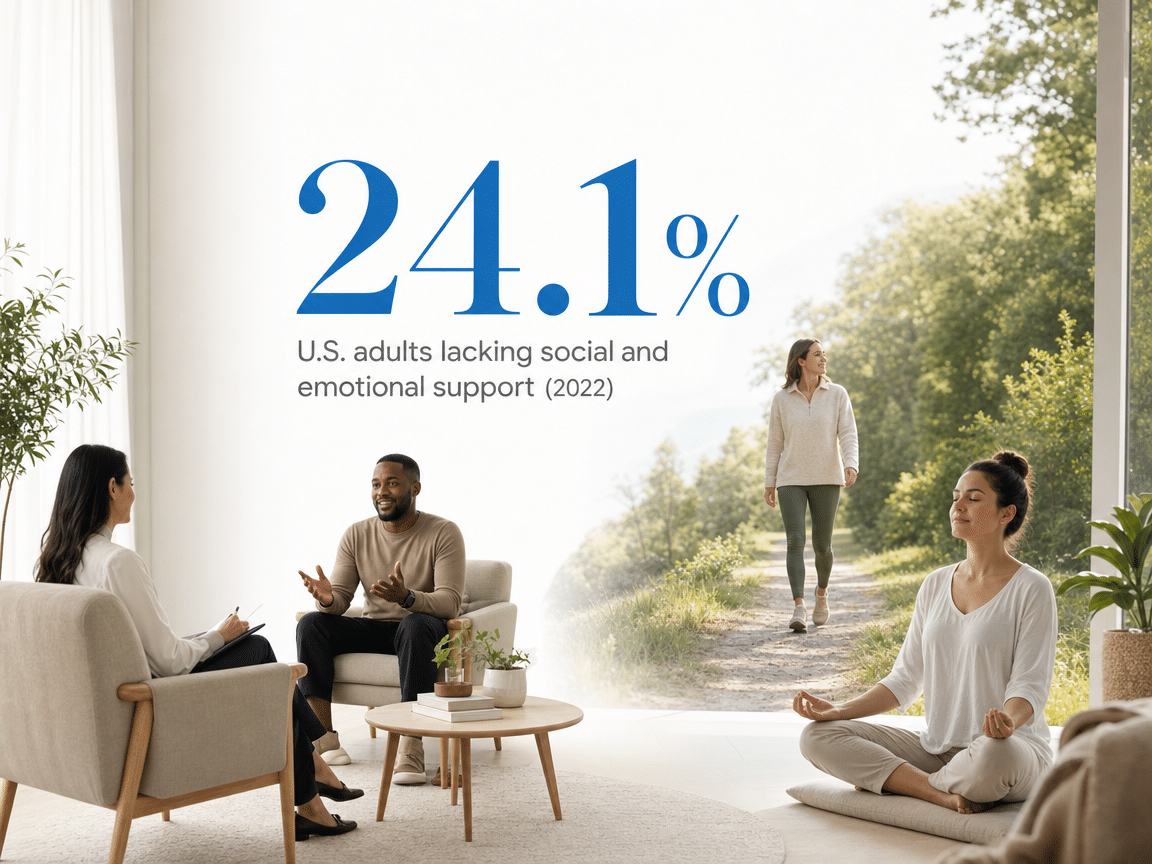
Frequently Asked Questions
Can I be lonely if I have an active social life and see people regularly?
Yes, and it’s more common than you’d think. Loneliness is about the quality of your contact, not the quantity. The CDC treats social isolation (how often you see people) and loneliness (how connected you feel) as related but separate. You can have a packed calendar full of coworkers, gym acquaintances, and app matches and still be short on the deeper conversations your nervous system actually needs.4
How do I know if what I’m feeling is loneliness or actual depression or anxiety?
Duration and function are the two markers to watch. If the restless sleep, tight chest, or flat evenings have lasted more than a few weeks and you’re quietly canceling on people or losing interest in things you used to enjoy, you’ve moved past a rough patch. A ten-minute mental health assessment will sort the difference between situational loneliness, an anxiety pattern, and early depression more accurately than trying to self-diagnose from a symptom list.
Is this really worse after the pandemic, or has it always been this way?
Both, honestly. Loneliness was a measurable public health issue before 2020, but the pandemic pushed the numbers higher and they haven’t fully reset. Among U.S. adults ages 50 to 80, the share reporting a lack of companionship rose from 33.9% in 2018 to 41.4% in early 2020. That’s an older sample, so don’t read it as your exact experience — but the direction of travel matches what younger professionals describe too.8
Does living alone actually put me at higher risk, or is that overstated?
The gap is real but modest. CDC data shows adults living alone report depression at 6.4% compared to 4.1% for adults living with others. That’s a meaningful difference at the population level, not a personal verdict. Plenty of people live alone and are genuinely fine because their friendships carry weight. Living alone is a risk marker — a reason to pay attention to your social layer — not proof that anything is wrong.5
Is telehealth therapy as effective as in-person for something like this?
For anxiety, mild-to-moderate depression, and the loneliness-and-disconnection pattern this article describes, yes. Talk therapy and medication management translate well to video, especially when the alternative is skipping sessions because of a 40-minute drive. In-person tends to matter more for trauma work, initial psychiatric evaluations, or when a dual diagnosis is in the picture. Many people start in person for the assessment and shift to telehealth for weekly sessions once they’re settled with a clinician.
If I start therapy, how long before I feel a difference?
Most people notice something shifting in four to six weeks of consistent weekly sessions — usually a small change first, like sleeping through the night or feeling less braced on Sunday evening. Deeper patterns take longer, often three to six months. The bigger predictor isn’t the format or the technique; it’s whether you attend consistently. That’s why the version of care that fits your schedule matters more than the one that looks ideal on paper.
References
- Loneliness, Lack of Social and Emotional Support, and Mental Health Among U.S. Adults — United States, 2022. https://www.cdc.gov/mmwr/volumes/73/wr/mm7324a1.htm
- Loneliness and Other Mental Health Issues: A Review of the Literature. https://pmc.ncbi.nlm.nih.gov/articles/PMC9636084/
- Community & Connection | Mental Health. https://www.cdc.gov/mental-health/about-data/community-connection.html
- Health Effects of Social Isolation and Loneliness. https://www.cdc.gov/social-connectedness/risk-factors/index.html
- Living Alone and Feelings of Depression Among Adults Age 18 and Older. https://www.cdc.gov/nchs/data/nhsr/nhsr199.pdf
- Our Epidemic of Loneliness and Isolation. https://www.hhs.gov/sites/default/files/surgeon-general-social-connection-advisory.pdf
- The impact of loneliness on depression, mental health, and physical health in a nationally representative sample of U.S. adults. https://pmc.ncbi.nlm.nih.gov/articles/PMC12240311/
- Loneliness and Social Isolation Among US Older Adults. https://pmc.ncbi.nlm.nih.gov/articles/PMC11751738/
- Loneliness, depression, and generalized anxiety across eight countries in 2024. https://pubmed.ncbi.nlm.nih.gov/41644667/
- Social Isolation and Loneliness in Older Adults. https://pmc.ncbi.nlm.nih.gov/articles/PMC7437541/
- Our Epidemic of Loneliness and Isolation: The U.S. Surgeon General’s Advisory on the Healing Effects of Social Connection and Community. https://www.govinfo.gov/app/details/GOVPUB-HE20-PURL-gpo212387
- Association between loneliness and depression, anxiety, and anger in Korean adults during the COVID-19 pandemic. https://pmc.ncbi.nlm.nih.gov/articles/PMC12258374/