

Key Takeaways
- The signs families miss most often are behavioral and emotional shifts — quiet withdrawal, sudden calm, giving things away — not the dramatic crisis moments people expect to see.
- A risk factor is background vulnerability; a warning sign is a change happening now. New, escalating, or out-of-character shifts are what should move you from watching to acting 1.
- Asking directly — “Are you thinking about suicide?” — does not plant the idea. It gives permission to answer honestly, and it mirrors how clinicians triage risk 5.
- A denial does not end your responsibility. Trust what you have observed, secure lethal means, build a written six-part safety plan, and keep showing up between professional visits 9, 14.
The Signs Families Miss Most Often
If you’re reading this, you already noticed something. A canceled dinner that felt off. A joke that landed wrong. A quiet stretch after weeks of chaos. That instinct matters, and you’re not overreacting by taking it seriously.
Most people expect a warning sign to look like a crisis — tears, a phone call at 2 a.m., a direct statement about wanting to die. Sometimes it does. But the signs families miss most often are the quiet ones: your brother suddenly giving away his guitar, your wife wrapping up a project she’d been dragging her feet on, your dad seeming strangely peaceful after months of anger. A sudden calm after a long low can feel like relief. It can also mean a decision has been made.
Federal and clinical guidance groups adult warning signs into what someone says, what they do, and how they feel 1, 15. The signs families overlook usually live in the second and third categories — behavior shifts and mood changes that are easy to explain away as stress, a rough week, or getting older. This guide walks through what to look for in each channel, how to ask directly, and who to call when your gut says something is wrong.
Warning Signs vs. Risk Factors: Why the Difference Matters Tonight
Here’s the distinction that will help you decide what to do in the next few hours: a risk factor is background. A warning sign is a change happening now.
Risk factors are the conditions that sit underneath someone’s life — a prior suicide attempt, depression, chronic pain, a recent job loss, a family history of suicide, ongoing substance use. They raise long-term vulnerability. They don’t tell you whether tonight is different from last Tuesday.
Warning signs are person-specific shifts in thoughts, feelings, or behavior that point to acute risk — something happening right now 3, 6. Your husband has always been anxious; that’s a risk factor. Your husband started writing goodbye texts and stopped eating this week; those are warning signs. The difference matters because warning signs are what should move you from watching to acting.
Direct Warning Signs: What They Say and Do
Suicide-Related Communication (Even When It Sounds Like a Joke)
Direct warning signs are the ones that don’t require guessing. The clearest one is when someone tells you — even sideways — that they’re thinking about ending their life 2.
It rarely sounds like the movie version. It sounds like your sister saying “I just want to sleep and not wake up” while she scrolls her phone. It sounds like a text from your best friend that ends with “honestly, everyone would be fine without me.” It sounds like a co-worker joking about their life insurance policy at lunch. Public health guidance is explicit: talking about wanting to die, feeling like there’s no reason to live, or making comments about being gone counts as a warning sign whether the tone is dramatic, flat, or wrapped in humor 15, 1.
If you find yourself replaying a comment hours later, that’s your gut flagging it. Take the second read seriously. You don’t have to be sure it was “real” to bring it up.
Preparation Behaviors: Giving Things Away, Tying Up Loose Ends
Some of the loudest warning signs are silent. Making arrangements, tidying up affairs, and giving away meaningful possessions are behavioral signals that clinical guidelines treat as high-priority indicators of acute risk 13, 2.
Watch for what feels like closure that came out of nowhere. Your dad hands you his watch on a random Tuesday. Your partner suddenly finishes the estate paperwork they’ve avoided for years. Your friend mails back a book they borrowed a decade ago with a note that reads more like a goodbye than a thank-you. Pets get rehomed. Passwords get shared. A will gets updated without a clear reason.
Any single one of these can be innocent. Stacked together, or paired with a shift in mood, they are not. If your loved one is quietly wrapping things up, that pattern is worth naming out loud — with them, and with a professional.
Seeking Access to Lethal Means
The third direct warning sign is the one families most often notice too late: someone looking for a way to end their life 2, 4.
This can look like a new firearm purchase, asking about a family member’s gun, stockpiling medication, searching methods online, or suddenly asking questions that don’t fit the conversation — how many pills is too many, what a certain overdose feels like, whether a rope would hold weight. It can also look like a spouse who never touches alcohol asking where the old prescription bottles are kept.
When means-seeking shows up alongside any communication or preparation behavior, treat it as the most time-sensitive signal on this list. This is the moment to move from watching to acting — starting the conversation tonight and, if the answer worries you, calling for help before you go to bed.
Indirect Warning Signs: The Shifts That Are Easier to Explain Away
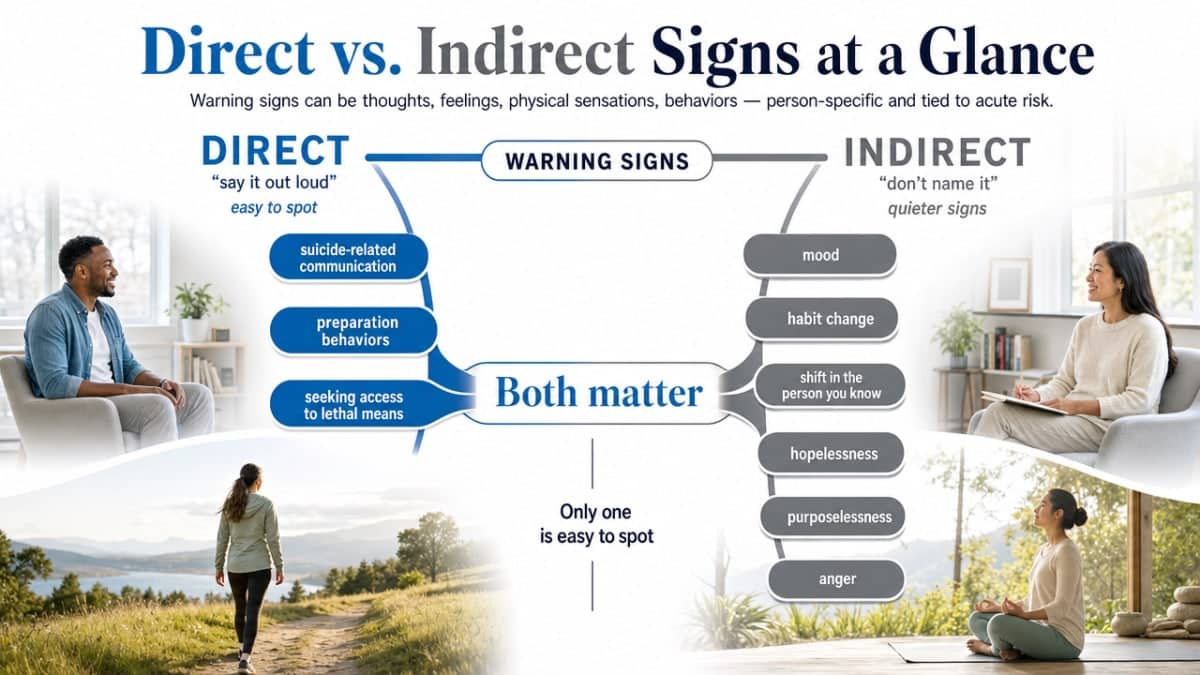
Direct vs. Indirect Signs at a Glance
Direct signs are the ones that name the problem out loud — a statement about ending life, a preparation behavior, a search for lethal means. Indirect signs are the ones that don’t. They show up as a mood, a habit change, a shift in the person you know. Both matter. Only one is easy to spot.
Federal clinical guidance defines a warning sign as “a person-specific thought, feeling, physical sensation, behavior, or any combination of the foregoing that indicates the presence of acute risk” 3. That definition is doing a lot of work. It means the sign can live entirely inside how your loved one is feeling, without a single sentence spoken aloud.
The direct list is short and loud: suicide-related communication, preparation behaviors, and seeking access to lethal means 3. The indirect list is longer and quieter: hopelessness, purposelessness, anger, recklessness, feeling trapped, social withdrawal, anxiety, mood changes, sleep disturbance, and increasing substance use 3. The next three sections walk through the indirect signs families most often talk themselves out of taking seriously.
Hopelessness and Feeling Like a Burden
Hopelessness is the sign most families explain away as a bad week. It shouldn’t be. A systematic review of the research concluded that hopelessness is one of the strongest psychological predictors of suicidal ideation and behavior 16. When someone stops believing tomorrow can be different, the risk climbs — even if nothing else on the list is showing yet.
Listen for the specific phrases. Clinical guidelines flag statements like “no reason for living,” “no sense of purpose,” “I am a burden on others,” and “people would be better off without me” as verbal warning signs to take at face value 13. They can come out flat, almost casual — over dishes, in the car, in a text. That casualness is not evidence they don’t mean it. It’s often evidence the thought has been there long enough to feel ordinary.
If your loved one keeps circling back to some version of “nothing will change” or “I’m just weighing everyone down,” name what you’re hearing. Ask them about it directly. Hopelessness treated as a passing mood is hopelessness left alone.
Withdrawal, Sleep Changes, and the Sudden Calm
Withdrawal rarely announces itself. Your sister stops answering the group chat. Your husband skips the Sunday call with his brother for the third week. A friend who used to say yes to everything starts turning down dinners with reasons that don’t quite land. Public health guidance lists withdrawing from activities and isolating from family and friends as core warning signs — not because pulling back is always dangerous, but because a real change in connection is often the first thing that shifts 15, 1.
Sleep is another quiet channel. Sleeping too much or too little, or a schedule that flips upside down, is on the same warning list 15. Nights spent awake, days spent under the covers, or a body that seems to be running on a different clock than the rest of the household — take those seriously.
The one that catches families most off guard is the sudden calm. After weeks of visible pain, your loved one seems lighter. They’re sleeping. They’re smiling at breakfast. It can feel like the storm passed. Sometimes it did. Sometimes a decision was made, and the peace you’re seeing is the peace of no longer fighting it. If the calm arrived without a reason — no new treatment, no resolved crisis, no honest conversation — treat it as a signal, not a finish line.
Anger, Recklessness, and Increasing Substance Use
Not every warning sign looks sad. Some of them look angry. Clinical guidance flags rage, agitation, and reckless behavior as indirect warning signs of acute risk 3, 4. One recent overview notes that among people with suicidal thoughts, anger stands out as especially closely tied to attempts 12. The person you know as steady is suddenly picking fights, driving too fast, blowing up over small things, or talking about revenge.
Recklessness runs alongside it. New willingness to take physical risks — speeding, unprotected situations, walking into confrontations they’d normally avoid — is on the same list 1, 15. So is increasing use of alcohol or drugs, especially when the pattern is new or the amount has climbed noticeably in a short window 3, 15. A partner who used to have one drink at dinner now has four. A brother in recovery quietly starts again.
Any one of these on its own has other explanations. Stacked together, or paired with anything from the earlier sections, they are the same signal in a different tone of voice.
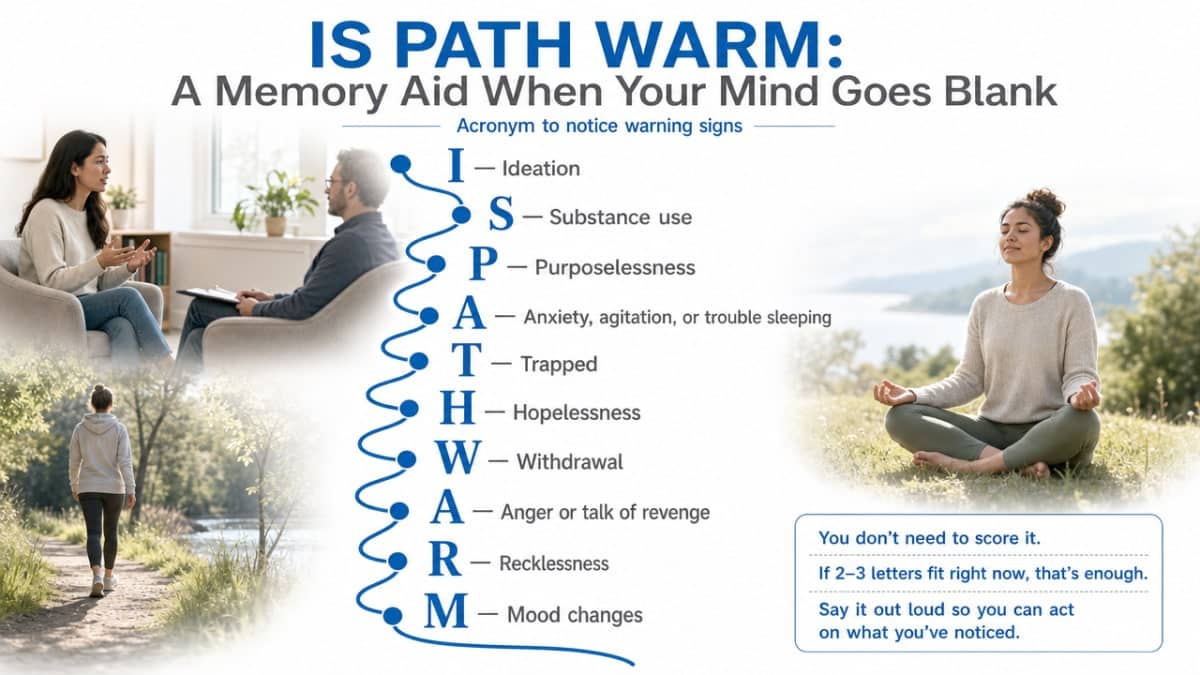
IS PATH WARM: A Memory Aid When Your Mind Goes Blank
In the middle of a scary conversation, your brain will not remember a bulleted list. Clinicians use a short acronym for exactly this reason: IS PATH WARM 12.
- I — Ideation (thoughts or talk of suicide)
- S — Substance use that’s new or climbing
- P — Purposelessness (“what’s the point”)
- A — Anxiety, agitation, or trouble sleeping
- T — Trapped (no way out)
- H — Hopelessness
- W — Withdrawal from people they’d normally lean on
- A — Anger or talk of revenge
- R — Recklessness
- M — Mood changes that are dramatic or out of character
You don’t need to score it. If two or three of these letters describe your loved one right now, that’s enough. Say the acronym out loud on the drive home if you need to. It’s a way to hold onto what you’ve noticed until you can act on it.
The Conversation: What to Actually Say
Setting the Moment (and Why You Shouldn’t Wait for the Perfect One)
There is no perfect moment. You will not find one by waiting for it, and putting the conversation off until things “settle down” often means putting it off past the window when it would have helped most.
What you can do is pick a private, unhurried setting. A drive together. A walk. The couch after dinner when the phones are down. Somewhere your loved one is not cornered and you are not rushed. Turn off the TV. Sit at their level. Lead with what you’ve noticed, not what you’ve concluded: “You haven’t seemed like yourself the past few weeks. I’ve been worried about you, and I wanted to ask you about it directly.” Clinical guidance stresses that families are often the first to spot the shift, and that what you observe is exactly the information a clinician will need later 14.
You don’t have to say it perfectly. You just have to say it.
Asking the Direct Question
Ask it plainly: “Are you thinking about suicide?”
Not “you’re not thinking of doing anything, are you?” Not “you’d tell me if it got that bad, right?” Those questions are built to get a no. The direct version gives your loved one permission to tell the truth, sometimes for the first time. A lot of people are quietly waiting for someone to ask.
You may be afraid that asking will plant the idea. It won’t. Nothing in the clinical literature supports that fear, and the standard triage workflows used across health systems are built on asking directly about ideation, plan, intent, and access to means 5. Asking is how professionals do this. It is how you can do it too.
Say it once, clearly, and then stop talking. Let the silence sit. Your loved one may need a beat to decide whether to answer honestly. If they look away, keep breathing. Don’t fill the space. What comes next is theirs to say.
What to Do With Their Answer
If they say yes — in any form, including “sometimes,” “a little,” or “not really, but…” — stay with them. Don’t panic-lecture. Don’t promise you’ll never tell anyone. Ask three follow-up questions the way a clinician would: Do you have a plan? Do you have access to what you’d use? Have you thought about when 5? Their answers tell you which rung of the response ladder you’re on tonight.
If they say no but something in your gut still won’t settle, trust that. Say so out loud: “I hear you, and I’m still worried. Can we talk to someone together?” A denial is not a discharge. Guidelines specifically recommend gathering information from family and close contacts alongside the person themselves, because what you’ve seen matters even when they minimize it 14.
Whatever answer you get, thank them for telling you. Then move — same night — to the next step in the ladder below. Don’t leave the conversation without a plan you’ve both agreed on.
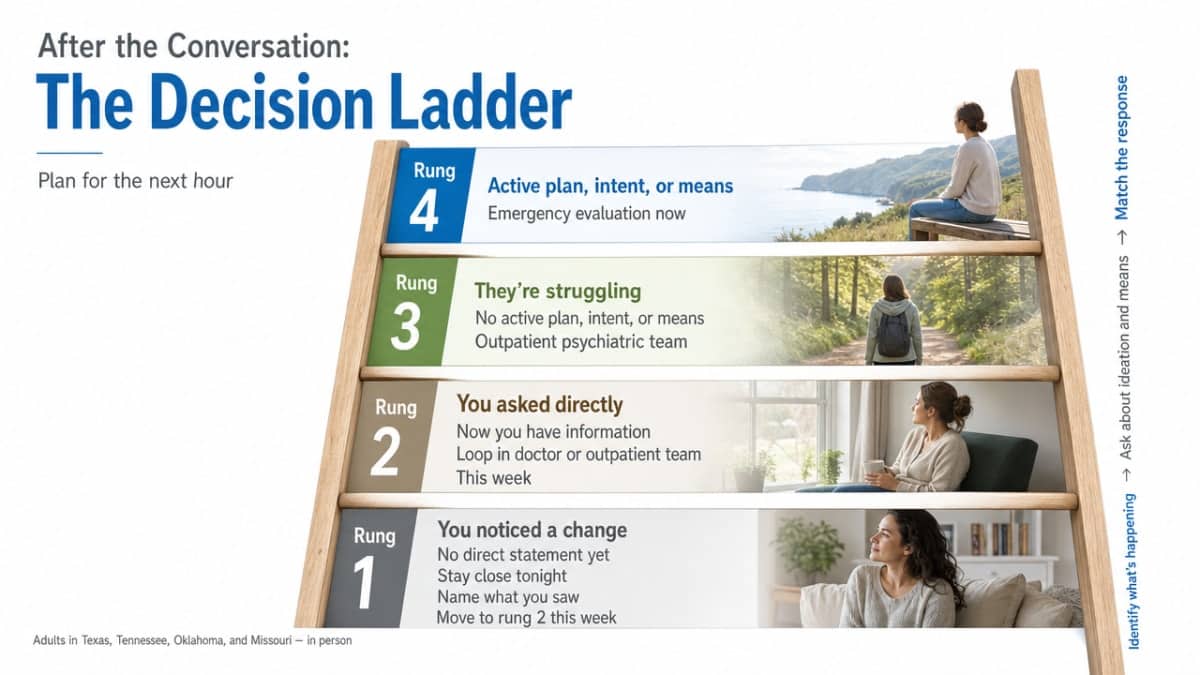
After the Conversation: The Decision Ladder
Once the words have been said out loud, you need a plan for the next hour, not the next month. Clinicians triage this the same way you can: identify what’s happening, ask about ideation and means, and match the response to what you learned 5.
Think of it as four rungs.
Rung one — you noticed a change. No direct statement yet, no plan, but something is off. Stay close tonight. Name what you saw. Move to rung two before the week ends.
Rung two — you asked directly. Whatever the answer, you now have information a professional needs. Loop in their doctor or an outpatient psychiatric team this week.
Rung three — they’re struggling, but there’s no active plan, intent, or means. This is where an outpatient psychiatric team belongs. Mind Body Optimization’s psychiatric providers see adults across Texas, Tennessee, Oklahoma, and Missouri in person and by telehealth for exactly this middle tier — when it’s serious but not an emergency. You can also call or text 988 anytime for immediate support and a warm handoff.
Rung four — there’s a plan, stated intent, or access to means right now. Call 911 or go to the nearest emergency room. Don’t leave them alone. Don’t wait until morning.
You don’t have to get the rung exactly right. You have to keep climbing until someone with training is on the other end of the line.
The Six-Part Safety Plan
A safety plan is not a contract, and it is not a promise not to die. It is a written, agreed-on list your loved one keeps on their phone or by the bed for the next hard hour. Research reviews of safety planning in adults show it improves suicidal ideation, lowers depression and hopelessness, reduces hospitalizations, and keeps people engaged in treatment 7, 8. It works because it turns a spiraling night into a short list of things to try in order.
The current adult version has six parts 9:
- Personal warning signs. The specific moods, thoughts, or situations that mean a crisis is starting for them — not the generic list, theirs.
- Internal coping strategies. Things they can do alone to ride it out: a shower, a walk, a specific playlist, a breathing exercise that has worked before.
- Social distractions. People and places that pull their attention out of their head — a coffee shop, a sibling’s group chat, a friend they can text about anything but this.
- Support contacts. Two or three named people, with phone numbers, who know what’s going on and have agreed to pick up.
- Professional and crisis contacts. Their outpatient psychiatric provider, therapist, and 988, listed with numbers.
- Means safety. The concrete step of putting distance between them and anything lethal — a locked gun safe off-site, medications counted and stored with you, alcohol out of the house for now.
Write it together. Save it where they’ll actually see it. A safety plan sitting in a drawer is not the plan you need tonight.
What Happens After You Make the Call
If you called 988, an outpatient psychiatric team, or 911, you did the hard part. Here’s what to expect so the next few days feel a little less unknown.
A first appointment with a psychiatric provider usually starts with a full conversation — not just with your loved one, but sometimes with you too. Clinical guidance is explicit that risk assessment works best when providers gather information from family and close contacts alongside the person themselves, so what you’ve been seeing is part of the record 14. Expect questions about current thoughts, any plan or intent, access to means, sleep, substance use, and what has helped before. If medication is part of the picture, expect a follow-up within days or a couple of weeks, not months.
One honest note: a risk assessment is a starting point, not a guarantee. A 2025 study of outpatient encounters found that even after a clinician-documented suicide risk assessment, roughly 0.12% of adults attempted within 90 days and 0.22% within 180 days 11. Small numbers, real people. That’s why the plan you leave with matters — a next appointment on the calendar, a safety plan on their phone, means secured at home, and you still checking in. You are not the therapist. You are the person who keeps showing up between visits, and that role does not end when someone else picks up the phone.
Taking Care of Yourself While You Take Care of Them
Sitting with someone else’s pain is heavy. If you’ve been the one noticing, asking, and checking in, you’re carrying real weight — and pretending you’re not doesn’t help either of you.
Sleep when you can. Tell one other person what’s going on so you’re not the only one holding it. If you have a therapist, use them; if you don’t, this is a fair reason to start. Your loved one needs you steady over weeks and months, not perfect for one night. Taking care of yourself is part of the plan, not a distraction from it.
Take the Next Step Toward Mental Stability
Connect with a professional who can help you navigate tough moments and find steadier ground.
Frequently Asked Questions
Will asking someone directly if they’re thinking about suicide plant the idea in their head?
No. Nothing in the clinical literature supports that fear, and the standard triage workflows used across health systems are built on asking about ideation, plan, intent, and access to means directly 5. Asking gives your loved one permission to tell the truth. A lot of people are quietly waiting for someone to ask.
What’s the difference between a warning sign and a risk factor?
A risk factor is background — depression, prior attempts, chronic pain, recent loss. A warning sign is a change happening now: a person-specific shift in thoughts, feelings, or behavior that points to acute risk 3, 6. Risk factors tell you someone is vulnerable over time. Warning signs tell you tonight is different.
When should I call 988 versus 911 versus an outpatient psychiatric team?
Call 911 or go to the ER when there is a stated plan, intent, or immediate access to lethal means — don’t leave your loved one alone. Call 988 anytime for immediate support, especially when you’re unsure. Call an outpatient psychiatric team, like Mind Body Optimization’s providers across Texas, Tennessee, Oklahoma, and Missouri, when it’s serious but not an emergency 5.
My loved one seems suddenly calm after weeks of depression. Is that a good sign?
Not always. If the calm arrived without a reason — no new treatment, no resolved crisis, no honest conversation — treat it as a signal, not a finish line. A sudden lift after a long low can mean a decision has been made and the person is no longer fighting the thought. Ask directly 1.
What do I do if they deny having any thoughts of suicide but I still feel worried?
Trust your gut and say it out loud: “I hear you, and I’m still worried. Can we talk to someone together?” A denial is not a discharge. Clinical guidance specifically recommends gathering information from family and close contacts alongside the person themselves, because what you’ve observed is part of the picture even when they minimize it 14.
Should I remove firearms or medications from the home, or is that overstepping?
It’s not overstepping — it’s one of the six standard components of an adult safety plan 9. Putting distance between your loved one and lethal means, like an off-site gun safe or medications counted and stored with you, is a concrete step that saves lives. Do it collaboratively when possible, but do it.
References
- Warning Signs of Suicide | SAMHSA. https://www.samhsa.gov/mental-health/suicidal-behavior/warning-signs
- Assessment and Management of Patients at Risk for Suicide. https://www.healthquality.va.gov/guidelines/MH/srb/VADoD-CPG-Suicide-Risk-Pocket-Card-2024_Final_508.pdf
- VA/DoD Clinical Practice Guideline for Assessment and Management of Patients at Risk for Suicide (2024). https://www.healthquality.va.gov/guidelines/MH/srb/VADoD-CPG-Suicide-Risk-Full-CPG-2024_Final_508.pdf
- Suicide Risk Assessment Guide: Reference Manual. https://www.mentalhealth.va.gov/docs/suicide_risk_assessment_reference_guide.pdf
- SAFE-T (Suicide Assessment Five-Step Evaluation and Triage) Flier. https://library.samhsa.gov/sites/default/files/safet-flyer-pep24-01-036.pdf
- Risk Factors and Warning Signs – SAMHSA. https://www.samhsa.gov/resource/dbhis/risk-factors-warning-signs
- The Effectiveness of the Safety Planning Intervention for Adults Experiencing Suicide-Related Distress: A Systematic Review. https://pubmed.ncbi.nlm.nih.gov/33913799/
- Effectiveness of Suicide Safety Planning Interventions. https://pmc.ncbi.nlm.nih.gov/articles/PMC10189833/
- Safety planning interventions to address suicidality in adults – PMC. https://pmc.ncbi.nlm.nih.gov/articles/PMC12706239/
- Suicide Risk Assessment and Prevention. https://pmc.ncbi.nlm.nih.gov/articles/PMC7587888/
- Clinician Suicide Risk Assessment for Prediction of Suicide Attempts After Health Care Encounters. https://pubmed.ncbi.nlm.nih.gov/40202745/
- Suicide: Assessment and Management (StatPearls). https://www.ncbi.nlm.nih.gov/books/NBK617057/
- Clinical Practice Guidelines for Management of Suicidal Behaviour. https://pmc.ncbi.nlm.nih.gov/articles/PMC10096207/
- Suicide Risk Assessment, Management, and Mitigation in the Emergency Setting. https://pmc.ncbi.nlm.nih.gov/articles/PMC10172543/
- Facts About Suicide (CDC). https://www.cdc.gov/suicide/facts/index.html
- Hopelessness, depression, and suicidal ideation: A systematic review. https://pubmed.ncbi.nlm.nih.gov/28408228/