

Key Takeaways
- Returning to work after treatment breaks into four sequenced fronts: legal footing, disclosure plan, schedule architecture, and a deliberate first 90 days.
- Employment tends to stabilize recovery rather than threaten it, with employed people in treatment significantly more likely to complete their program 11.
- The ADA and FMLA give you real leverage — reasonable accommodations like modified schedules, job-protected leave, and confidentiality that keeps your diagnosis inside HR 3, 5, 9.
- Protect outpatient appointments like standing client meetings, aim for small visible wins early, and revisit the plan with your care team as recovery stabilizes 10.
Why Monday morning feels heavier than it should
You finished treatment. You did the harder thing. And somehow, the idea of walking back into your office on Monday feels like standing at the edge of a diving board you didn’t sign up for.
That weight is real. You’re not being dramatic. You’re carrying a stack of unknowns at the same time: what your inbox looks like, what your manager is thinking, whether someone will ask where you’ve been, how you’ll protect your outpatient appointments without waving a flag. Underneath all of it, the quieter fear — that one bad day at work could undo what you just built.
Here’s what helps. Returning to work is not one giant decision. It’s four smaller ones, sequenced in an order that protects your recovery instead of testing it: your legal footing, your disclosure plan, your schedule, and your first 90 days. Work through them in that order and Monday stops being a cliff. It becomes a calendar.
Work is a recovery asset, not a recovery risk
You may be bracing for the opposite message. That work is the thing that got you here. That the deadlines, the pressure, the after-hours drinks with clients are the reason you needed treatment in the first place. Some of that might be true. But the research points somewhere you may not expect: for most people leaving treatment, going back to work actually helps recovery hold.
About two-thirds of adults with a substance use disorder are already employed 2. You are not the strange case. You are the common one. That matters because it means workplaces have been quietly holding people through recovery for a long time, even when nobody says it out loud.
The stabilizing effect shows up in the numbers, too. In one peer-reviewed study of people in treatment, those who were employed during care were significantly more likely to complete their program than those who were not 11. SAMHSA’s evidence-based guide reaches the same conclusion from the other direction: employment is one of the strongest predictors of positive outcomes for people with substance use disorders, including lower rates of recurrence and better quality of life 1.
A steady paycheck. A reason to be somewhere at 9 a.m. Coworkers who expect you. Small daily proof that you can do a hard thing. Those are recovery ingredients, not threats to it.
That doesn’t mean you go back the same way you left. It means you go back on purpose — with a plan that protects the parts of your job that used to strain you and builds in the outpatient care that keeps the whole thing standing.

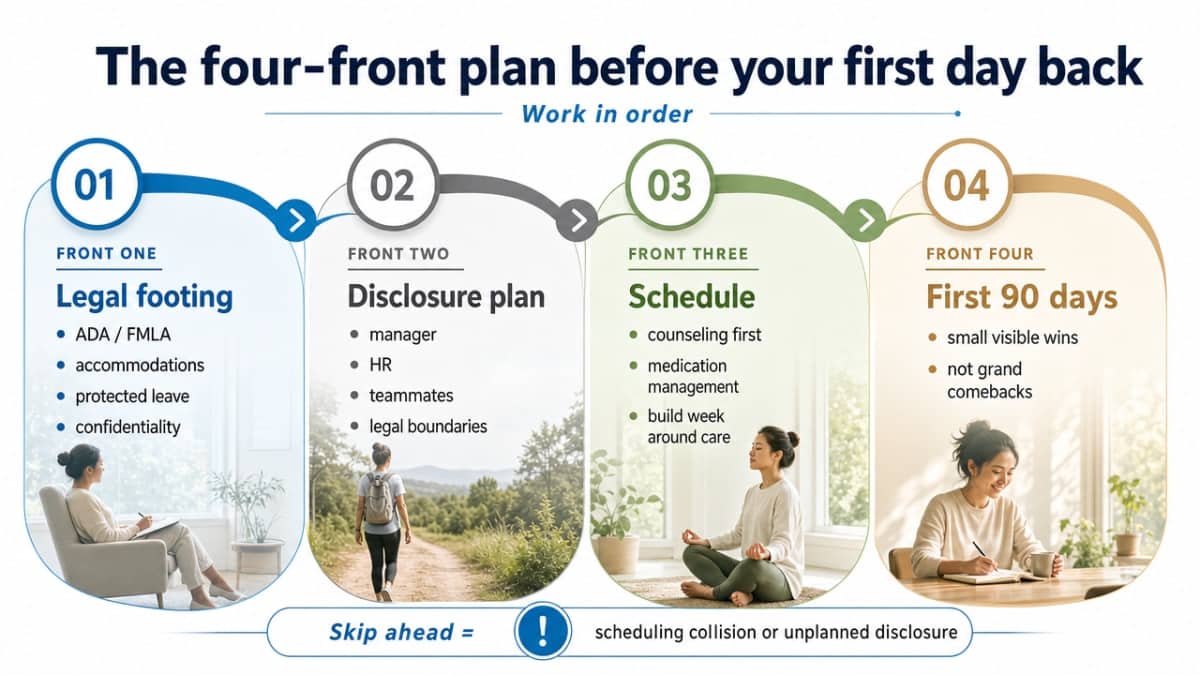
The four-front plan before your first day back
Think of the next few weeks as four fronts, worked in order. Skip ahead and you’ll feel it — usually as a scheduling collision or a disclosure conversation you didn’t plan for.
Front one: your legal footing. Before you say anything to anyone at work, know what the ADA and FMLA actually give you — reasonable accommodations, job-protected leave, and confidentiality your employer has to honor 5, 9.
Front two: your disclosure plan. Decide who gets what information. Your manager, HR, and teammates each sit in a different circle, and the boundaries between them are legal, not just social.
Front three: your schedule. Outpatient counseling and medication management are not optional add-ons. They go on the calendar first, and the rest of your week builds around them.
Front four: your first 90 days. Small, visible wins, not grand comebacks. That’s how professional confidence comes back — quietly, on a Tuesday, when you ship something clean.
Your legal footing: ADA, FMLA, and what you can actually ask for
What the ADA covers when the condition is a substance use disorder
Here’s the part most people don’t realize until they need it: a substance use disorder is a medical condition, and the Americans with Disabilities Act treats it that way. EEOC guidance is explicit that conditions like opioid use disorder are diagnosable medical conditions likely to qualify as ADA disabilities, which means people in recovery are generally protected from discrimination and can request reasonable accommodations to keep working 3.
The nuance matters. The ADA protects you when you are in recovery or receiving treatment. It does not protect current illegal drug use. So the fact that you completed treatment and are engaged in ongoing outpatient care — counseling, medication management, whatever your plan looks like — is exactly what puts you inside the protection, not outside it.
You do not have to use the word “disability” to feel like this applies to you. You do not have to see yourself that way at all. The law is a tool. You can pick it up, use it to protect your outpatient appointments and your job, and put it back down.
Reasonable accommodations you can request in plain English
Under the ADA, a reasonable accommodation is a workplace change that lets you do your job while managing a health condition. For someone returning to work after treatment, EEOC guidance points to three that come up again and again: a modified or altered schedule so you can attend outpatient care, unpaid leave when you need a block of time away, and reassignment to a different role when your current one is genuinely not workable 3.
In plain English, that looks like this:
Modified schedule. A standing Wednesday 4 p.m. block for therapy. A later start on the days you see your prescriber. A remote afternoon so you can do a telehealth session without eating your lunch break in a parked car.
Unpaid leave. A defined stretch of time — a week, two weeks, sometimes more — for intensive outpatient work or a step-down program. Job-protected, unpaid, and yours to request.
Reassignment. If your current role has features you genuinely cannot do safely anymore — overnight shifts, specific triggers, a client relationship built on drinking — you can ask to be moved to a vacant role you can do 4.
You do not have to justify why. You have to identify what you need. Your clinician can help document it, and your employer engages in what the law calls an interactive process to figure out what works.
FMLA leave for treatment and step-downs
The Family and Medical Leave Act is the other tool in your pocket. If you work for a covered employer and meet the eligibility rules, FMLA gives you up to 12 weeks of unpaid, job-protected leave in a 12-month period for a serious health condition — and treatment for a substance use disorder qualifies 9.
Two things to know. First, FMLA and ADA are separate. You can use FMLA for the treatment block and then request ADA accommodations for the ongoing outpatient piece — a modified schedule for therapy, for example. Second, FMLA can be taken intermittently. If your step-down plan involves a weekly intensive outpatient session for a stretch, that time can be covered too. Your job or an equivalent one is waiting when you come back.
Confidentiality: what HR can and cannot tell your manager
This is the piece that quiets a lot of Sunday-night dread. When you request an accommodation, medical information you share is confidential. EEOC guidance is direct: employers must keep medical information collected during the accommodation process confidential. Supervisors and managers may be told about necessary restrictions on your work and the accommodations you need — but they are not entitled to your diagnosis 5.
Disclosure strategy: who needs to know what
The three-circle map: manager, HR, teammates
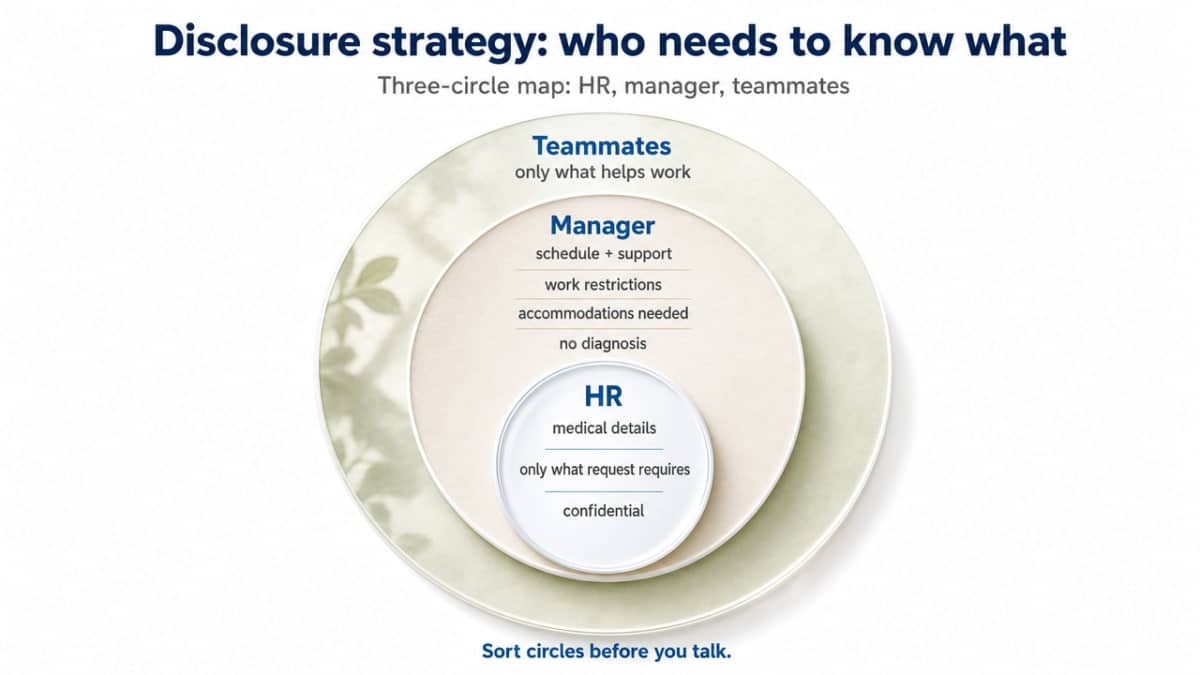
Not everyone at work sits in the same information circle. Sorting them out before you talk to anyone saves you from over-sharing on autopilot.
Inner circle: HR. HR is where the medical detail goes, and only as much as your accommodation request requires. Under EEOC guidance, employers must keep medical information collected during an accommodation request confidential — including any diagnosis you disclose 5. That’s the circle where you can say the actual words, if you choose to, and know they stop there.
Middle circle: your manager. Your manager gets what they need to schedule and support you — not your diagnosis. EEOC guidance is specific: supervisors may be told about necessary work restrictions and the accommodations you need, but they are not entitled to your underlying medical condition 5. So your manager can be told you have a standing medical appointment on Wednesday afternoons that needs to be protected. They cannot be told what the appointment is for.
Outer circle: teammates. Teammates get nothing they don’t need. No diagnosis, no treatment history, no explanation of the last few weeks. Friendly, brief, and moving on is a complete answer.
Scripts you can borrow on Sunday night
You do not have to write these from scratch at 10 p.m. the night before. Borrow, adjust, and send.
To HR, requesting an accommodation:
“I’d like to request a reasonable accommodation under the ADA. I have a medical condition I’m managing with ongoing outpatient treatment, and I need a modified schedule to attend appointments — a standing block on Wednesdays from 3:30 to 5:00 p.m. My clinician can provide documentation of the medical need if that’s helpful. I’d prefer that the specific diagnosis stay in HR.”
That’s it. You’ve named the law, named the change you need, offered documentation, and drawn the confidentiality line. You do not owe more.
To your manager, after HR has confirmed the accommodation:
“I wanted to give you a heads-up that I’ll have a standing medical appointment on Wednesday afternoons going forward. HR has the details. I’ll make sure my Wednesday deliverables are wrapped by lunch, and I’m happy to shift my Monday hours if it helps cover anything.”
Notice what’s missing: any medical detail, any apology, any explanation. You’re a professional giving a heads-up and offering a solution.
If your manager asks a follow-up question you don’t want to answer:
“It’s a health thing I’m handling. HR has what they need. Thanks for being flexible on the schedule.”
Warm tone, hard boundary. Then change the subject to a work topic.
Handling the nosy coworker and the ‘where were you?’ question
The question is coming. Someone will lean over the cubicle wall on your second day back and say, “So where have you been?” Your job is to have an answer ready so you’re not scrambling.
A short, honest, non-specific line works better than anything clever:
“I was out on medical leave. All good now — glad to be back. What did I miss on the Henderson project?”
Three moves in one sentence: name the category (medical leave), close the door (all good now), and redirect to work. Most people take the exit. The rare person who pushes — “Medical, like what?” — gets a friendly, firm: “I’d rather keep the details private, but thanks for asking.” Then you go back to the Henderson project.
You are not being cold. You are being professional. That boundary is yours to hold.
Schedule architecture: protecting outpatient care as infrastructure
Treat therapy and med checks like standing client meetings
Here is the mindset shift that changes everything: your Wednesday therapy hour is not a personal appointment you’ll move if something urgent comes up. It’s a standing client meeting. The client is you, and the account is your recovery.
Put every recurring piece of your outpatient plan on your work calendar first, before anything else gets scheduled around it. A weekly counseling session. A monthly medication management check-in. A support group if that’s part of your plan. Block the time, label it neutrally — “medical appointment” or “personal hold” — and set it to private. Then guard it the way you would a board meeting.
This is not overkill. NIDA notes that ongoing treatment and recovery support improve social functioning, including performance in work and family roles 10. Continuing care is the mechanism. If you skip the session to catch up on email, you’re borrowing from the exact system that keeps you at work. The written return-to-work plans that recovery-friendly workplaces recommend exist for this reason — to set expectations and reduce the stress of having to renegotiate your calendar every week 8.
Move meetings around it, not through it.
Making telehealth and flexible scheduling do the heavy lifting
The other thing that keeps this sustainable: not every appointment has to eat a half-day. A telehealth counseling session from your home office over a lunch break is a very different logistical ask than driving across town for a 4 p.m. slot on a Wednesday in Dallas traffic.
If you’re continuing care with a provider like Mind Body Optimization — which offers virtual counseling and telehealth psychiatry across Texas, Tennessee, Oklahoma, and Missouri, alongside in-person clinics — you can often mix formats. A quick 30-minute telehealth medication check on a Tuesday morning. An in-person therapy session on a Thursday evening after work. A midday video session on a day you’re already remote.
Talk to your care team about what your work week actually looks like and build the schedule together. That’s the point of the modified-schedule accommodation you requested earlier — it makes room for exactly this kind of flexible pattern, so outpatient care fits into your job instead of competing with it 3.
Rebuilding professional confidence in 30, 60, and 90 days
Days 1–30: small, visible wins
Forget the comeback story. Your first month is not the time to prove you’re back at 110%. It’s the time to prove you’re reliable — which, if you’re honest, is the currency you actually lost.
Pick three small, visible things and do them cleanly every week. Show up to your morning standup on time. Send a Friday status update that’s short, accurate, and on your own initiative. Close out one small ticket a day before you touch the big one. These sound almost embarrassingly modest. That’s the point. Reliability is a pattern, and patterns are built out of small things done repeatedly.
Keep your outpatient appointments as if they were board meetings — because for the next 90 days, they are the meetings that make the rest of your calendar possible. If you get to the end of week four and you’ve hit your Wednesday therapy block four times in a row, that is a win. Write it down somewhere only you see.
Days 31–60: feedback loops and one stretch task
Month two is when you go looking for information instead of waiting for it. Ask your manager for a 20-minute check-in. Not a review — a check-in. One question does most of the work: “What’s one thing I could be doing better right now?” Then listen, take one note, and adjust. That single conversation quietly rewrites the story your manager is telling themselves about your return.
Then, pick one stretch task. Not a full project. One task that’s slightly above where you’ve been playing — a client call you lead, a section of a deck you own, a decision you make without escalating. Small enough that a rough day doesn’t sink it. Big enough that finishing it changes how you feel walking into work on Monday. Confidence rebuilds through evidence, and this is you building the evidence.
Days 61–90: a real review conversation
By day 90 you’ve earned a different kind of conversation. Schedule 30 minutes with your manager and go in with three things: what you’ve delivered, what you’d like to own next, and any adjustments to your schedule accommodation now that you know what actually works.
This is also the moment to check in on your outpatient plan with your care team. Maybe the standing Wednesday block can shift to every other week. Maybe telehealth covers more of it now so you claw back a commute. Continuing care is meant to flex with you as recovery stabilizes and social functioning strengthens 10. The written return-to-work plan you started with is not a cage — it’s a draft you revise once you have real data 8.
Ninety days in, you’re not the person who walked back on Monday of week one. You’re someone with a track record. Keep building.
Reading the room: is your workplace actually recovery-supportive?
Not every workplace handles this well, and part of your plan is honestly assessing which one you’re walking back into. The Department of Labor’s Recovery-Ready Workplace framing gives you a useful checklist: does your employer inform employees about their right to reasonable accommodations, does it use person-first language in policies and communications, and does it treat treatment as a health matter rather than a performance failure 6, 7?
Look at the small signals. How does your HR handbook talk about substance use — as a medical condition or as misconduct? Does your manager already flex around other people’s medical appointments without commentary? When someone came back from a different kind of leave last year, did the team fold them back in or freeze them out?
If the signals are good, lean in. If they’re mixed, keep your circle tight — HR for the accommodation, the minimum for everyone else. You get to decide how much of yourself the room earns access to.
When the return gets harder than expected
Some weeks land clean. Some don’t. You’ll have a Thursday when a client email lands wrong, your Wednesday therapy session got moved, and you can feel the old pull in your chest by 4 p.m. That is not failure. That is data.
Call your care team before you call it a bad stretch. A quick telehealth check-in with your counselor or prescriber can shift a week that’s tilting. Continuing care is designed to flex when things get heavier — that’s the whole point of ongoing outpatient support 10.
Then look at the calendar, not yourself. Did an appointment get skipped? Did a schedule accommodation quietly erode? You can revisit the accommodation you set up, adjust the block, or add a second one. The interactive process under the ADA is not one-and-done 5.
A hard week does not undo 60 good ones. Ask for help early and keep showing up.
Take the Next Step Toward Work-Life Balance
Get support tailored to your schedule as you transition back to work.
Frequently Asked Questions
Do I have to tell my employer I was in treatment for a substance use disorder?
No. You are not required to disclose your diagnosis. If you need a schedule change or leave to support ongoing care, you can request a reasonable accommodation without naming the condition. EEOC guidance requires employers to keep medical information confidential — supervisors may be told about work restrictions and accommodations, but not your diagnosis 5.
Does the ADA actually protect someone in recovery from a substance use disorder?
Yes. EEOC guidance is explicit that conditions like opioid use disorder are diagnosable medical conditions likely to qualify as ADA disabilities, and people in recovery or in treatment are generally protected from discrimination and can request reasonable accommodations 3. Current illegal drug use is not protected — but engaging in ongoing outpatient care is exactly what puts you inside the protection.
Can I use FMLA leave for addiction treatment and step-down care?
Yes, if you work for a covered employer and meet the eligibility rules. FMLA provides up to 12 weeks of unpaid, job-protected leave in a 12-month period for a serious health condition, and treatment for a substance use disorder qualifies 9. Leave can also be taken intermittently, which covers weekly intensive outpatient sessions during a step-down phase.
What accommodations can I request to protect my outpatient appointments?
The three most common ones for people returning from treatment are a modified schedule, unpaid leave, and reassignment to a vacant role you can do 3, 4. A modified schedule is usually the workhorse — a standing weekly block for therapy, a later start on prescriber days, or a remote afternoon for telehealth. Your clinician can document the medical need.
What should I say when a coworker asks where I’ve been?
Keep it short, honest, and non-specific, then redirect to work: “I was out on medical leave. All good now — glad to be back. What did I miss?” If someone pushes for details, a friendly but firm “I’d rather keep the details private, thanks for asking” closes the door. You do not owe anyone your medical history.
What if I start struggling once I’m back at work?
Call your care team early, not late. A quick telehealth check-in with your counselor or prescriber can shift a week that’s tilting, and continuing outpatient support is designed to flex when things get heavier 10. You can also revisit your accommodation — the ADA’s interactive process is not one-and-done, so blocks can be adjusted or added 5.
References
- Substance Use Disorders Recovery with a Focus on Employment. https://library.samhsa.gov/sites/default/files/pep21-pl-guide-6.pdf
- Workplace Supported Recovery | Substance Use and Work. https://www.cdc.gov/niosh/substance-use/workplace-supported-recovery/index.html
- How Health Care Providers Can Help Current and Former Patients Who Have Used Opioids Stay Employed. https://www.eeoc.gov/laws/guidance/how-health-care-providers-can-help-current-and-former-patients-who-have-used-opioids
- Use of Codeine, Oxycodone, and Other Opioids: Information for Employees. https://www.eeoc.gov/laws/guidance/use-codeine-oxycodone-and-other-opioids-information-employees
- Enforcement Guidance on Reasonable Accommodation and Undue Hardship under the ADA. https://www.eeoc.gov/laws/guidance/enforcement-guidance-reasonable-accommodation-and-undue-hardship-under-ada
- Recovery-Ready Workplace. https://www.dol.gov/agencies/eta/RRW-hub/Recovery-ready-workplace
- Addressing Stigma. https://www.dol.gov/agencies/eta/RRW-hub/Getting-started/Addressing-stigma
- Recovery Friendly Workplace Toolkit. https://recoveryfriendly.ri.gov/sites/g/files/xkgbur1026/files/2024-01/RFW%20Toolkit.pdf
- Family and Medical Leave Act (FMLA) – Wage and Hour Division. https://www.dol.gov/agencies/whd/fmla
- DrugFacts: Treatment Statistics (NIDA). https://www.nida.nih.gov/publications/drugfacts/treatment-statistics
- Employment as a predictor of substance abuse treatment completion. https://www.ncbi.nlm.nih.gov/pmc/articles/PMC3582397/