

Key Takeaways
- Clinical perfectionism is defined by self-worth becoming dependent on hitting demanding standards, not by the standards themselves, so the tell is how harshly you turn on yourself after a miss 9.
- The old split between healthy strivings and harmful concerns is weakening, since even perfectionistic strivings show associations with suicidal ideation and rarely exist apart from self-criticism 3.
- Perfectionism runs as a transdiagnostic thread through depression, anxiety, eating disorders, burnout, and suicide risk, and it predicts treatment outcomes when left unaddressed 12.
- CBT uses behavioral experiments and cognitive restructuring to decouple self-worth from output, and telehealth with medication management makes that work fit inside a demanding schedule 9.
The email you drafted eleven times
It is 9:47 PM. You have rewritten the same three-sentence email eleven times. The recipient is a colleague you have known for four years. The subject line is “quick question.” You know, somewhere behind your eyes, that this is not normal. You also know you are going to draft it a twelfth time before you hit send.
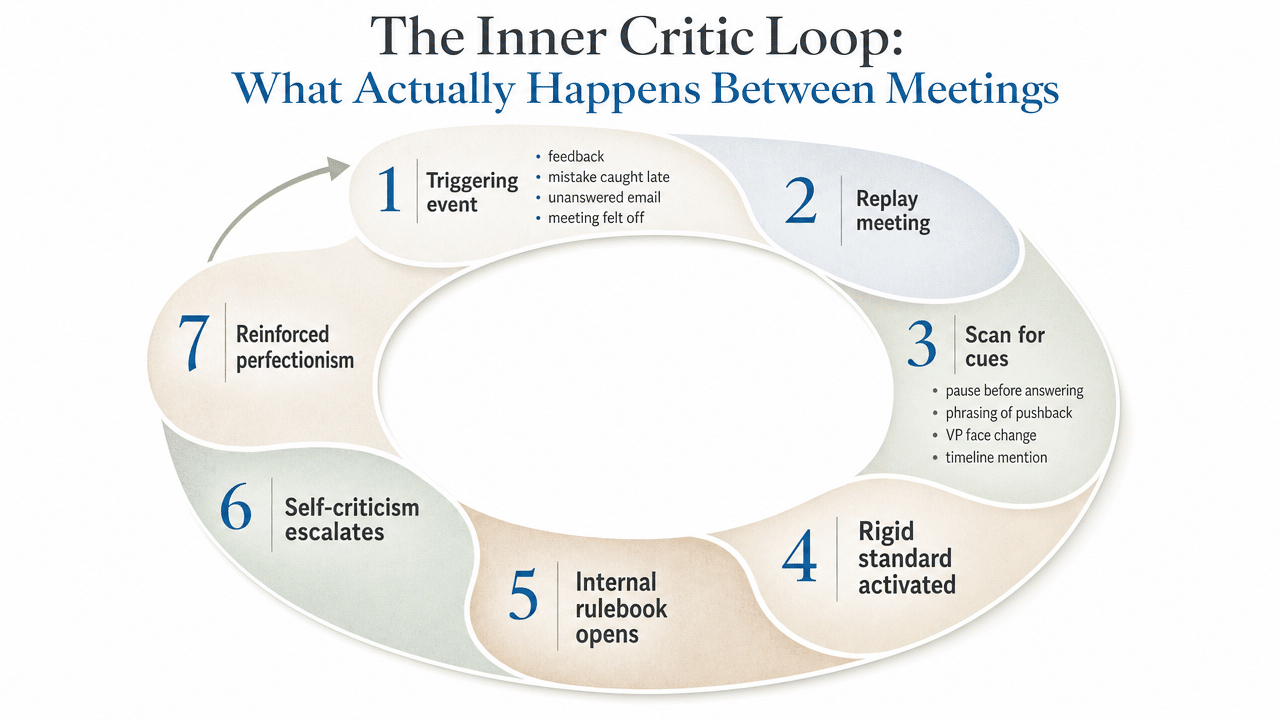
From the outside, you look like the person who has it together. Promotions on time. Clients who ask for you specifically. A calendar that other people envy and quietly fear. Inside, you replay a two-second stumble from Tuesday’s meeting on a loop, and Sunday nights feel like the hours before a test you never quite studied enough for.
Here is what the research now says, plainly: the drive that got you here is not a free upgrade. Perfectionism is being reframed by clinicians as a shared thread running through anxiety, depression, social anxiety, eating disorders, burnout, and even suicidal thinking 12. Older ideas about a benign, “adaptive” version of it are being challenged as more data comes in 1.
You do not need a lecture on high standards. You need someone to name what is actually happening, show you what the evidence says, and lay out a treatment path that fits a 50-hour week. That is what the rest of this article is for.
What clinicians actually mean by clinical perfectionism
Clinicians have a specific definition for what you might be doing at 9:47 PM with that email. Clinical perfectionism is “the overdependence of self-evaluation on the pursuit and achievement of personally demanding standards in at least one salient domain” 9. Read that sentence twice. The engine is not the high standard. The engine is what happens to your sense of self when the standard slips.
A colleague with genuinely high standards revises the report once, notices two clunky sentences, fixes them, and sends it. She feels satisfied. If a client pushes back, she updates her thinking about the client, not about whether she is competent.
Clinical perfectionism looks different, even when the output is identical. You revise the same report eleven times. You notice the two clunky sentences and then start noticing them everywhere in your work history. If the client pushes back, you do not update your view of the client. You update your view of yourself. The pushback becomes evidence about your worth, not information about a document.
That is the tell. Your self-worth is stapled to the deliverable. When it lands well, you feel briefly okay. When it lands badly, or even ambiguously, you feel like the version of you that people respect might be a mistake they haven’t caught yet.
The standard itself is not the problem. Plenty of surgeons, litigators, engineers, and editors hold demanding standards without their nervous systems paying rent on every draft. What clinicians look for is the coupling: how much of your identity rides on hitting the mark, and how harshly you turn on yourself when you miss 4. Notice which one describes your Tuesday.
Strivings vs. concerns: why the ‘good perfectionism’ story is falling apart
You may already be doing the mental math: “Okay, but my kind of perfectionism is the productive kind. It’s what makes me good at my job.” That instinct has decades of pop psychology behind it. It also has less scientific support than it used to.
Researchers typically split perfectionism into two rough camps.
- Perfectionistic strivings
- The pull toward high personal standards, achievement, and organization.
- Perfectionistic concerns
- The darker cousin: fear of making mistakes, harsh self-criticism, and the sense that other people are quietly grading you and finding you wanting.
When Norwegian researchers looked at adolescents across both dimensions, the picture was sharper than the old “good vs. bad perfectionism” story suggests. Perfectionistic concerns about mistakes and negative evaluation from others were associated with higher risk of mental health problems, while perfectionistic strivings tracked with psychological adjustment, positive affect, and life satisfaction 2. Concerns carried the heavier mental health cost. Strivings looked, on the surface, like the safer bet.
Then the suicide meta-analysis complicated things. When researchers pooled data across studies, perfectionistic concerns showed the expected small-to-moderate links with suicidal thoughts, but perfectionistic strivings did too. The authors were direct about what that means:
strivings’ association with suicide ideation “draws into question the notion that such strivings are healthy, adaptive, or advisable” 3.
Read that sentence slowly, because it undercuts a story you may have been telling yourself for years. The pursuit of very high standards is not automatically a neutral or protective trait. It can travel alongside the same self-criticism that drives the darker version.
Here is the honest read: strivings and concerns rarely live apart in real people. You do not get to keep the productive half and quarantine the punishing half. If you set standards that leave no room for a rough draft, the self-criticism that shows up when you miss is not a bug in the system. It is part of the same system.
The useful question is not whether your perfectionism is the “good kind.” It is whether the way you talk to yourself after a mistake matches the way you talk to a colleague after theirs. If those two voices sound nothing alike, that gap is worth naming.
The transdiagnostic pattern: one trait, many diagnoses
Here is the piece that changes how you read the rest of this article. Clinicians used to sort your Tuesday-meeting replay into one bucket and your friend’s food rules into another. Different diagnoses, different treatment plans, different waiting rooms. That framing is quietly being replaced.
A clinical review of perfectionism across disorders put it in one sentence:“Perfectionism is a risk and maintaining factor for eating disorders, anxiety disorders and depression,” and it “predicts treatment outcome” in those conditions 12.Translation: the same underlying pattern shows up across diagnoses, keeps them going, and, if it is not addressed directly, drags down how well treatment works. That is what clinicians mean by transdiagnostic. One trait, many doors.
Picture it as a single thread running through a stack of files.
- In depression, perfectionism shows up as self-criticism so relentless it becomes one of the strongest predictors of depressive symptoms, even after other personality factors are accounted for 4.
- In social anxiety, it shows up as fear of being seen as anything less than flawless in front of others 7.
- In eating disorders, it operates as both a precursor and an active maintainer of symptoms, shaping how the condition starts and why it holds on 11.
- In high-stress work, it shows up as maladaptive perfectionism feeding burnout, with work-family conflict as the pipeline between them, at least in the nurse populations studied so far 6.
- In suicidal thinking, it shows up as absolutist, all-or-nothing interpretations of failure 3.
What this means for you is straightforward. If you have been treated for anxiety and the symptoms keep circling back, or if you cleared one diagnosis only to find another waiting, the through-line may not be a series of separate problems. It may be a single pattern that no one has named out loud. Treating the pattern, not just the latest label, is where the leverage sits.
How this shows up at work
Burnout, work-family conflict, and the Sunday-night knot
You know the knot. It shows up somewhere around 6 PM on Sunday, tightens through the evening, and by Monday morning it feels less like anxiety and more like weather. You have been working through it for so long you stopped noticing it was there.
Burnout research gives that knot a shape. In a study of nurses, maladaptive perfectionism was tied to significantly greater emotional exhaustion and depersonalization, and the pipeline running between the two was work-family conflict 6. Perfectionistic standards did not just make the workday longer. They spilled into evenings and weekends, colonized the hours meant for other things, and left less of you available for anyone at home, including yourself. The exhaustion followed.
That study looked at one high-stress profession, so treat it as a well-lit example rather than proof about every job. The mechanism, though, will feel familiar if you are billing hours, on-call for clients, or running code reviews at 10 PM. When “good enough” is not a category your brain accepts, work does not end. It just pauses between drafts. The recovery time your nervous system needs to reset gets eaten by one more pass through the deck.
Social anxiety in performance-review culture
You can present to a boardroom and still feel your stomach drop when a partner asks you to “swing by for a quick chat.” You can lead a team of eight and still rehearse the 1:1 with your manager for two days. If that split feels contradictory, it isn’t.
A meta-analysis of perfectionism and social anxiety found moderate associations between socially prescribed perfectionism—the sense that other people are holding you to standards you have to meet or lose their regard—and social anxiety symptoms across samples 7. The fear is not of speaking. It is of being seen as anything less than the version of you that earned the seat.
Performance-review culture is built for this pattern to thrive. Calibration meetings you are not in, ratings on a curve, 360 feedback you cannot fully verify. Your brain, primed to read other people as evaluators, has an endless supply of ambiguous data to comb for evidence that you are slipping. A neutral email from your director becomes a small mystery you solve badly at midnight.
The tell is not whether you look calm in the room. It is what happens in the twenty minutes after you leave it.
Eating, control, and the body as another deliverable
This one is harder to see, partly because the culture around high-performing professionals treats disordered eating as discipline. Meal-prepping Sundays. Skipping lunch to power through. A workout streak you will not break, even when you are sick. Structure gets read as strength, and the line between rigor and something clinical goes quiet.
Perfectionism is described as a key premorbid personality trait in people with eating disorders, present before onset and shaping the course of illness 5. A more recent review is direct about the role it plays: perfectionism“plays a considerable role” in the etiology of eating disorders and “represents a precursor and a feature of the acute phases” of the illness 11.It is not a footnote. It is often the through-line.
The mechanism is one you already know from work. When self-worth is stapled to output, the body becomes another surface to optimize. Weight, macros, ring closures, sleep score. Metrics you can grade yourself on, harshly, when the promotion is delayed or the client goes quiet. The rules tighten when everything else feels uncertain.
If food and body rules are the corner of your life where control feels reliable, that is worth naming, not defending. It is the same pattern in a different domain.
When perfectionism becomes a suicide risk factor
A 2024 review of the field made the case directly: perfectionism belongs in modern suicide-risk assessment, and it has been quietly overlooked for years. Meta-analytic evidence indicates that perfectionism is on the rise among young people and is associated with heightened risk for suicide, and both self-generated and socially based pressures to be perfect show up in the premorbid personality of people who go on to experience suicidal ideation and attempts 1. Read that as: the pattern often exists before any crisis, sitting inside people who look, from the outside, like they are doing fine.
The mechanism is less mysterious than it sounds. A study of university students found that people with perfectionist tendencies,“by being more self-critical, may be more susceptible to maladaptive behaviors and absolutist all-or-nothing thoughts,” which lead them to interpret failures as catastrophic and report suicidal thoughts more frequently 10.A missed deadline stops being a missed deadline. It becomes proof of something total about who you are.
If any of this is describing your inner life, that is information, not a verdict. Talk to a clinician who treats perfectionism directly. You do not have to be in crisis to reach for help, and you do not have to hit a threshold to deserve it.
Why the pattern often starts long before your first job
If you have been reading this and thinking, “I have been like this since I was eight,” you are not wrong about yourself. Perfectionism is not something most people pick up during their first performance review. It gets built earlier, in bedrooms with A-minus report cards on the desk and dinner tables where the follow-up question was always about the one point missed.
A developmental review of children and adolescents describes maladaptive perfectionism in youth as a significant risk factor for internalizing problems, with pathways running through family expectations and school environments where love and worth start to feel conditional on output 8. Another review puts the definition plainly: setting for yourself “an extremely high or even flawless level of performance” is associated with depression, anxiety, eating disorders, and other mental health problems, and it typically takes root while identity and self-worth are still being formed 13.
The point of noticing this is not to assign blame to parents or teachers who mostly meant well. It is to soften the story you tell about yourself. The pattern is old. That means it is learned. And things that are learned can be worked with.
What CBT for clinical perfectionism actually looks like
Behavioral experiments that test the catastrophe
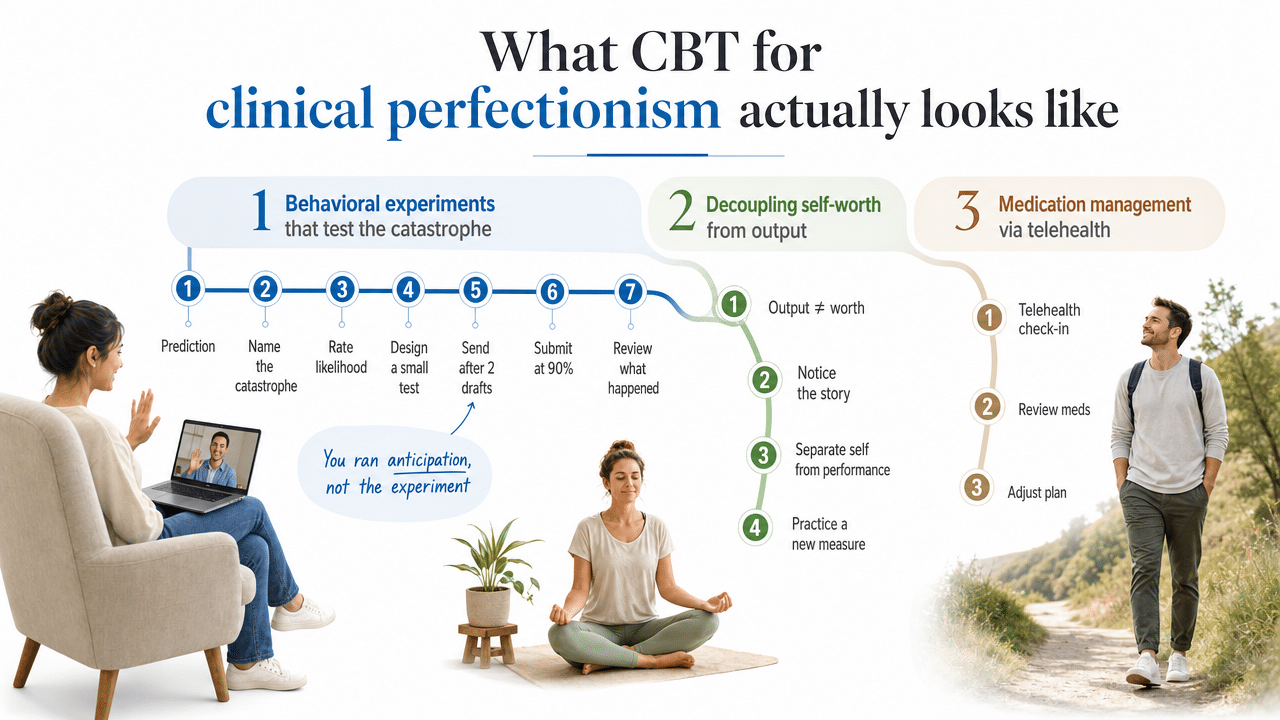
Cognitive-behavioral therapy for clinical perfectionism does not start with a worksheet about self-talk. It starts with a hypothesis and a test. Your brain has been running the same prediction for years: if you send the email without a twelfth pass, something bad happens. If you leave the deck at 90%, the client notices, your reputation slips, and the story about who you are quietly rearranges itself. The problem is you have never actually run the experiment. You have only run the anticipation.
Behavioral experiments make the prediction testable. Your therapist helps you name the exact catastrophe you are trying to prevent, rate how likely you think it is, and then design a small, real-world test. Send the email after two drafts instead of eleven. Submit the memo with one sentence you find slightly awkward. Leave a meeting without the follow-up recap.
Then you collect the data. What actually happened? Not what your 11 PM brain said would happen. The CBT framework for clinical perfectionism uses these experiments deliberately to loosen the rules you have been treating as physics 9. Over weeks, the gap between predicted disaster and actual outcome becomes evidence your nervous system can no longer ignore.
Decoupling self-worth from output
The behavioral experiments handle the rules. The harder work sits underneath them: the wiring that says your value as a person rises and falls with your last deliverable. Clinical perfectionism is defined precisely by that overdependence of self-evaluation on achievement 9, so treatment has to widen the base your self-worth stands on.
In session, this looks like mapping where your identity currently lives. Most professionals discover the pie chart is embarrassing. Ninety percent work, a sliver for relationships, a crumb for anything else. Your therapist works with you to rebuild domains that have gone quiet: friendships you stopped tending, a hobby you were once bad at on purpose, a version of rest that does not double as prep.
Cognitive restructuring targets the self-criticism itself, which the research names as one of the strongest predictors of depressive symptoms even after other personality factors are controlled 4. You learn to hear the internal voice as a voice, not a verdict.
Medication management and telehealth for a 50-hour week
Therapy is not the only lever, and your schedule is not a reason to skip care. If perfectionism has been feeding an anxiety or depressive disorder for years, medication management can quiet the physiological volume enough for the CBT work to land. A psychiatrist who understands high-performing professionals will not push medication as a fix for standards. They will use it, when appropriate, to treat the anxiety or depression that has grown up around them.
Telehealth is where the calendar math finally works. A 45-minute session between a 2 PM meeting and a 4 PM call, from your home office, without the commute, without the elevator small talk with a colleague you did not want to bump into. Sessions can hold at lunch, at 7 AM, at 8 PM. Integrated outpatient care that pairs a therapist working the CBT protocol with a prescriber who knows your case treats the pattern, not just the latest label.
Small wins that count as progress
Progress in this work does not look like a suddenly quiet mind. It looks like small, specific moments that would sound absurd if you described them to someone who doesn’t share the wiring.
- You send the email after two drafts.
- You leave a typo in a Slack message and don’t go back to edit it.
- You submit the deck at 4:57 PM instead of holding it until 5:14 for one more pass.
- You skip a workout when you’re sick, and the day does not fall apart.
- You tell a colleague you don’t know the answer, in a meeting, out loud.
None of these will feel like victories in the moment. Your nervous system will register them as mild threats and log them as evidence that something is slipping. That is the pattern doing what patterns do. Notice it. Do not argue with it.
What counts is that you ran the experiment and gathered the data. That is the same mechanism CBT uses to loosen the rules you have been treating as physics 9. Every unrevised email is one data point against a prediction your brain has been making for years.
Start addressing perfectionism with real support today
Connect with a professional who understands how perfectionism impacts your daily life and work.
Frequently Asked Questions
How do I know if my high standards have crossed into clinical perfectionism?
The tell is not the standard itself. It is what happens to your self-worth when you fall short. Clinical perfectionism is defined as the overdependence of self-evaluation on hitting personally demanding standards 9. If a missed detail feels like evidence about who you are as a person, not information about a document, you are likely in that territory.
Is there really such a thing as ‘healthy’ perfectionism?
The old “adaptive vs. maladaptive” split is under pressure. A meta-analysis found that even perfectionistic strivings show associations with suicidal ideation, which “draws into question the notion that such strivings are healthy, adaptive, or advisable” 3. Strivings and self-criticism rarely live apart in real people, so treat any striving that comes with harsh internal punishment as worth attention.
Can perfectionism cause anxiety and depression, or does it just come with them?
Both, based on current evidence. A clinical review treats perfectionism as a risk and maintaining factor for depression and anxiety disorders, meaning it helps set the stage and keeps symptoms going once they arrive 12. Self-criticism, in particular, is among the strongest predictors of depressive symptoms even after other personality variables are accounted for. It is not just a bystander.
Will treating my perfectionism make me less successful at work?
No. Treatment does not lower your standards. It changes what your self-worth is stapled to. The traits underneath your career—conscientiousness, follow-through, care about quality—stay intact. What loosens is the punishment cycle when something slips. Most professionals find they produce similar or better work with less recovery cost, because the eleventh draft was rarely adding value your colleagues could see.
What does CBT for perfectionism actually involve, and how long does it take?
CBT for clinical perfectionism uses behavioral experiments, cognitive restructuring, and work to reduce over-dependence on achievement for self-worth 9. You test predictions in real settings—sending an email after two drafts, leaving a small imperfection—and gather data on what actually happens. Protocols typically run 8 to 12 sessions, though timelines vary based on how long the pattern has been active.
Is telehealth therapy effective if I can’t fit weekly in-person sessions into my schedule?
Yes. Telehealth removes the two obstacles that stop most professionals from starting: commute time and the calendar Tetris of a lunch-hour appointment. Sessions can hold at 7 AM, at lunch, or after your last meeting. Integrated outpatient care that pairs a CBT-trained therapist with a psychiatric prescriber, delivered virtually, treats the underlying pattern without requiring you to rearrange your work life around it.
References
- The need to focus on perfectionism in suicide assessment, treatment, and prevention. https://pmc.ncbi.nlm.nih.gov/articles/PMC10785971/
- Perfectionism in Adolescence: Associations With Gender, Age, and Mental Health. https://www.ncbi.nlm.nih.gov/pmc/articles/PMC8424040/
- A meta-analytic review of the perfectionism–suicide relationship. https://pubmed.ncbi.nlm.nih.gov/28734118/
- Perfectionism and psychopathology: A review of research and treatment. https://pubmed.ncbi.nlm.nih.gov/25894443/
- Perfectionism and eating disorders: A review of research and treatment. https://pubmed.ncbi.nlm.nih.gov/18377125/
- Perfectionism and burnout in nurses: The mediating effect of work–family conflict. https://pubmed.ncbi.nlm.nih.gov/27505219/
- Perfectionism and social anxiety: A meta-analysis. https://pubmed.ncbi.nlm.nih.gov/30894494/
- Perfectionism and psychopathology in children and adolescents: A developmental perspective. https://www.ncbi.nlm.nih.gov/pmc/articles/PMC4213986/
- Clinical perfectionism: A cognitive–behavioural approach to assessment and treatment. https://www.ncbi.nlm.nih.gov/pmc/articles/PMC5652866/
- Academic Perfectionism, Psychological Well-Being, and Suicidal Behavior in University Students. https://pmc.ncbi.nlm.nih.gov/articles/PMC9819691/
- Mediating Mechanisms of Perfectionism: Clinical Comorbidity and Psychopathology. https://pmc.ncbi.nlm.nih.gov/articles/PMC9329670/
- Perfectionism as a transdiagnostic process: a clinical review. https://pubmed.ncbi.nlm.nih.gov/20488598/
- Perfectionism’s Influence on Adolescent Mental Health. https://scholarsarchive.byu.edu/cgi/viewcontent.cgi?article=5424&context=byusq