

Key Takeaways
- Standard outpatient alcohol care typically runs one to three hours weekly, combining telehealth counseling, prescriber check-ins, and optional mutual-support meetings that fit around a working professional’s calendar 1, 10.
- Care intensity should match severity and withdrawal risk, not preference — daily heavy drinking, physical withdrawal, prior relapses, or active crisis signal a need for IOP, partial hospitalization, or supervised detox first 9.
- Three FDA-approved medications — naltrexone, acamprosate, and disulfiram — pair with counseling as a whole-patient approach, are not controlled substances, and do not appear on standard employer drug panels 3, 12.
- Integrated care treats alcohol use alongside co-occurring anxiety, depression, or trauma under one plan, following SAMHSA’s no-wrong-door screening standard so nothing gets handed off between disconnected providers 4, 5.
What a Treatment Week Actually Looks Like When You’re Still Working
Picture a normal Tuesday. You log in at 7:15 a.m. for a 30-minute video visit with a prescriber before your first meeting at 9. On Thursday evening, after the laptop is closed, you sit on the couch for a 50-minute counseling session with a therapist who already knows your full history — the drinking, yes, but also the anxiety that shows up at 3 a.m. and the way you’ve been sleeping. Maybe on Sunday night, you join an online mutual-support meeting from your kitchen because Mondays have always been the hardest.
That is outpatient alcohol treatment in 2025. Not a parking lot at a treatment center. Not a leave of absence. A clinical plan that lives inside the calendar you already have.
The National Institute on Alcohol Abuse and Alcoholism has been clear that telehealth, self-guided tools, and mutual support can be combined into a flexible plan, and that providers have been delivering remote alcohol care for years now — not just since the pandemic 1. Federal telehealth policy has caught up too: behavioral health visits from home are durable coverage, not a temporary workaround 10.
You may have been told outpatient care means church-basement folding chairs or a six-week disappearance from your job. It does not have to. The rest of this guide walks through what each piece — the visits, the medications, the counseling, the integrated mental health care — actually looks like when you still have a 9-to-5, a team that depends on you, and a private life you intend to keep private.
Outpatient, Defined Without the Brochure Language
The Three Intensities You’ll Hear Named
When you start reading about outpatient alcohol care, you’ll see three labels thrown around. They sound clinical, but the differences come down to one thing: how many hours a week you spend in treatment.
Standard outpatient is what most working professionals actually use. One counseling session a week, usually 50 minutes. A check-in with a prescriber every two to four weeks if medication is part of the plan. Maybe a mutual-support meeting on your own time. Total clinical contact: one to three hours a week. It fits inside lunch breaks, before work, or after the kids are in bed.
Intensive outpatient, often shortened to IOP, is a step up. Nine to twelve hours a week, typically delivered as three group sessions plus an individual session. Many IOPs run evening tracks specifically because their patients work. You keep your job, your home, and your routines, but treatment is no longer something you slot in around the edges of your week.
Partial hospitalization is the most intensive form that still lets you sleep in your own bed. Twenty or more hours a week, often a full workday of programming, five days a week, for a few weeks. This is usually a short-term bridge, not a long-term plan.
NIAAA describes treatment as something that “can be outpatient and/or inpatient” and is matched to severity rather than chosen by preference 2. The NCBI clinical review on alcohol use disorder says the same in plainer terms: care intensity gets matched to severity and withdrawal risk 9. You don’t pick the level. A clinician helps you pick it.
Where Telehealth Actually Fits (And Where It Doesn’t)
Telehealth is not a lesser version of outpatient care. For a lot of what happens in standard outpatient treatment, it is the same care, delivered over video. NIAAA notes that “many healthcare professionals and programs have offered telehealth alcohol treatment for years” — well before the pandemic forced the rest of the system to catch up 1. HHS confirms that behavioral health visits delivered to a patient’s home are durable coverage now, not a temporary policy 10.
Here is what that looks like inside a normal week. A 50-minute individual counseling session lands on Thursday at 6 p.m., from your couch. A 20-minute prescriber check-in for medication management slots into a Wednesday morning at 7:30, before your first meeting. An optional mutual-support meeting runs online on Sunday night. Three touchpoints, none of them require a commute, none of them require a manager’s approval, none of them appear on a shared work calendar 1, 10.
Telehealth handles individual therapy, group sessions, prescriber visits, and check-ins well 7. A study of Medicare beneficiaries with opioid use disorder — a different population and a different substance, worth saying plainly — found telehealth was associated with better retention in medication treatment and lower odds of overdose, which suggests remote substance use care can hold people in treatment rather than push them out 8.
What telehealth doesn’t cover: medically supervised withdrawal if you’re drinking heavily every day, certain in-person assessments, lab draws, and an injectable medication that has to be administered by a clinician. Most professionals don’t need any of that. The ones who do usually know it.
Treating Alcohol and the Anxiety or Depression Underneath It as One Picture
Why Integrated Care Is the Default, Not the Upgrade
Here is something worth saying out loud: most people who drink heavily are not just drinking. They’re also managing anxiety that won’t sit still, a depression that flattens weekends, sleep that broke years ago, or a piece of trauma they’ve never put down. The drinking is often the part that became visible first — to you, to a partner, maybe to a doctor — because it’s the part with the wine glass and the receipts.
For a long time, the treatment system handled this as two separate problems. You’d see one provider for the drinking and a different one for the anxiety, and the two would never talk. SAMHSA has spent years pushing the field past that, with what they call a “no wrong door” standard: anyone showing up for mental health care should be screened for substance use, and anyone showing up for substance use care should be screened for mental health conditions 4. NIMH puts the rationale plainly — integrated care “combines mental health and substance use treatment so patients can receive more convenient, coordinated care in one place” 5.
For a working professional, that convenience is not a luxury. It’s the difference between two prescribers, two intake packets, two co-pays, and two video links — or one team that already knows your full picture. SAMHSA notes that co-occurring disorders can include any combination of two or more substance use and mental health conditions, which is another way of saying your situation is not unusual and does not need to be sorted into the right bucket before someone helps 11.
What Gets Screened, and What That Conversation Sounds Like
A first appointment is mostly questions. Not the interrogating kind — the kind that’s trying to see the whole shape of what’s happening. How much are you drinking, on which days, and what does a heavy day look like? When did the anxiety start showing up, and is it worse before you drink or after? Are you sleeping? Have you ever had a panic attack, a depressive stretch, a period after a loss or an event that you never quite came back from?
Standardized screeners run quietly underneath that conversation — short questionnaires for alcohol use, depression, anxiety, and trauma exposure. The point isn’t to label you. It’s to make sure nothing gets missed, which is exactly what SAMHSA’s screening-in-both-directions standard is designed to catch 4.
If something co-occurring shows up, the plan changes in concrete ways. The same prescriber who manages a medication for alcohol use disorder can also manage an SSRI or a non-addictive sleep approach. Your counselor uses one treatment plan that names both targets, not two plans pretending the other doesn’t exist 5. You tell your story once.
Medications That Fit Around a Workday
Most people are surprised to learn there are FDA-approved medications for alcohol use disorder. Three of them, actually, and none of them are sedatives, none of them are habit-forming, and none of them require you to take a leave of absence to start. SAMHSA frames medication plus counseling as a “whole-patient” approach to substance use disorders, and that is exactly how a good outpatient prescriber will talk about it with you 3.
Naltrexone, taken as a daily pill. One tablet, usually in the morning. It blunts the reward you get from drinking, which is what makes the second and third drinks feel less interesting. You swallow it with coffee. Nobody at work sees anything different 3.
Naltrexone, as a monthly injection. Same molecule, given as an extended-release shot in a clinician’s office once every four weeks. SAMHSA notes this intramuscular form is approved for alcohol use disorder and opioid use disorder 3. For professionals with a calendar that already includes a monthly haircut, this is the easiest cadence in medicine. One appointment a month. No daily decision.
Acamprosate, three times a day. A non-addictive medication that helps quiet the restless, irritable, sleep-disrupted feeling that often shows up in the first months of not drinking. Three doses sounds like a lot until you realize they pair fine with breakfast, lunch, and dinner.
Disulfiram, taken daily. The oldest of the four. It causes a strong physical reaction if you drink while on it, which makes it less a craving medication and more a commitment device. Some people want exactly that. Others don’t. A prescriber will tell you honestly which category you’re probably in.
NIAAA’s clinician resource lists these alongside behavioral treatment and mutual support as the three pillars of evidence-based AUD care — meaning medication isn’t the alternative to therapy, it’s the partner 12. A telehealth prescriber can start most of these after a video visit, send the prescription to your pharmacy, and follow up in two weeks. The injection is the one exception that requires a brief in-person visit each month.
You do not have to take medication to do outpatient treatment. Many people don’t. But if the cravings are loud, or the first two weeks of not drinking have been brutal in the past, this is the part of the plan most professionals tell their prescriber, later, that they wish they’d known about sooner.
The Counseling Side: What Actually Happens in the 50 Minutes
If you’ve never been in therapy for drinking, the image in your head is probably wrong. Nobody asks you to identify yourself a certain way. You don’t read a script. You sit on your couch, or in a quiet office, and you talk to one person for 50 minutes about what your actual week looked like.
Most of the early sessions are about patterns. When do you drink? Not the easy answer — the real one. Is it the 6 p.m. release valve after a hard call, the Sunday-night dread, the airport bar on travel days, the bottle of wine that quietly became two? A counselor trained in alcohol use disorder is listening for the function the drinking is serving, because that’s what the work eventually targets.
The methods have names you may have heard. Cognitive behavioral therapy helps you notice the thought that arrives right before the pour and gives you something to do with it. Motivational interviewing is a conversational style that doesn’t push you; it draws out your own reasons for change, which tend to be more durable than anyone else’s. NIAAA lists behavioral treatments alongside medications and mutual support as the three pillars of evidence-based AUD care — meaning the counseling is not the soft accompaniment to the real treatment, it is part of the real treatment 12.
Sessions are usually weekly at the start, then every other week as things stabilize. Delivered by video, they look the same as in-person; HHS confirms individual therapy is a well-established telehealth service 7. If anxiety, depression, or trauma showed up in your screening, the same counselor often works both threads in the same hour rather than splitting them across two providers 5. You leave with one or two concrete things to try before next week. That’s the rhythm.
What Professionals Are Really Afraid Of: HR, Licensure, and Identity
Confidentiality, Records, and Your Employer
The fear you don’t say out loud at 2 a.m. is usually the same one: someone at work finds out. A manager. HR. A peer who used to be a friend. The career you built becomes the career you have to explain.
You also don’t have to file FMLA, request leave, or tell anyone you’re in treatment to start. A weekly counseling session by video, a prescriber check-in before work, an evening mutual-support meeting — none of that requires disclosure to your employer 1. SAMHSA’s helpline is confidential and available 24/7, including outside work hours, if you want a private first conversation before you book anything in your name 6.
The conversations you have with a counselor are between you and that counselor. That isn’t a marketing line. It’s how the system is built.
Licensed Roles, Drug Testing, and the Performance Story
If you hold a license — medical, legal, financial, real estate, commercial driver, anything regulated — the question underneath the question is whether getting help triggers a report. In most cases, voluntarily starting outpatient treatment, before a complaint or an incident, is not a reportable event. The reportable events are usually the things that happen when treatment is avoided: a DUI, an impaired-on-the-job moment, a missed deadline that turns into a board complaint. A licensure attorney in your state can give you the specific answer in 20 minutes, and many do that consultation confidentially by phone.
Drug testing is its own worry. Standard employer panels test for substances, not for prescribed medications used to treat alcohol use disorder. Naltrexone, acamprosate, and disulfiram are not controlled substances and do not show up as anything on a routine screen 3.
About the performance story you’ve been telling yourself: the version where treatment is the thing that costs you the career. Look at what untreated heavy drinking is already costing — the Monday fog, the meetings you half-remember, the sleep you’ve stopped getting. Treatment is what protects the work, not what threatens it.
When Outpatient Isn’t Enough — And How to Tell
This is the section your gut may have been waiting for. Because somewhere underneath the question of which outpatient program to pick is a quieter question: is outpatient even the right starting point for me, or am I picking it because it’s the least disruptive? Honest answer — sometimes those are the same thing, and sometimes they aren’t.
The NCBI clinical review on alcohol use disorder is direct: care intensity gets matched to severity and withdrawal risk, not preference 9. There are a few signals that suggest outpatient telehealth and weekly counseling probably won’t be enough on their own, at least not at the start.
Daily heavy drinking with physical withdrawal. If you’ve tried to stop for 24 to 48 hours and felt shaking hands, sweating, racing heart, nausea, or — at the serious end — seizures or hallucinations, that’s a medical situation. Withdrawal from heavy daily alcohol use can be dangerous and sometimes requires medically supervised detox before outpatient care begins 9.
Previous outpatient attempts that didn’t hold. Not as a verdict on you, as data. If you’ve done weekly counseling before and the drinking came back within weeks, a step up to intensive outpatient or partial hospitalization gives you more structure during the hardest stretch.
An unsafe home environment. A partner who drinks, a stocked bar cart, a stressor you can’t currently leave. The plan has to account for the room you’re actually in.
Active suicidal thoughts or a recent crisis. This changes the level of care immediately, and the right next call is to a crisis line or your prescriber, not a scheduling page. SAMHSA’s helpline is available 24/7 if you need a confidential starting point 6.
None of these mean outpatient is off the table forever. They mean the first two to four weeks may need to look different — a brief detox stay, an IOP track, or a partial hospitalization bridge — before standard outpatient becomes the right fit. A good assessment at intake will tell you this honestly. If a clinician says “let’s start with something more intensive and step you down,” that isn’t a sales pitch. That’s care intensity matched to severity, which is exactly what the evidence says should happen 9.
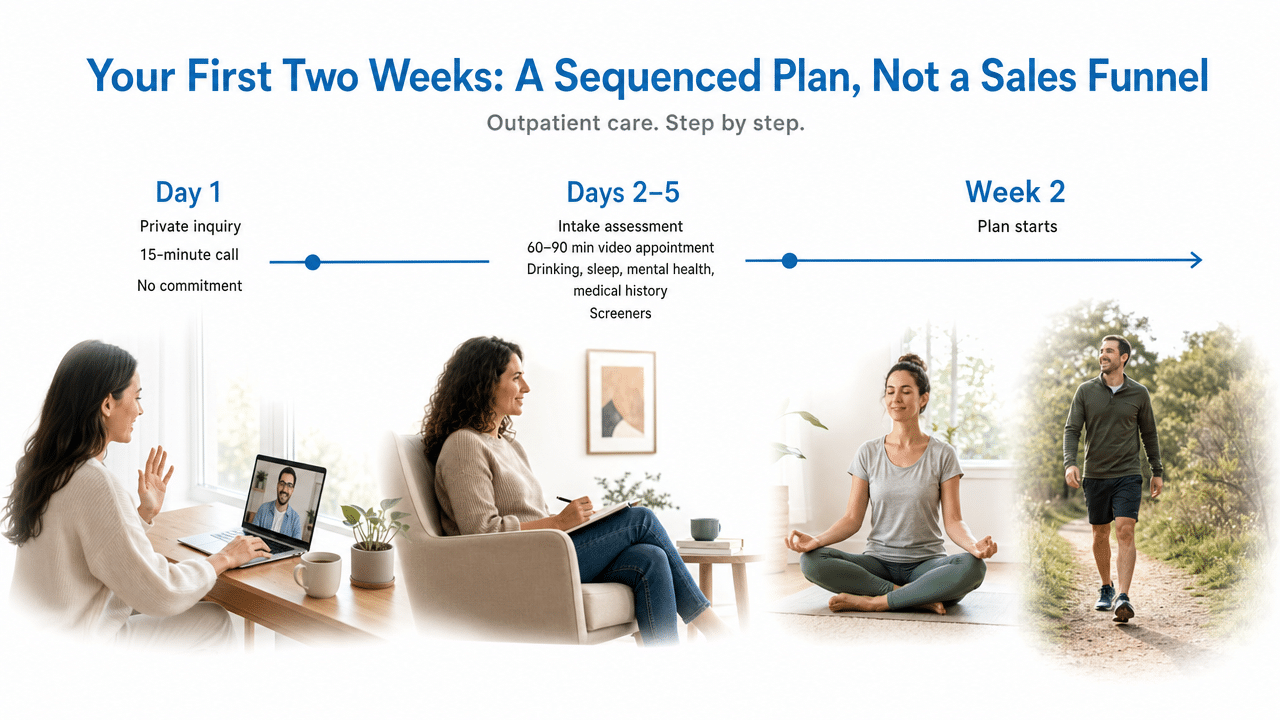
Your First Two Weeks: A Sequenced Plan, Not a Sales Funnel
You don’t have to commit to a program to start. You have to commit to one phone call, one form, or one assessment. Here is what a calm first two weeks can actually look like when you decide you’re ready.
Day 1 — a private inquiry. Sometime outside work hours, you reach out to a provider that offers outpatient and telehealth alcohol care, or you call SAMHSA’s confidential 24/7 helpline if you want to talk to a person before you put your name on anything 6. That conversation takes 15 minutes. Nobody asks you to commit to anything.
Days 2 to 5 — the intake assessment. A 60- to 90-minute video appointment with a clinician. They ask about your drinking, your sleep, your mental health, and your medical history. They run the screeners that catch what you didn’t think to mention. At the end, they tell you honestly which level of care matches your situation — standard outpatient, IOP, or something more intensive first — based on severity and withdrawal risk, not preference 9.
Week 2 — the plan starts. If standard outpatient is the right fit, you book a recurring weekly counseling session, usually evenings or early mornings 1. If medication is part of the plan, a prescriber starts you on it after a separate visit, often the same week 3. If anxiety, depression, or trauma showed up in the screening, those get folded into the same treatment plan rather than handed off to a stranger 5.
That is the whole first two weeks. One inquiry, one assessment, one or two appointments on the books. No leave of absence. No conversation with HR. No 30-day disappearance. Just the quiet beginning of care that finally fits inside the life you’ve been protecting.
Schedule support that works with your schedule
Get confidential, flexible care for alcohol use without stepping away from your career.
Frequently Asked Questions
Can I do outpatient alcohol treatment entirely by telehealth, or do I have to go in person?
For most people in standard outpatient care, yes — counseling, prescriber check-ins, and group sessions can run by video, and behavioral health telehealth in the home is now durable federal policy, not a temporary rule 1, 10. The exceptions are a monthly extended-release naltrexone injection, certain lab draws, and medically supervised withdrawal if you’re drinking heavily every day 9. An intake assessment will tell you which pieces, if any, need to be in person.
Will my employer or HR find out if I start outpatient treatment?
No, not from your provider. Outpatient mental health and alcohol care is medical care, protected by the same privacy rules as any other doctor visit. Your insurer processes a claim for a medical service, but clinical notes don’t go to your employer. You don’t need to file FMLA or request leave to start a weekly counseling session or a prescriber visit outside work hours 1. SAMHSA’s confidential 24/7 helpline is another private starting point 6.
Do I have to take medication, and which ones are actually used for alcohol use disorder?
No, medication is optional. Many people do outpatient treatment with counseling and mutual support alone. If you choose it, there are three FDA-approved options: naltrexone (a daily pill or a monthly injection), acamprosate (taken three times a day), and disulfiram (a daily pill that causes a reaction if you drink). None are controlled or habit-forming. SAMHSA frames medication plus counseling as a whole-patient approach, not an either/or 3, 12.
What if I also have anxiety, depression, or sleep problems alongside the drinking?
That’s common, and integrated care is the standard. SAMHSA uses a “no wrong door” rule — anyone presenting for alcohol care gets screened for mental health concerns, and vice versa 4. NIMH describes integrated care as combining mental health and substance use treatment in one place so you get more convenient, coordinated care 5. In practice, one prescriber and one counselor work both threads on a single treatment plan rather than handing you between two systems 11.
How do I know if outpatient is enough or if I need a higher level of care?
A clinical assessment matches care intensity to severity and withdrawal risk, not preference 9. Signs you may need a step up first: shaking, sweating, racing heart, or seizures when you stop drinking for a day or two; previous outpatient attempts that didn’t hold; an unsafe home environment; or active suicidal thoughts. A brief detox stay, intensive outpatient, or partial hospitalization can serve as a bridge before standard outpatient becomes the right fit 9.
What is the lowest-friction way to start without committing to a full program?
One private inquiry outside work hours. That can be a 15-minute call to SAMHSA’s confidential 24/7 helpline if you want to talk to a person before putting your name anywhere 6, or an inquiry to an outpatient provider that offers telehealth alcohol care. The next step is usually a 60- to 90-minute video assessment that tells you honestly which level of care matches your situation 1. No commitment until then.
References
- Telehealth Options for Alcohol Treatment. https://www.niaaa.nih.gov/publications/telehealth-options-alcohol-treatment
- Understanding Alcohol Use Disorder. https://www.niaaa.nih.gov/publications/brochures-and-fact-sheets/understanding-alcohol-use-disorder
- Treatment Options for Substance Use Disorder. https://www.samhsa.gov/substance-use/treatment/options
- Managing Life with Co-Occurring Disorders. https://www.samhsa.gov/mental-health/serious-mental-illness/co-occurring-disorders
- Finding Help for Co-Occurring Substance Use and Mental Disorders. https://www.nimh.nih.gov/health/topics/substance-use-and-mental-health
- National Helpline for Mental Health, Drug, Alcohol Issues. https://www.samhsa.gov/find-help/helplines/national-helpline
- Telehealth Research Recap: Behavioral Health. https://telehealth.hhs.gov/documents/ResearchRecap-Telehealth_and_Behavioral_Health_09-30-24.pdf
- Receipt of Telehealth Services, Receipt and Retention of Medications for Opioid Use Disorder, and Risk of Overdose. https://pubmed.ncbi.nlm.nih.gov/36044198/
- Treatment of Alcohol Use Disorder – NCBI Bookshelf. https://www.ncbi.nlm.nih.gov/books/NBK561234/
- Telehealth policy updates. https://telehealth.hhs.gov/providers/telehealth-policy/telehealth-policy-updates
- Co-Occurring Disorders and Other Health Conditions. https://www.samhsa.gov/substance-use/treatment/co-occurring-disorders
- Recommend Evidence-Based Treatment: Know the Options. https://www.niaaa.nih.gov/health-professionals-communities/core-resource-on-alcohol/recommend-evidence-based-treatment-know-options