

Key Takeaways
- The U.S. male suicide rate has stayed flat at 22.7 per 100,000 since 2018, showing that awareness campaigns alone aren’t shifting the number 3.
- Men aren’t refusing to talk — they’re hitting design failures like cost, wait times, and broken referrals, with 80% of at-risk men already seeing a general practitioner without reaching mental health care 11.
- Perceived need, not actual severity, drives whether a man seeks help; waiting until it feels bad enough is the same threshold that keeps 42% of men home 11.
- Low-friction first appointments — one intake covering counseling and medication, same-week openings, telehealth — outperform male-branded prevention programs, which show no significant effect on attempts or ideation in randomized trials 9.
The number that hasn’t moved
Here is the part nobody wants to sit with: in 2023, the male suicide rate in the United States was 22.7 per 100,000, and it hadn’t meaningfully budged since 2018 3. Five years of awareness ribbons, hashtags, and locker room posters. Five years of the same number.
Globally, more than 720,000 people die by suicide each year, and suicide is the third leading cause of death among people ages 15 to 29 1. Men make up a disproportionate share of those deaths. You probably already knew that in the abstract. What may be new is the flatness of the American line — the way the rate refuses to respond to being talked about.
That flatness matters, because it tells you something specific. If awareness alone were the fix, the number would have moved. It hasn’t. Which means the problem isn’t really that men haven’t heard the message. The problem is what happens — or doesn’t happen — after they hear it.
This piece is written for the man staring at his phone at 11 p.m. wondering if what he’s feeling counts as a real thing. It’s also written for the partner, sister, or coworker who noticed him going quiet and doesn’t know what to do next. The goal here isn’t to convince you something is wrong. If you’re reading, you already suspect. The goal is to show you what the actual next step looks like — and why, for a lot of men, the current on-ramp to care is the thing that’s broken, not them.
What this actually feels like from the inside
It rarely announces itself as depression. That’s the trap.
It’s more likely to show up as a fuse that used to be longer. Traffic that didn’t used to bother you. The way your jaw sets when your kid asks the same question twice. Sleep that starts fine and then gives up at 3:47 a.m. — same time, most nights, staring at a ceiling you can’t quite make out. A second drink that became a third somewhere in the last few months, and you’re not sure exactly when.
Underneath all of that, there’s usually a quieter thing. A low, steady sense that you are becoming a problem for the people who count on you. Not in a dramatic way. Just a slow arithmetic: they’d be less tired without me. Less worried. Less broke. That specific thought — feeling like a burden — is one that federal clinicians specifically watch for 4, 5. It doesn’t feel like a warning sign from the inside. It feels like being honest.
You might also notice you’ve started taking small, stupid risks. Driving faster than you need to. Picking a fight you don’t actually want. Skipping the follow-up appointment. Researchers list recklessness and rising substance use in the same breath as hopelessness for a reason — they tend to travel together 5.
None of this makes you broken. It makes you a person carrying something without a good place to set it down. The point of naming it plainly is not to alarm you. It’s so you can stop wondering whether what you’re feeling counts. It counts.
The story we keep telling is wrong
It’s not that men won’t talk
The dominant story goes like this: men die by suicide because they refuse to open up. Fix the talking, fix the number. It’s a tidy narrative. It’s also mostly wrong.
When researchers actually ask men who’ve been suicidal what stopped them from getting help, the answers are more concrete than “I couldn’t share my feelings.” They name:
- Cost.
- Waiting times.
- Not trusting that a stranger with a clipboard will actually help.
- The worry that being labeled a patient will change how their boss, spouse, or kids see them 12.
In another study, the barriers men endorsed most often were straightforward and logistical: not knowing what to look for in a therapist, not knowing whether therapy even works, and a strong sense that they should be able to solve their own problems first 16.
Read that list again. Only one item on it is about emotional expression. The rest is a design problem.
So if you’ve been quietly told — or told yourself — that the reason men aren’t getting help is some kind of collective silence, you’re being sold a story that lets the system off the hook. Men aren’t refusing to speak. Many are just being asked to speak in a room that costs $180 a visit, has a six-week wait, and requires them to first announce that they are broken.
Self-reliance isn’t the enemy — it’s the frame
There’s a real pattern in the research. Men who score higher on traditional masculine norms — self-reliance, emotional control, toughness — are less likely to seek help and less likely to stay in care when they do 14, 15. That’s been shown across dozens of studies. It’s not a moral failing. It’s a statistical tendency.
But here’s where most articles about this go sideways. They treat self-reliance as the villain. Something to be dismantled before you’re allowed to get help. Which lands, if you’re the man reading this, like being told the way you’ve survived the last twenty years is the actual problem.
That’s not accurate, and it’s not useful.
Self-reliance is a tool. Like any tool, it works for some jobs and not others. It’s excellent for finishing a project at 1 a.m., holding a family together through a rough year, or getting yourself through a deployment. It is a bad tool for diagnosing what’s happening in your own head at 3 a.m. when your sleep is shot and your fuse is gone. You wouldn’t rewire your own house without a meter. This is the same category of problem.
Men in qualitative studies describe the shift this way: they didn’t stop being self-reliant when they got help. They just widened what self-reliance meant 18. Getting a consult became part of managing the situation, not surrendering it. That reframe — help as maintenance, not defeat — is the one that actually seems to fit how a lot of men already think.
The handoff that keeps breaking
They just didn’t end up in the room where the actual conversation could happen.
That is not a story about men who won’t ask for help. That is a story about a handoff that keeps breaking. The contact point exists. The referral to counseling or psychiatry — the part where somebody says, “Let’s book you with someone this week, here is who, here is the link” — is the piece that doesn’t complete. Sometimes it’s a business card slid across a desk. Sometimes it’s a phone number that goes to voicemail. Sometimes it’s a network directory with a six-week wait and no one taking new patients.
So the guy goes home. The prescription gets filled or it doesn’t. The follow-up gets scheduled or it doesn’t. And a week later he’s back to sleeping four hours a night, telling himself he already tried.
If you’ve been that guy, you weren’t failing. You were doing the thing you were supposed to do. The system just didn’t catch the pass.
The fix isn’t more courage on your end. It’s shortening the distance between deciding to get help and actually being on the phone with a person who can help. That means:
- A scheduling page you can use without calling anyone.
- Same-week openings, not same-quarter.
- Psychiatry and counseling under one roof so you’re not being handed a second phone number after the first one didn’t work.
- Insurance sorted before the first appointment, not after.
These sound like small design choices. They are the difference between the 80% and the men who actually stay in care.

Why perceived need, not actual need, decides whether he calls
Here’s the strange part about how men decide whether to get help: it’s rarely about how bad things actually are. It’s about whether they’ve decided the situation qualifies.
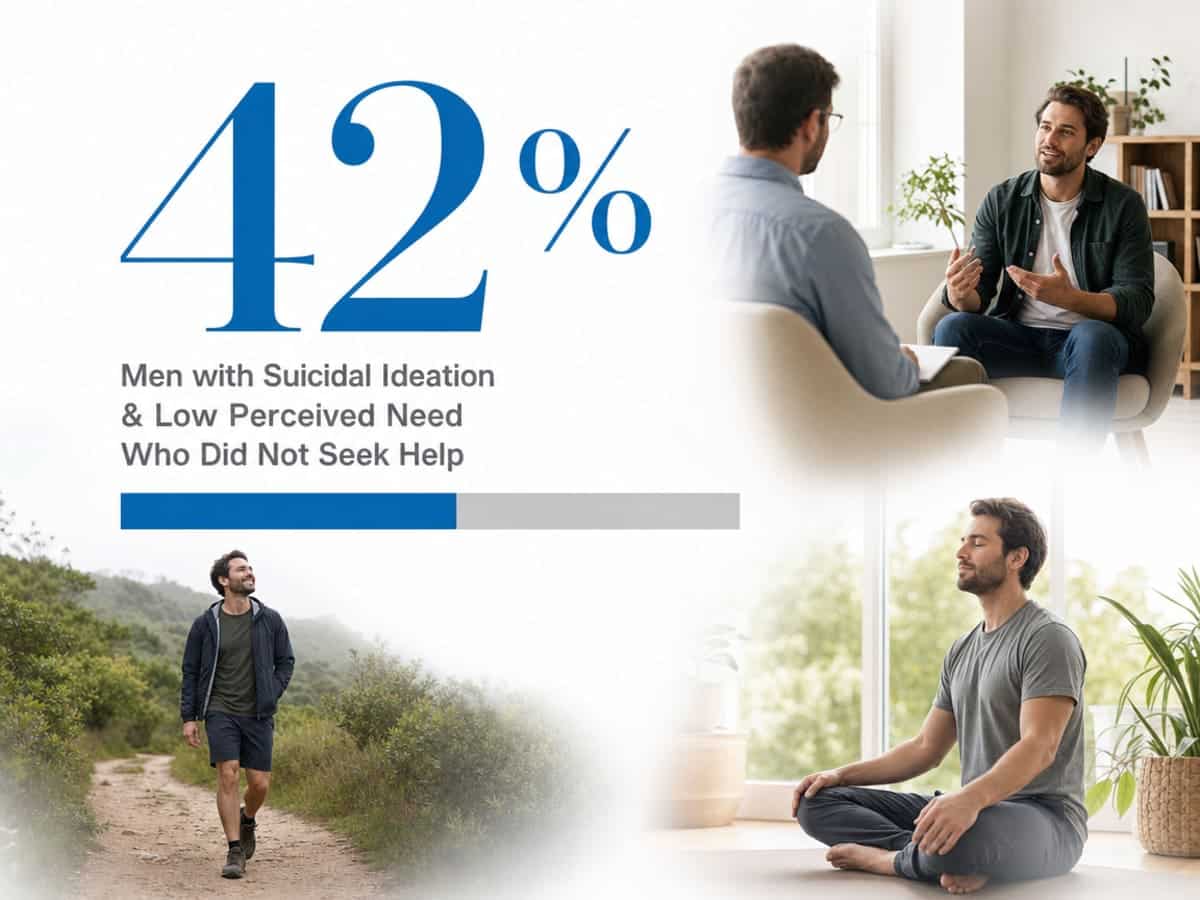
In one study of men with past-year suicidal ideation, 42% of those with lower perceived need for help sought no support at all 11. They were having the thoughts. They just hadn’t filed the thoughts under “thing that requires help.” They’d filed them under bad week, work stress, sleep issues, need to cut back on drinking, will feel better after the quarter closes. The threshold for what counts as a real problem kept moving.
You may recognize this. The internal negotiation goes something like: other guys have it worse, I’m still functioning, I made it to the meeting, the kids are fine, I’ll deal with it after the holidays. Every one of those sentences is true. None of them are the point. The point is that you can be genuinely functioning on the outside and quietly running out of road on the inside, and the gap between those two things is exactly where perceived need lives.
What that means practically: waiting until it feels bad enough is not a reliable plan. The threshold you’re using to decide is the same threshold that kept the 42% home. If sleep is off, if the fuse is short, if a second drink became a fourth, if the thoughts are showing up — that’s already the signal. You don’t need it to get worse to earn the appointment. Making the call at “something’s off” is not jumping the line. It’s the whole point of the line existing.
What to watch for when he won’t say it out loud
Most men who are quietly in trouble don’t announce it. They also don’t hide it as carefully as they think. If you love one, the signs are usually there — you just have to know the shape they take.
They’re rarely dramatic. They look like a guy who used to text back and now doesn’t. Someone who started drinking a little more, then a little more than that, and stopped mentioning it. A brother who’s driving faster, taking corners he wouldn’t have taken a year ago. A husband who used to complain about work and has gone quiet — not calm, quiet. A father who keeps saying things like the family would be fine without him, dressed up as a joke.
The federal warning signs for adult suicide risk are worth knowing by name, because they cut through the guesswork. CDC and SAMHSA both point to the same cluster 4, 5:
- Talking about wanting to die or feeling hopeless
- Feeling trapped or in unbearable pain
- Saying they’re a burden
- Increasing alcohol or drug use
- Recklessness
- Withdrawing and isolating
- Unusual rage or mood swings
Any one of those, on its own, might mean a rough month. Two or three showing up together, in someone who used to be steadier — that’s the pattern.
What you’re looking for is a change from his baseline. Not whether he matches some checklist of a depressed person. The steady guy who’s suddenly picking fights. The social one who canceled the last four things. The dependable one who forgot the dentist appointment, then the anniversary, then stopped apologizing for either. Change is the signal. Content is secondary.
You don’t need to be certain before you say something. You just need to have noticed.
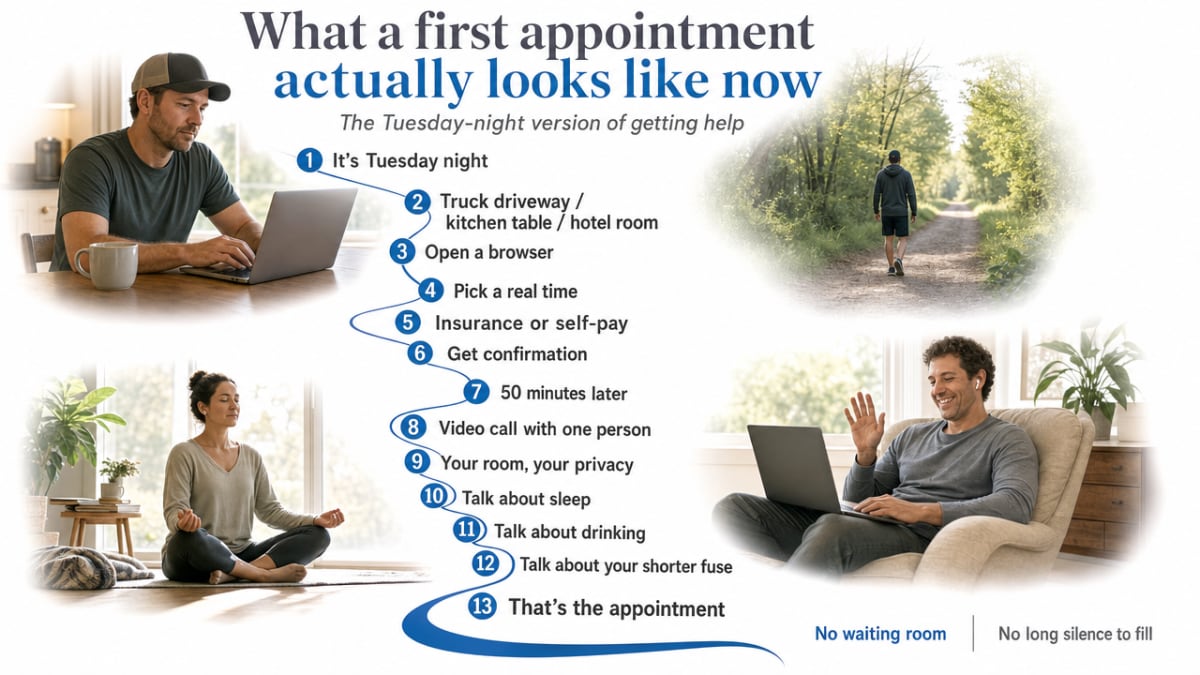
What a first appointment actually looks like now
The Tuesday-night version of getting help
Forget the version in your head. The one with the leather couch, the notepad, the long silence you’re supposed to fill. That’s a movie set. It’s not what most first appointments look like anymore, and it’s especially not what one looks like if you don’t want it to.
Here is a more accurate version. It’s a Tuesday. You’re in your truck in the driveway, or at the kitchen table after the kids are down, or in a hotel room on a work trip. You open a browser. You pick a time — a real one, not a callback slot three weeks out. You put in your insurance, or you don’t. You get a confirmation. Fifty minutes later, you’re on a video call with one person, in a room only you can see, talking about sleep and drinking and the fuse that got shorter this year.
That’s it. That’s the appointment.
No waiting room. No sign-in clipboard where someone from your church might see your name. No drive across town. Nobody calling you a patient before you’ve even said what’s going on. You can keep your hat on. You can have coffee. You can end the call if you hate it and never come back, and it will have cost you an hour, not a piece of your identity.
That matters, because one of the barriers men themselves name most often isn’t the talking — it’s not knowing what they’re walking into, and not being sure the thing on the other end is worth the trip 16. The Tuesday-night version removes most of that. You’re not committing to a course of treatment. You’re having one conversation with one person to figure out what, if anything, would actually help. That’s a lower bar. It’s supposed to be.
When medication and counseling belong in the same conversation
Some of what’s happening to you might be a thought pattern that a good counselor can help you work through. Some of it might be a chemistry problem — sleep, anxiety, mood — that a prescription can quiet down enough for the counseling to actually stick. Most guys need some version of both, at least at first. The question of which one, and in what order, isn’t yours to solve alone in the driveway.
Here’s where the old on-ramp used to break. You’d see a counselor who couldn’t prescribe. Or a prescriber who didn’t do therapy. You’d get handed a second phone number, told to call, and a month later you’d still be white-knuckling it because the second appointment never happened. That handoff is exactly where a lot of men fall out of care 11.
The version that works better is having both under one roof. A psychiatric provider who can look at whether medication makes sense. A counselor who can meet with you the same week to work on the parts medication won’t fix. One intake, one chart, one place — so if the plan changes, nobody starts from zero. If you’re also drinking more than you want to be, that gets handled in the same building, not shipped to a separate program across town.
You don’t have to decide any of that before the first appointment. You just have to be on the call. The plan gets built with you, not handed to you.
If you’re the person reading this about someone else
You’ve been watching him for a while. Long enough that you’ve started editing yourself around him — softer questions, fewer plans, careful timing. You’re not imagining it. If you’re still reading at this point, you already know something is off.
Here’s what tends to actually help, based on what men in these studies said they wanted: a private, low-pressure conversation with someone they trust, in a setting that doesn’t feel clinical 10. That’s usually you. Not a hotline, not a pamphlet — you, on a Saturday morning, in the truck or the garage or the kitchen. You don’t need a script. You need one honest sentence. Something like: “You’ve seemed off, and I’ve been worried. Are you okay?” Then let it be quiet. Do not fill the silence.
He may deflect the first time. Most men do. That doesn’t mean the door is closed. It means you get to ask again next week, and the week after. Persistence, from someone he respects, is the intervention.
What you don’t have to do: diagnose him, fix him, or drag him into treatment. What helps more is removing friction. Sit next to him and open a scheduling page together. Offer to be on the first video call in the other room, if he wants. If he mentions drinking more, taking risks, or feeling like the people around him would be better off — that last one especially — treat it as the signal it is 5, and don’t wait for a tidier moment.
If tonight feels sharper than that, 988 takes calls, texts, and chats around the clock, and you can use it too — for guidance on how to talk to him 6. You are allowed to ask for help with helping him.
Where 988 fits, and where it doesn’t
988 is the number to know before you need it. It’s the national crisis line, and it works by call, text, or chat, around the clock 6. Save it in your phone now, when nothing is wrong. That’s the whole trick — you don’t want to be searching for it at 2 a.m.
Here’s when it fits. When tonight feels sharper than yesterday. When the thoughts have moved from background noise to something with a plan attached. When you’re sitting in a parked car and don’t want to drive home yet. When someone you love just said the sentence that scared you and you don’t know what to do with your hands. Text, call, chat — pick the one that feels least like a big deal. All three reach a real person.
Here’s what 988 isn’t. It isn’t your ongoing care. It isn’t a substitute for a Wednesday appointment with someone who knows your name, your prescription, and how last month went. Think of it as the emergency room — essential when you need it, not the plan. The plan is the appointment you book after the call, or before you ever need to make one.
What the evidence honestly says about male-tailored programs
You deserve a straight answer here, because there’s a lot of confident marketing in this space. The most current systematic review of suicide prevention programs designed specifically for men — 17 studies, 14 different interventions — found that among the randomized trials, there were no significant effects on suicide attempts, suicidal ideation, or depression, and the help-seeking results were mixed 9. That’s not a comforting sentence to write. It’s the honest one.
What that means for you: be skeptical of any program, app, or campaign that promises to move the number by itself. The evidence isn’t there yet. What men in the older scoping work said actually helped was more human than programmatic — a trusted, respected person offering support in a low-pressure setting, not a branded initiative 10.
So the takeaway isn’t that nothing works. It’s that no single script works for every man, which is why individualized care — a real person, one appointment, a plan built for your life — still outperforms the poster on the breakroom wall. Start there.
Take the Next Step Toward Feeling Understood
Connect with someone who gets what you’re facing and start building real support today.
Frequently Asked Questions
What do I actually say to a friend or brother I’m worried about?
Keep it short and specific. Something like: “You’ve seemed off the last couple months. I’m not trying to fix anything — I just want to know how you’re actually doing.” Then stop talking. Let it be awkward. Pick a setting without eye contact if you can — a drive, the garage, a walk. Men in the research consistently say they open up more easily to someone they trust in a low-pressure, informal setting 10.
What happens in a first appointment if I’ve never done this before?
You talk. That’s it. The person on the other end asks about sleep, stress, drinking, what’s been changing, what brought you in. You don’t have to have a diagnosis or a story ready. You don’t have to cry. You don’t have to commit to anything after. It’s a conversation to figure out whether something would help and what that something might look like — medication, counseling, both, or a check-in in two weeks.
Does telehealth count if I might need medication?
Yes. A psychiatric provider can evaluate you, prescribe most medications, and adjust them over video visits, with the prescription sent to your pharmacy. Certain controlled medications have extra rules, but common prescriptions for anxiety, depression, and sleep are handled routinely through telehealth. You don’t have to drive across town to get a real medical opinion.
How do I know if this is depression, burnout, or something more serious?
You don’t, and that’s the job of the appointment, not yours. Burnout, depression, anxiety, and grief share a lot of symptoms — bad sleep, short fuse, low motivation, drinking more. Sorting them out takes about forty minutes with someone trained to ask the right questions. If it’s burnout, you’ll know. If it’s more, you’ll also know. Guessing on your own is what keeps men stuck for months.
Do I have to call 988 to get help, or is that only for emergencies?
988 is built for crisis moments — when tonight feels sharper than yesterday, or when someone you love just said something that scared you. It’s free, works by call, text, or chat, and runs 24/7 6. For the slower version — bad sleep, rising drinking, a short fuse — you want a scheduled appointment, not the crisis line. Different tools for different nights.
Will my job, security clearance, or family find out if I go to counseling?
Outpatient mental health records are protected under federal privacy law. Your employer doesn’t get a notice. Your spouse doesn’t get a call. For most security clearances, seeking mental health care is not itself disqualifying — the government has said publicly it views getting help as responsible, not a red flag. If a specific role has questions, ask the intake team before your first appointment. They handle this every week.
References
- Suicide. https://www.who.int/news-room/fact-sheets/detail/suicide
- Suicide worldwide in 2021: global health estimates. https://www.who.int/publications/i/item/9789240110069
- Changes in Suicide Rates in the United States From 2022 to 2023. https://www.cdc.gov/nchs/products/databriefs/db541.htm
- Preventing Suicide – CDC. https://www.cdc.gov/suicide/prevention/
- Warning Signs of Suicide. https://www.samhsa.gov/mental-health/suicidal-behavior/warning-signs
- 988 Suicide & Crisis Lifeline. https://www.samhsa.gov/mental-health/988
- SAMHSA’s Suicide Prevention Initiatives. https://www.samhsa.gov/mental-health/suicidal-behavior/prevention-initiatives
- SAFE-T Suicide Assessment Five Step Evaluation and Triage. https://library.samhsa.gov/product/safe-t-suicide-assessment-five-step-evaluation-and-triage/pep24-01-036
- Effectiveness and gender-tailoring of suicide prevention interventions for men: a systematic review. https://pubmed.ncbi.nlm.nih.gov/42337495/
- Men and suicide prevention: a scoping review. https://pubmed.ncbi.nlm.nih.gov/28871841/
- Help-Seeking and Barriers to Service Use amongst Men with Past-Year Suicidal Ideation and not in Contact with Mental Health Services. https://pubmed.ncbi.nlm.nih.gov/36987997/
- Male suicide and barriers to accessing professional support: a qualitative thematic analysis. https://link.springer.com/article/10.1007/s12144-023-05423-1
- Mental health, men and culture: how do sociocultural constructions of masculinities relate to men’s mental health help-seeking behaviour in the WHO European Region?. https://www.ncbi.nlm.nih.gov/books/NBK559706/
- The role of gender norm conformity in men’s psychological help-seeking and treatment engagement: a scoping review. https://pubmed.ncbi.nlm.nih.gov/40459871/
- The role of masculinity in men’s help-seeking for depression. https://pubmed.ncbi.nlm.nih.gov/27664823/
- What gets in the way? Men’s perspectives of barriers to mental health treatment. https://pubmed.ncbi.nlm.nih.gov/31692401/
- Males and Mental Health Stigma. https://pmc.ncbi.nlm.nih.gov/articles/PMC7444121/
- Masculinity and Help-Seeking Among Men With Depression. https://pmc.ncbi.nlm.nih.gov/articles/PMC7732518/