

Key Takeaways
- Outpatient therapy prevents suicide by building four things over time: practical CBT and DBT skills, a written safety plan, consistent sessions with someone who knows your baseline, and shared recognition of your early warning signs.
- The evidence supports acting before a crisis: structured psychotherapies reduced suicidal ideation in 55% of studies and attempts in 37.5% 1, and safety planning has been linked to a 43% drop in attempts 9.
- Format matters less than substance. Telehealth-delivered Brief CBT cut suicide attempts by up to 60% versus typical care 2, so evening video sessions can carry the same clinical weight as in-person work.
- Focus next on booking a specific evening slot and staying consistent through steady weeks, since continuity of care and earlier follow-up are tied to lower suicide risk 10.
Starting Therapy Before You’re in Crisis Is the Point
You’re probably reading this in a browser tab you don’t want anyone to see. Maybe between meetings. Maybe after a night where the thoughts got louder than usual, even though nothing happened, and you’re wondering whether that counts as bad enough to do something about.
Here’s the honest answer: yes, it counts. And starting therapy now — while your calendar still fits it, while you’re still functional at work, while the thoughts are still something you can describe rather than something you’re drowning in — is the whole point of prevention. Suicide prevention doesn’t begin in an emergency room. It begins in a Tuesday 7pm session, weeks or months earlier, with a therapist who helps you build skills, a safety plan, and a relationship you can lean on when the ground shifts.
The rest of this article won’t try to convince you that you’re sick enough to deserve help. You already deserve it. What you’ll get instead is a clear picture of what ongoing therapy actually does, what the research shows about its effect on suicidal thoughts and attempts, and how to fit it into a life that already feels full.
What ‘Prevention’ Actually Means in Outpatient Therapy
When most people hear “suicide prevention,” they picture a hotline, an emergency room, or a wellness check. Those matter. But they’re the last line, not the first. Prevention in outpatient therapy is something different, and quieter: it’s the ongoing work of making a future crisis less likely to happen and less dangerous if it does.
In practical terms, that work has four moving parts:
- You learn specific skills for the moments your thoughts spiral — the kind you can use at your desk or in your car, not just in a therapist’s office.
- You build a written safety plan that names your warning signs, your reasons for living, and exactly who to call when something feels off.
- You keep a standing appointment, so there’s a person who knows your baseline and notices when you drift from it.
- You get better at spotting the early warning signals — the sleep changes, the withdrawal, the intrusive thoughts creeping back — before they become an emergency.
That’s it. That’s prevention. It’s not dramatic, and it doesn’t feel like rescue. It feels like a Tuesday evening session where you talk about a hard week at work and practice a grounding exercise. But the research on these components — cognitive and dialectical behavior therapies, structured safety planning, and early, consistent follow-up — shows they measurably reduce suicidal thoughts and attempts over time 1. The next section walks through what that evidence actually says.
The Evidence That Ongoing Therapy Changes the Trajectory
You deserve a real answer to the question you’re probably asking: does therapy actually move the needle on suicidal thoughts, or does it just help you feel a little more organized about them? The honest answer is that yes, it does — and the evidence is more specific than most people realize.
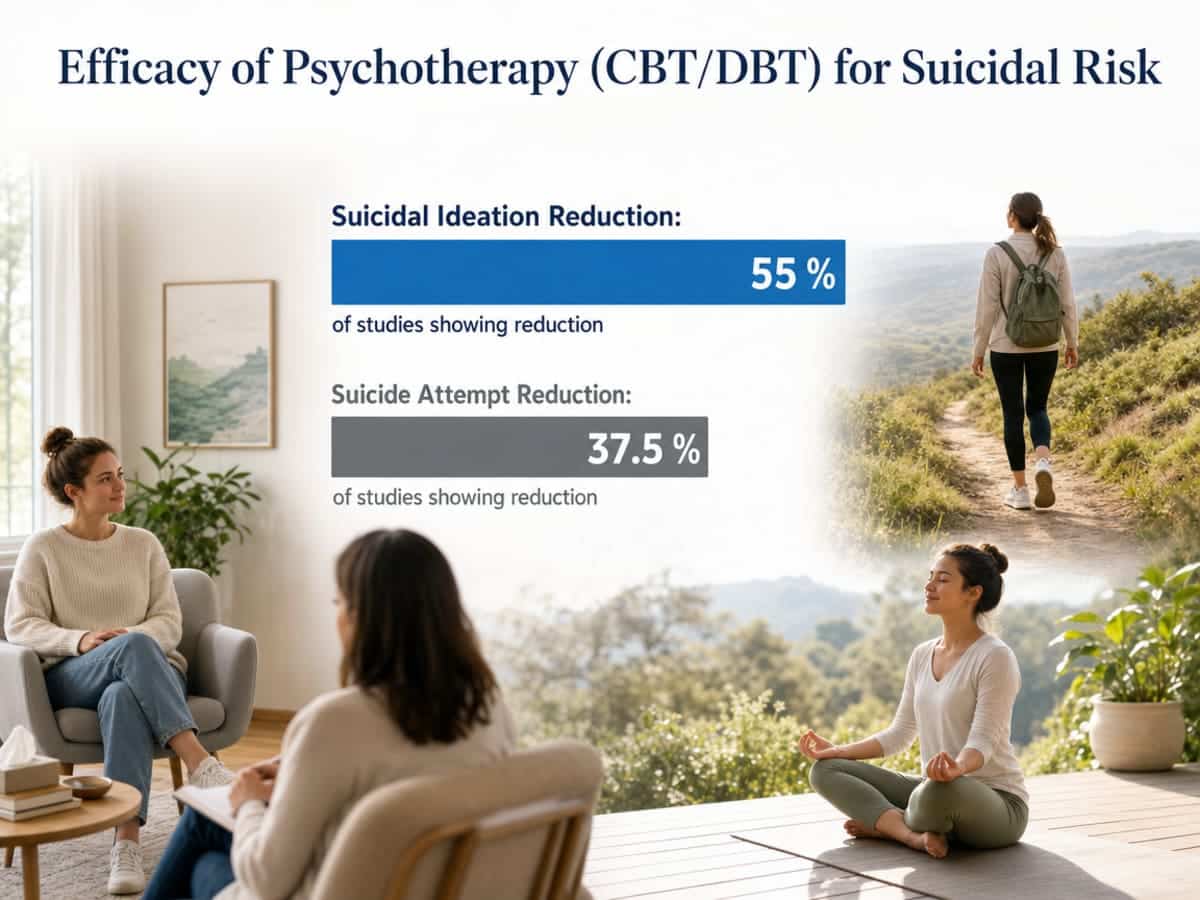
The clearest single picture comes from an NIH-hosted review of 31 studies of cognitive behavioral therapy and dialectical behavior therapy in people who already had suicidal ideation or a prior attempt. Across those studies, 55% showed a reduction in suicidal ideation and 37.5% showed a reduction in actual suicide attempts after treatment 1. That’s not “therapy helps you feel better in general.” That’s structured outpatient psychotherapy, measured against the two outcomes that matter most, in people who were already at elevated risk.
A few things about that number are worth sitting with. First, the studies weren’t of a mystery treatment — they were of the same skills-based, talk-based therapies your therapist would likely use with you: identifying the thoughts that trigger the spiral, learning to tolerate distress without acting on it, changing how you respond to the moments when everything feels unbearable. Second, these were people already carrying weight — depression, borderline traits, prior attempts. If therapy shifts outcomes for them, it has room to shift outcomes for someone earlier in the arc, too.
The review also names a real limitation: the studies varied in size and design, and researchers want more randomized trials to sharpen the picture 1. That’s a fair caveat. It doesn’t erase the pattern, though. When more than half of studies show reduced ideation and more than a third show reduced attempts, you’re looking at a trajectory that bends — quietly, over months of consistent sessions — in the direction of staying alive.
That’s what “ongoing therapy as prevention” means in practice. Not a promise. A measurable shift in the odds, earned session by session, before anything reaches an emergency.
The Four Things a Working Therapy Relationship Builds
If you’ve never done ongoing therapy before, it can feel abstract — you show up, you talk, something is supposed to help. But the work is more specific than that. Over months of sessions, a good therapist helps you build four concrete things: skills you carry into your week, a written plan for the worst nights, a relationship that notices you, and a language for spotting trouble early. Each one does part of the prevention work. Together, they’re what makes ongoing therapy different from venting to a friend.
Skills You Can Use Between Sessions (CBT and DBT)
The skills are the part people underestimate. You might picture therapy as an hour of talking about your childhood. Some of it is. But cognitive behavioral therapy and dialectical behavior therapy — the two approaches with the strongest evidence for reducing suicidal thoughts and attempts — are much more practical than that.
In a CBT session, you and your therapist look at a specific moment from your week. The Sunday night when the intrusive thoughts came back. The email that made your chest tight. You trace the thought, the feeling, and what you did next. Then you rehearse a different response — something you can actually do at your desk, in your car, at 2am when you can’t sleep. Over time, you build a small library of these responses. You don’t wait until Tuesday’s session to use them. You use them Wednesday morning.
DBT adds a specific set of skills for the hardest moments:
- Distress tolerance — getting through a bad hour without making it worse.
- Emotion regulation — turning down the volume on a spike.
- Interpersonal effectiveness — asking for what you need at work without imploding.
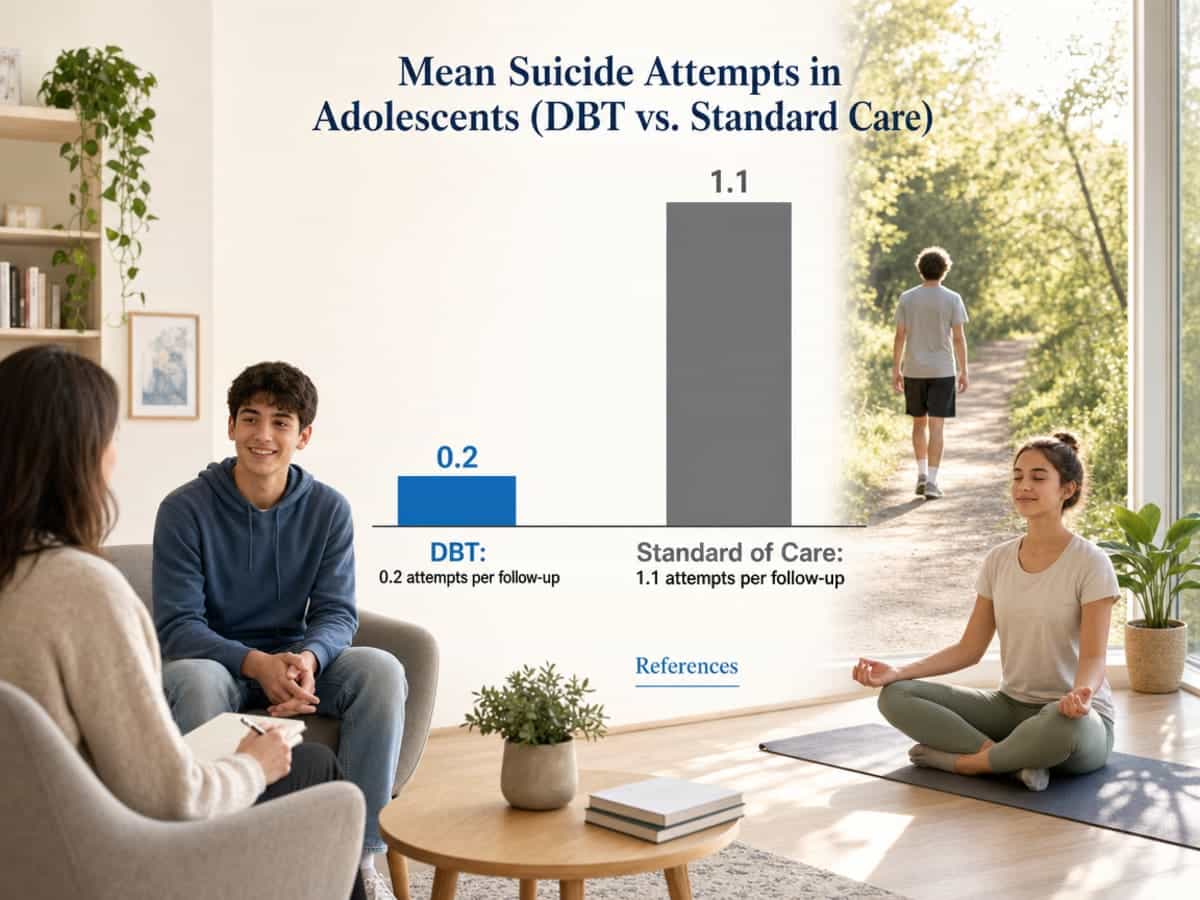
In a two-year randomized trial of adults with borderline personality disorder and chronic suicidality, people who did DBT were half as likely to make a suicide attempt as those receiving standard care 4. That’s what practiced skills do — they change what happens in the moment your thoughts turn dark.
The homework is the point. The session teaches. The week is where it works.
A Personalized Safety Plan You’d Actually Use at 11pm
A safety plan is a one-page document you build with your therapist, usually in the first few sessions. It’s not a form you fill out and forget. It’s a specific, written sequence of steps for the moments your thoughts escalate — the kind of thing you’d actually open on your phone at 11pm on a Wednesday when the noise gets loud.
Yours will include:
- Your personal warning signs (the sleep pattern, the isolation, the specific thought that shows up first).
- Internal coping steps you’ve practiced.
- People you can text — not “my support system” in the abstract, but Sarah, and your brother, in that order.
- One or two places that reliably help you feel less alone.
- 988 and your therapist’s contact info.
- A step about reducing access to anything you might use to hurt yourself, worked out with your therapist rather than left to willpower.
The reason clinicians take this seriously is that the numbers on structured safety planning are unusual for a single, low-cost intervention. In outpatient mental health settings, safety planning and its adaptations have been associated with a 43% reduction in suicide attempts, a 47% decrease in psychiatric emergency visits, and a 69% reduction in total inpatient days compared with usual care 9. One page, built once, revised as you go — and it shifts what happens on the worst night of your month.
You keep it somewhere you’ll find it when you need it. Not filed away. Screenshotted on your phone.
Continuity: Why the Next Appointment Matters More Than People Think
The single most protective thing about ongoing therapy isn’t any one technique. It’s that someone is expecting you next Tuesday.
That sounds small. It isn’t. A large cohort study following 76,462 patients after psychiatric hospitalization found that earlier outpatient mental health follow-up was significantly associated with lower suicide risk, with the strongest effects among people carrying depression, bipolar disorder, substance use disorders, and schizophrenia 10. Timing mattered. The sooner care resumed, the better the odds.
You’re probably not being discharged from a hospital. But the underlying mechanism is the same: a scheduled next contact keeps you connected to someone who knows your baseline. Your therapist notices when you say “fine” but your shoulders are up around your ears. They remember that last month, the same work project sent you spiraling. They can ask about it before you’d think to bring it up. That kind of continuity is hard to fake with an app or a monthly check-in.
Practically, this means two things. First, book the next session before you leave the current one, even if you’re not sure you’ll need it. Future-you will be grateful. Second, don’t cancel sessions when weeks feel steady. Steady weeks are when you build capacity for the hard ones. Therapists sometimes describe this as “deposits in the account” — you’re not showing up because something is wrong. You’re showing up so that when something goes wrong, the account isn’t empty.
Early Warning Recognition, Before You’d Call It a Crisis
The fourth thing a working therapy relationship builds is a shared vocabulary for what “getting worse” looks like for you specifically. Not generic warning signs from a pamphlet. Yours.
Maybe it’s that you stop cooking and start eating standing up over the sink. Maybe it’s canceling on the one friend you actually like seeing. Maybe it’s a specific phrase — “I’m just tired” — that shows up in your texts when you’re actually much further down than tired. Maybe it’s the return of a specific intrusive thought you’d learned to name in session six.
Over months of ongoing therapy, you and your therapist build a map of these signals. They start catching them before you do. “Last time you described your week this way, things got hard about two weeks later. Can we talk about what’s coming up?” That’s the conversation that keeps a hard month from becoming an emergency.
You get better at it, too. You start noticing your own patterns in real time, not in retrospect. That’s not a small win — that’s the shift from being surprised by your own decline to being able to intervene early. Which is, in the end, what prevention actually is: catching the drift while it’s still small enough to talk about on a Tuesday.
Telehealth, Evening Sessions, and the Calendar Problem
The most common reason people put off starting therapy isn’t skepticism. It’s the calendar. You already run tight between a 9am standup, a 1pm review, and whatever spills into the evening. Adding a 50-minute appointment across town, twice a month, sounds like one more thing you’ll cancel by week three.
Telehealth changes the math. A session on your laptop from your kitchen table takes 50 minutes, not 50 minutes plus a commute plus parking plus the small social recovery of walking back into your office. Evening slots — 6pm, 7pm, 8pm — exist specifically because clinicians know their working-adult patients can’t take a Wednesday afternoon off every week. At Mind Body Optimization, telehealth counseling and psychiatric appointments are built around exactly this reality, across Texas, Tennessee, Oklahoma, and Missouri.
The bigger question is whether virtual sessions do the actual clinical work. The evidence here is more direct than you might expect. In the first randomized clinical trial to test suicide-specific therapy over telehealth, Brief Cognitive Behavioral Therapy delivered by video reduced suicide attempts by as much as 60% compared with typical mental health care, in high-risk suicidal patients 2. That’s not “telehealth is fine.” That’s a suicide-focused protocol, delivered virtually, outperforming standard care on the outcome that matters most.
A few practical notes. You’ll want a private-enough space — a bedroom with the door closed, a car in a quiet lot, a home office. Headphones help. So does closing Slack. And so does treating the session like any other blocked calendar hold: not something you move when a meeting invite lands on top of it. The 7pm slot on Tuesday is the appointment. Everything else routes around it.
That’s how prevention actually fits into a working week. Not by rearranging your life around therapy, but by putting therapy inside the life you already have.
An Honest Note on What Telehealth Alone Can’t Fix
Here’s where you deserve the caveat. A recent systematic review and meta-analysis of telehealth aftercare following suicide-related emergencies found that in randomized trials, telehealth follow-up did not add measurable benefit above usual treatment for suicidal behavior 7. That’s a real finding, and worth naming clearly.
What it doesn’t mean: that virtual therapy doesn’t work. The BCBT trial in the previous section is direct evidence that suicide-specific therapy delivered by video reduces attempts. What the aftercare review does suggest is narrower and important: telehealth on its own — a check-in call, an app, an automated follow-up after an emergency — isn’t the ingredient doing the heavy lifting. The therapeutic relationship is.
So the takeaway isn’t “in-person or bust.” It’s that the format matters less than the substance. You need a trained therapist doing structured work with you over time — CBT skills, DBT skills, a safety plan, consistent sessions — whether that happens in a Plano office or on your laptop in Knoxville. A weekly video session with someone who knows you is prevention. A one-off telehealth check-in isn’t.
What the First Eight Weeks Should Look Like
If you’re going to start, it helps to know what the shape of “starting” actually looks like. Not vaguely. Specifically. Here’s a reasonable eight-week arc for someone who’s functional at work, dealing with quiet suicidal thoughts, and beginning outpatient therapy for the first time.
Weeks 1–2. Your first session is an intake. Your therapist will ask direct questions about your thoughts, your history, your sleep, your work, and what brought you in this month rather than last year. Answer honestly, including about passive ideation. They’ve heard it before, and they need the real picture to help you. By the end of week two, you should have a written safety plan started and a working sense of whether the fit feels right. If it doesn’t, say so — a good therapist would rather help you find someone better than watch you disappear after session three.
Weeks 3–5. This is where the skills work begins. You’ll probably start tracking specific thoughts and situations between sessions, then bring them in to unpack together. Expect homework. Expect one small win — a coping skill used once, a hard conversation had, a bad night that felt less bad than it would have. Notice it.
Weeks 6–8. By now the pattern should be steady: weekly sessions, a safety plan you’ve revised at least once, and skills you’re using without having to think as hard about them. This is also when you and your therapist decide what comes next — whether to keep weekly cadence, add a psychiatric evaluation for medication support, or fold in something like EMDR if trauma is part of the picture. That’s the review point. That’s when you know it’s working.
Booking the First Session Without Making It a Whole Ordeal
The gap between deciding to start therapy and actually being in a session is where most people lose themselves. You mean to call. You open the tab. Something urgent lands in Slack. Two weeks pass. If you can shorten that gap, do.
Here’s what booking actually looks like when it’s built for a working schedule. You fill out a short intake form online — usually less than ten minutes. You pick a time from a live calendar that already shows evening and telehealth slots. You get matched with a therapist whose approach fits what you’re bringing in (CBT for anxious spirals, DBT if emotions run hot, EMDR if trauma is under the noise). Insurance verification happens in the background. Mind Body Optimization runs this on a HIPAA-compliant real-time scheduling widget across Texas, Tennessee, Oklahoma, and Missouri, so the booking itself doesn’t require a phone call during business hours you don’t have.
Two practical suggestions. Book the first session for a week when your calendar is already busy — you’re less likely to talk yourself out of it than during a quiet stretch. And book it for the evening, not a lunch break. You’ll want the hour after to sit with what came up, not run to a 2pm review.
The hardest session is the one you haven’t scheduled yet. Once it’s on your calendar, you’re already in the work.
Take a proactive step for your well-being
Connect with support that fits your schedule and helps you prevent crisis before it starts.

Frequently Asked Questions
Should I start therapy if I’m not in crisis but have occasional suicidal thoughts?
Yes. Occasional suicidal thoughts — passive ideation, dark what-ifs, the thought that surfaces when you’re exhausted — are exactly the signal outpatient therapy is designed to work with. You don’t need to wait until things get worse to qualify for care. Starting now, while the thoughts are still describable and your life still has room for a weekly session, is what prevention actually looks like.
Is telehealth therapy actually effective for suicide prevention, or should I insist on in-person sessions?
Telehealth works when the therapy itself is structured. A randomized trial of Brief Cognitive Behavioral Therapy delivered by video showed meaningful reductions in suicide attempts among high-risk patients compared with typical care 2. What matters is the substance — CBT or DBT skills, a safety plan, a real therapist who knows you — not the format. Pick whichever helps you actually show up each week.
What’s the difference between CBT and DBT, and how do I know which one I need?
CBT focuses on the link between thoughts, feelings, and actions — useful when anxious spirals, catastrophic thinking, or rumination drive your worst moments. DBT adds skills for high-intensity emotions: distress tolerance, emotion regulation, interpersonal effectiveness. It’s often used when feelings hit hard and fast 4. You don’t have to choose alone. Your therapist will match the approach to what’s actually showing up in your week.
How long does it take before therapy starts reducing suicidal thoughts?
Most people notice small shifts within the first six to eight weeks — a coping skill used once, a bad night that felt less bad. Larger changes in ideation and attempt risk build over months of consistent sessions, which is what the psychotherapy research actually measures 1. If nothing has budged by session eight, that’s a conversation to have with your therapist, not a reason to give up.
Do I have to tell my therapist about passive suicidal ideation if I’ve never made a plan or attempt?
Yes, and it will help you more than you expect. Passive ideation is common, treatable, and exactly the information your therapist needs to build an accurate safety plan and choose the right approach. Naming it doesn’t automatically trigger hospitalization — clinicians assess risk carefully and work with you on the least disruptive care that fits. Withholding it just means you’re doing therapy with one hand tied.
What should I do right now if my thoughts escalate between scheduled sessions?
Open your safety plan first — it’s built for this exact moment. Work through your coping steps, contact the people it names, and reach out to your therapist for a same-week check-in if things stay heavy. If you feel unsafe, call or text 988, or go to your nearest emergency room. Then tell your therapist what happened at your next session so your plan can be sharpened.
References
- Effectiveness of Psychotherapy on Suicidal Risk. https://pmc.ncbi.nlm.nih.gov/articles/PMC6389707/
- First-ever randomized clinical trial uses telehealth for suicide prevention. https://wexnermedical.osu.edu/mediaroom/pressreleaselisting/first-ever-randomized-clinical-trial-uses-telehealth-for-suicide-prevention
- Dialectical Behavior Therapy for Adolescents With Bipolar Disorder: A Randomized Clinical Trial. https://pmc.ncbi.nlm.nih.gov/articles/PMC10500432/
- Two-year randomized controlled trial and follow-up of dialectical behavior therapy vs treatment as usual for suicidal behaviors. https://pubmed.ncbi.nlm.nih.gov/16818865/
- Efficacy of Dialectical Behavior Therapy for Adolescents at High Risk for Suicide. https://pubmed.ncbi.nlm.nih.gov/29926087/
- Dialectical behavior therapy for high suicide risk in individuals with borderline personality disorder: A randomized clinical trial. https://pubmed.ncbi.nlm.nih.gov/25806661/
- A Systematic Review and Meta-Analysis of Telehealth Aftercare Following Suicide-Related Emergencies. https://pubmed.ncbi.nlm.nih.gov/41403248/
- Comparison of the Safety Planning Intervention With Follow-up vs Usual Care of Suicidal Patients Treated in the Emergency Department. https://pubmed.ncbi.nlm.nih.gov/29998307/
- Safety Planning Intervention in psychiatric services (protocol summary). https://cdn.clinicaltrials.gov/large-docs/17/NCT07469917/Prot_SAP_000.pdf
- Follow-Up Timing After Discharge and Suicide Risk Among Patients With Psychiatric Disorders. https://pmc.ncbi.nlm.nih.gov/articles/PMC10562943/