

Key Takeaways
- Shallow chest breathing feeds the fight-or-flight loop, but consciously slowing your breath sends direct physiological signals of safety through the vagus nerve.9,1
- Roughly six breaths per minute, with a longer exhale, is the rate where vagal activity peaks and most clinical benefits consistently appear.1,6
- Match the tool to the moment: box breathing steadies acute stress, cyclic sighing lifts pre-performance mood, and paced breathing builds a daily baseline.5,6
- Breathwork belongs inside a broader plan, not as a replacement for therapy or medication when anxiety disrupts work, sleep, or relationships.10,7
What Actually Happens in Your Body During an Anxious Moment
You know the feeling. A message pops up. A calendar invite lands with no context. Your manager says, “Do you have a minute?” Before your thinking brain has caught up, your chest is tight, your shoulders are climbing toward your ears, and your breath has gone shallow and high in the chest. That is not weakness. That is your nervous system doing exactly what it was built to do.
When your brain reads a situation as a threat, whether it is a saber-toothed tiger or a Slack notification at 4:47 p.m. on a Friday, the sympathetic branch of your autonomic nervous system takes over. Your heart rate climbs. Your muscles tense. Your breathing speeds up and moves out of your belly into your upper chest, pulling in quick, shallow sips of air. That shift in breathing pattern is not a side effect. It is a core part of the fight-or-flight loop, and it feeds back into the very anxiety it is trying to protect you from.9
Here is the part worth sitting with: fast, shallow chest breathing keeps signaling your brain that something is wrong, even after the actual trigger is gone. Your body reads its own breath rate as evidence. Rapid breathing means danger. Slow, steady breathing means safety. That feedback loop is why you can leave a stressful meeting, sit down at your desk, and still feel wired forty minutes later.
The good news is that this loop has a door in it. Because breathing is one of the few body systems you can consciously override, it becomes the most direct, portable way to interrupt an anxious moment and tell your nervous system, from the inside, that the threat has passed 1.
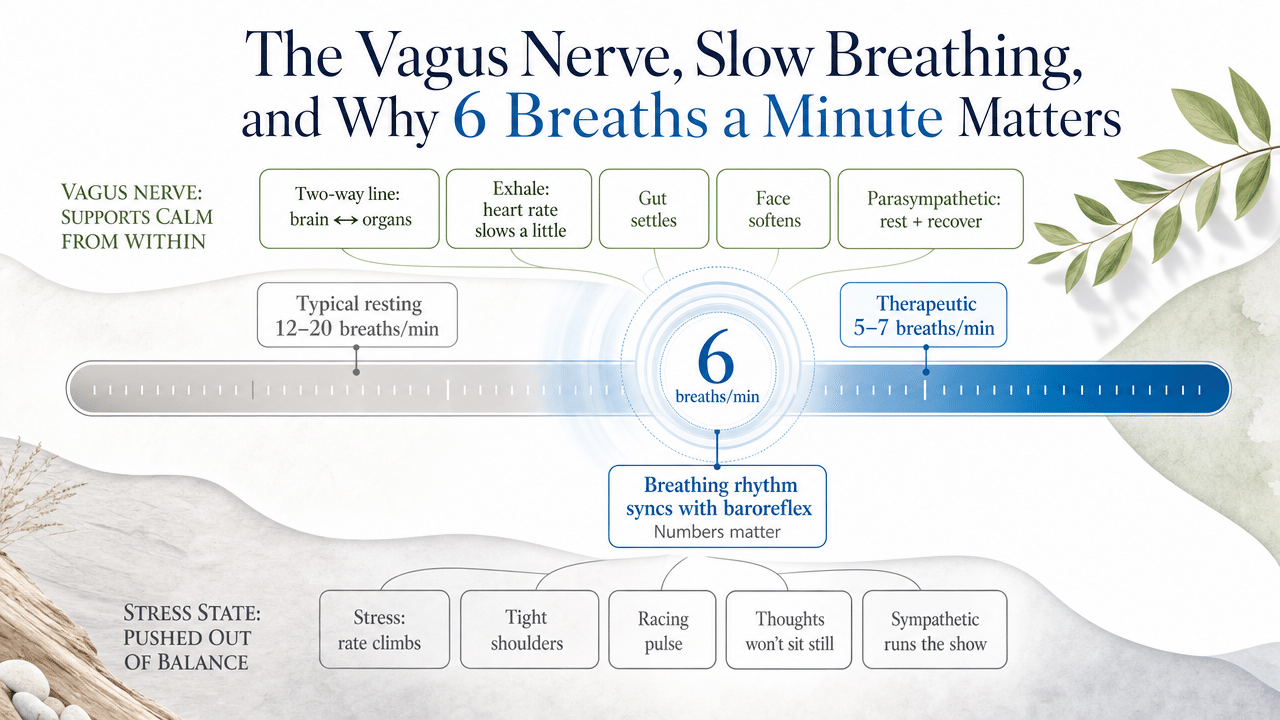
The Vagus Nerve, Slow Breathing, and Why 6 Breaths a Minute Matters
Your vagus nerve is the longest cranial nerve in your body, and it acts like a two-way phone line between your brain and your organs. When it is active, your heart rate slows a little on the exhale, your gut settles, your face softens, and your nervous system leans into the parasympathetic “rest and recover” mode. When it is quiet, the sympathetic side runs the show, and you feel that as tight shoulders, a racing pulse, and thoughts that will not sit still.
Here is where the numbers start to matter. Most adults breathe somewhere between 12 and 20 times a minute at rest, and under stress that number climbs. When you deliberately slow your breath down to about six breaths a minute, something specific happens: your breathing rhythm starts to sync with the natural rhythm of your baroreflex, the reflex that adjusts your blood pressure with each heartbeat. That alignment sends a steady, low-frequency signal up the vagus nerve, which enhances parasympathetic activity, reduces sympathetic drive, and quiets the limbic circuits that generate the emotional charge of anxiety.9
Six breaths a minute means one full inhale-and-exhale cycle every ten seconds. Most people find it easier if the exhale is a beat or two longer than the inhale, because the exhale is where vagal activity peaks. You do not need to hit exactly six. Anywhere in the five-to-seven range gets you into the same physiological neighborhood, and the effect strengthens the longer you stay there.1
What is worth holding onto is that this is not a hack or a trick your brain plays on itself. It is a mechanical, measurable shift. The rate and depth of your breath directly change the electrical traffic on your vagus nerve, which changes the chemistry in your bloodstream, which changes what your brain does with the next incoming email. You are not talking yourself out of anxiety. You are giving your body different physical data to work with, and it responds.
That is why six breaths a minute keeps showing up across studies with very different populations and protocols. It is the rate where the physiology cooperates with you instead of fighting you, and it is the foundation almost every technique in the rest of this article is built on.
What the Clinical Trials Actually Show
Eight Weeks of Diaphragmatic Breathing, Measured on the Beck Anxiety Inventory
If you are the kind of person who wants to see the numbers before you commit to a practice, this trial is a good place to start. A randomized controlled trial of adults with anxiety put one group through an eight-week diaphragmatic breathing relaxation program while a control group did not. At the end of the eight weeks, the breathing group showed significant drops in Beck Anxiety Inventory scores, along with measurable reductions in heart rate and breathing rate, tracked through biofeedback tools like skin conductance and peripheral blood flow 2.
The Beck Anxiety Inventory is not a mood journal. It is a validated clinical instrument that clinicians use to gauge how badly anxiety is interfering with your daily life. When a score moves on that scale, it means real, felt symptoms, like the racing heart, the trembling hands, the fear that something bad is about to happen, moved with it.
Two things are worth naming honestly. The study was single-center, and it did not follow participants for years afterward, so we cannot say from this trial alone how long the benefits last once the eight weeks end. What it does tell you is that a structured, daily breathing practice, done consistently for a couple of months, can move the same numbers a clinician would use to measure your anxiety in the first place. That is not a small thing.2
Breathing Exercises Added to Therapy for Generalized Anxiety Disorder
Now zoom in on a harder case: people who already carry a generalized anxiety disorder diagnosis. GAD is the version of anxiety that does not need a specific reason. It hums in the background all day, then spikes when you sit down to eat dinner or try to fall asleep. Standard treatment usually involves therapy, sometimes paired with medication.
A 2022 clinical study asked a straightforward question: what happens if you add structured breathing exercises on top of that standard therapy? The group that combined breathing work with their usual treatment showed better respiratory function and lower anxiety levels than the group getting therapy alone. In other words, the breathwork was not competing with the therapy. It was making the therapy work harder.3
That matters if you are already in counseling or thinking about starting. You are not choosing between a session with a clinician and ten minutes of breathing at your kitchen table. You get more out of both when you use them together. The study’s authors were careful to note that the ideal frequency and specific protocol for GAD still need larger trials to nail down, but the direction of the finding is clear: adding a daily breathing practice to good clinical care improves outcomes beyond what either does on its own.3
Cortisol, Blood Pressure, and the 880-Participant Signal
Anxiety is not only what you feel. It is also what your body is running in the background, the cortisol drip that keeps you wired at 11 p.m., the elevated blood pressure that shows up in your annual physical, the tension you cannot quite put down. If breathwork is going to be more than a mood tool, it has to move those numbers too.
The National Center for Complementary and Integrative Health summarized a 2019 analysis that pulled together three studies with 880 participants total. The finding: diaphragmatic breathing exercises may help reduce stress, with beneficial changes in cortisol levels and blood pressure. Separately, the American Heart Association’s scientific statement on meditation and cardiovascular risk noted that practices involving slow, controlled breathing can improve autonomic regulation and lower blood pressure in people carrying elevated stress.4,8
These are not miracle numbers. Both sources are careful to say the effects are modest and the research base is still growing. What they do confirm is that the calm you feel after ten slow breaths is not imaginary. Your stress chemistry is shifting underneath it, in the same directions your primary care doctor would want to see.4,8
Comparing the Protocols: Cyclic Sighing, Box Breathing, and Paced Breathing
By this point you might be wondering which technique to actually try. There are dozens circulating online, and most articles list them without ever comparing them head-to-head. A 2023 Stanford Medicine randomized study did the comparison for you.
Researchers put healthy adults through one of four brief daily practices for a month:
- Cyclic sighing — a short inhale, a second inhale on top of it to fully inflate the lungs, followed by a long, slow exhale.
- Box breathing — equal counts of inhale, hold, exhale, hold.
- Cyclic hyperventilation — faster, deeper breaths with intermittent holds.
- Mindfulness meditation — as a control.
Each session lasted only five minutes a day. All three breathing protocols reduced anxiety and lowered negative mood more than mindfulness meditation did, but the cyclic sighing group showed the greatest daily improvement in positive feelings.5
The likely reason is mechanical. When you double up on the inhale and then draw out a slow exhale, you fully inflate the small air sacs in your lungs and then dump carbon dioxide efficiently on the way out. The long exhale is also where vagal activity peaks, which is the same lever the six-breaths-a-minute research keeps pointing at.1
Box breathing has its own strengths. The structure, four seconds in, four hold, four out, four hold, gives your brain something to count, which is useful when your thoughts are moving too fast to settle. It is a favorite of first responders and military trainers for a reason: it works well under acute stress when you need to steady yourself in the middle of doing something else.
Cyclic hyperventilation is the outlier here. It reduced anxiety in this study, but it is the technique most likely to backfire if you already live with panic attacks. The scoping review on clinical anxiety noted contradictory findings on hyperventilation-style protocols, with some trials showing they can actually trigger panic in vulnerable people. If you have a panic disorder diagnosis, this is the one to skip until you can practice it with a clinician watching.10
Two caveats before you pick a favorite. The Stanford study ran with generally healthy adults, not people carrying a diagnosed anxiety disorder, so the results may not transfer one-to-one to clinical anxiety. And the differences between the three breathing protocols were smaller than the difference between doing any of them and doing nothing structured at all. Consistency matters more than picking the perfect protocol. Start with cyclic sighing if you want the biggest lift in mood, box breathing if you want structure under pressure, and slow paced breathing if you are building a longer daily practice.5
Matching the Technique to the Moment
The 60-Second Reset Between Meetings
You have four minutes before the next call and your last one ran hot. This is the window box breathing was built for. Sit back, feet on the floor, and run four counts in, four hold, four out, four hold. Do that four times. Sixty-four seconds, and you have moved through roughly four breath cycles at a pace that is already slower than your baseline.
Why this one, in this moment? You do not have time to settle into a fifteen-minute practice, and your brain is still buzzing from whatever just happened. The counting gives your attention something to grip while your body catches up. The equal in-out ratio steadies your breathing without demanding you slow it down dramatically, which is harder to pull off when your pulse is still elevated.1
If four counts feels tight, use three. The exact number matters less than the fact that you interrupted the shallow, chest-high pattern that would have carried into the next meeting with you. That is a win. Small, but real.
Pre-Presentation Nerves and the Long Exhale
The five minutes before you present are a different animal. Your heart is already pounding, your mouth is dry, and box breathing’s tidy counts can feel like one more thing to manage. Cyclic sighing works better here because it does the mechanical work for you: a normal inhale through the nose, a second short inhale on top to fully inflate your lungs, then a long, slow exhale through the mouth. Repeat for two or three minutes.
The Stanford randomized comparison found cyclic sighing produced the biggest daily lift in positive mood of any protocol tested, which matters when you are about to walk into a room and need to sound like yourself. The extended exhale is where vagal activity peaks, so each sigh is nudging your nervous system out of alarm mode while giving you something concrete to do with your hands and lungs.5
3 A.M. Rumination and Sunday-Night Anticipation
The middle-of-the-night wake-up is its own particular kind of misery. You are not in danger. You are lying in a dark room. And still your brain is looping through tomorrow’s meeting, last week’s email, an unpaid bill. Fast, punchy techniques will not help here. What you need is something slow enough to actually pull you back toward sleep.
This is where paced breathing at around six breaths a minute earns its keep. Inhale for a count of four, exhale for a count of six. Do not chase perfect counts, and do not check the clock. The paced-breathing review found that five to six breaths per minute, sustained across a longer stretch, is what lowers anxiety and the frequency of panic-style episodes. Fifteen minutes is the studied dose, but even five or ten will start to slow your heart rate and lengthen the exhale-side pause that signals safety.6,9
Sunday nights work the same way. That low, gnawing dread about Monday is anticipatory anxiety, and it responds to the same slow, deliberate pacing. Try it on the couch before bed, not in bed itself, so your brain does not learn to associate the mattress with effort. If you fall asleep partway through, you were probably going to need that rest anyway.
The Paced Breathing Dose That Shows Up in the Data
Most breathing advice online skips the part that actually matters: how long, how often, and at what rate. Without those numbers, you are guessing. The HRV and paced breathing review pins it down. Breathing at five to six breaths per minute, held steady for fifteen minutes, done twice a day, is what the research links to lower anxiety and fewer panic attacks.6
Put that next to your baseline. A typical resting respiratory rate for adults sits between 12 and 20 breaths per minute, and it climbs when you are stressed. Dropping to five or six breaths per minute is roughly a two- to fourfold slowdown. That is not a small tweak. It is a deliberate override, and the studied dose is thirty minutes of it a day, split into two sessions.6
Fifteen minutes twice a day sounds like a lot when your calendar is already stacked. Two things help. First, you do not have to be perfect. Ten minutes in the morning and ten before bed still puts you in the studied territory, and the effect builds with consistency, not with any single session. Second, the sessions do not need to be silent or seated. You can pace your breath on a walk, during a commute, or while your laptop is booting up.6
What you are dosing, functionally, is vagal tone. The longer you spend at that slow rate, the more your nervous system rehearses the pattern, and the easier it becomes to drop back into it when a hard moment hits. Think of the twice-daily practice as the training block. The 60-second reset between meetings is the game.9
Where Breathwork Stops and Clinical Care Begins
Here is the honest part, because you deserve it. Breathwork is a legitimate physiological tool. It is not a diagnosis, and it is not a treatment plan on its own. The 2023 scoping review of breathwork in adults with DSM-5 anxiety disorders is careful about this line: breathing protocols reduced panic severity, avoidance, and hyperventilation symptoms across sixteen trials, but the authors do not position breathwork as a substitute for the assessment and clinical care those diagnoses require. The National Institute of Mental Health takes the same posture, listing breathing exercises as part of a broader plan that includes psychotherapy and, when appropriate, medication.7,10
A few signals mean it is time to bring a clinician into the loop:
- If your anxiety is showing up most days for six months or more.
- If it is pulling you out of work, sleep, or relationships you care about.
- If panic attacks are getting more frequent, or you are starting to avoid places and situations to prevent them.
- If you are using alcohol or anything else to take the edge off.
- If breathing helps in the moment but the underlying dread is still there when you wake up tomorrow.
None of that means breathwork stops working. It means breathwork is doing what it does best, taking the edge off in real time, while a bigger question, why is your nervous system running this hot in the first place, is still waiting for an answer. That answer usually needs someone trained to help you find it, whether that is a therapist, a psychiatrist, or both working together. Asking for that help is not a step backward from your practice. It is what a serious practice eventually points you toward.11
Building Breathwork Into a Personalized Anxiety Plan
Think of your anxiety plan as a small kit, not a single tool. Breathwork is one instrument in it. The daily paced-breathing block trains your baseline. The 60-second reset handles the meeting that ran hot. The long exhale carries you through the presentation. Underneath all of that, a clinician can help you look at what is actually driving the alarm system, whether that is a diagnosable anxiety disorder, trauma history, sleep debt, or something else worth naming.7,11
A good plan is personal. What works between meetings for you might not work at 3 a.m. What helps in week one might get boring in week six, which is when a therapist or psychiatrist can help you refine the practice, layer in cognitive tools, or address a sleep or medication piece that breathing alone cannot reach. That is the whole-body idea, and it is what pulls a scattered set of techniques into something that actually holds up over months.10
If you have been running your anxiety on willpower and caffeine, that is your signal. Schedule a session and build the toolkit with someone who does this every day. You do not have to figure it out alone, and you should not have to.
Take the First Step Toward Calmer Days
Get personalized support to help manage anxiety and stress in a way that fits your busy schedule.Frequently Asked Questions
How quickly can breathwork actually calm anxiety in the moment?
Can breathwork replace therapy or medication for anxiety?
Which breathing technique works best: cyclic sighing, box breathing, or paced breathing?
How often and how long should I practice breathwork to see results?
Is breathwork safe if I have panic attacks or a diagnosed anxiety disorder?
When should I stop relying on breathwork alone and talk to a clinician?
References
- Breathing Practices for Stress and Anxiety Reduction. https://pmc.ncbi.nlm.nih.gov/articles/PMC10741869/
- The Effectiveness of Diaphragmatic Breathing Relaxation Training for Reducing Anxiety. https://pubmed.ncbi.nlm.nih.gov/27553981/
- Effect of breathing exercises on respiratory indices and anxiety level of patients with generalized anxiety disorder. https://pmc.ncbi.nlm.nih.gov/articles/PMC8989478/
- Stress. https://www.nccih.nih.gov/health/stress
- ‘Cyclic sighing’ can help breathe away anxiety. https://med.stanford.edu/news/insights/2023/02/cyclic-sighing-can-help-breathe-away-anxiety.html
- Heart Rate Variability and Paced Breathing: Review. https://ecommons.cornell.edu/server/api/core/bitstreams/5dd8f823-e9f0-4328-80cf-b8d909aa39eb/content
- Generalized Anxiety Disorder: When Worry Gets Out of Control. https://www.nimh.nih.gov/health/publications/generalized-anxiety-disorder-gad
- Meditation and Cardiovascular Risk Reduction: A Scientific Statement From the American Heart Association. https://www.ncbi.nlm.nih.gov/pmc/articles/PMC5579472/
- How Do Breathing Techniques Work? Mechanisms Underlying the Effects of Slow Breathing. https://www.ncbi.nlm.nih.gov/pmc/articles/PMC5709795/
- Breathwork Interventions for Adults with Clinically Diagnosed Anxiety Disorders: A Scoping Review. https://pmc.ncbi.nlm.nih.gov/articles/PMC9954474/
- Relaxation Techniques: What You Need To Know. https://www.nccih.nih.gov/health/relaxation-techniques-what-you-need-to-know