

Key Takeaways
- A treatment alliance runs on seven concrete elements: person-centered care, collaboration, shared decisions, open communication, trust, support, and continuity — not chemistry with your clinician 12.
- The three-talk model structures real shared decisions, with team talk linked to guideline-concordant care and decision talk linked to satisfaction and medication adherence 1.
- Maintenance care needs a 12 to 18 month planning horizon with checkpoints at 3, 6, and 12 months, and family involvement defined in writing while you are well 11.
- Audit your alliance before your next appointment across the three talks, seven elements, and five monitoring domains, then bring one specific gap into the conversation.
What Actually Holds Care Together When Your Mood Tries to Sabotage It
You already know the pattern. A medication that worked for two years stops working. A therapist retires. You feel good for six weeks and start wondering if you really need the pill anymore. Somewhere in there, an appointment gets missed, then another, and the version of you that made the original treatment plan feels like a stranger.
The thing that keeps care from unraveling in those moments is not chemistry with your psychiatrist. It is not whether you like them. It is a working relationship built on shared decisions, written-down preferences, open communication, and continuity across the people treating you 12. Researchers call this a treatment alliance. You can think of it as the operating system your care runs on when your mood tries to argue you out of it.
Here is the honest part: a strong alliance reliably improves your satisfaction with care and how engaged you feel. Its effects on symptom reduction and medication adherence are more mixed in the research 4. That is not a reason to skip building one. It is a reason to build it deliberately, with specific behaviors instead of vague hopes.
This guide walks through what those behaviors look like — the conversations, the checkpoints, the family roles, the telehealth tradeoffs — so you can walk into your next appointment with something more useful than a wish that things go well.
Alliance Is a System, Not a Vibe
The Seven Things a Working Relationship Actually Contains
When researchers pull apart what makes a treatment alliance in bipolar disorder actually hold up, they keep landing on the same short list: person-centered care, a collaborative relationship, shared decision-making, open communication, trust, support, and continuity over time 12. That is seven things, not one feeling. And each of them is something you can watch for, ask about, and build.
Person-centered care means your psychiatrist is treating you, not a diagnosis code. They know you play in a band on weekends and that sedation at 8 p.m. is not a minor inconvenience. Collaborative relationship means the plan gets built with you in the room, not handed to you as a printout. Shared decision-making — making the call together — means when there is a real choice between two medications or two therapy approaches, you hear the tradeoffs and you weigh in.
Open communication is the boring one that saves everything. It is you telling your psychiatrist you stopped the lamotrigine two weeks ago instead of pretending you didn’t. Trust is what makes that admission possible. Support means the team has your back when you show up to an appointment after a bad week and can’t remember what you were going to say. Continuity is the piece most people underestimate: seeing the same psychiatrist and the same therapist over months and years, so nobody has to relearn your history every visit.
You are not going to score a perfect seven on your first appointment. That is not the point. The point is that when something feels off in your care, you now have language for what specifically is missing — not just “I don’t like my doctor.”
The Three-Talk Model: How Real Shared Decisions Happen
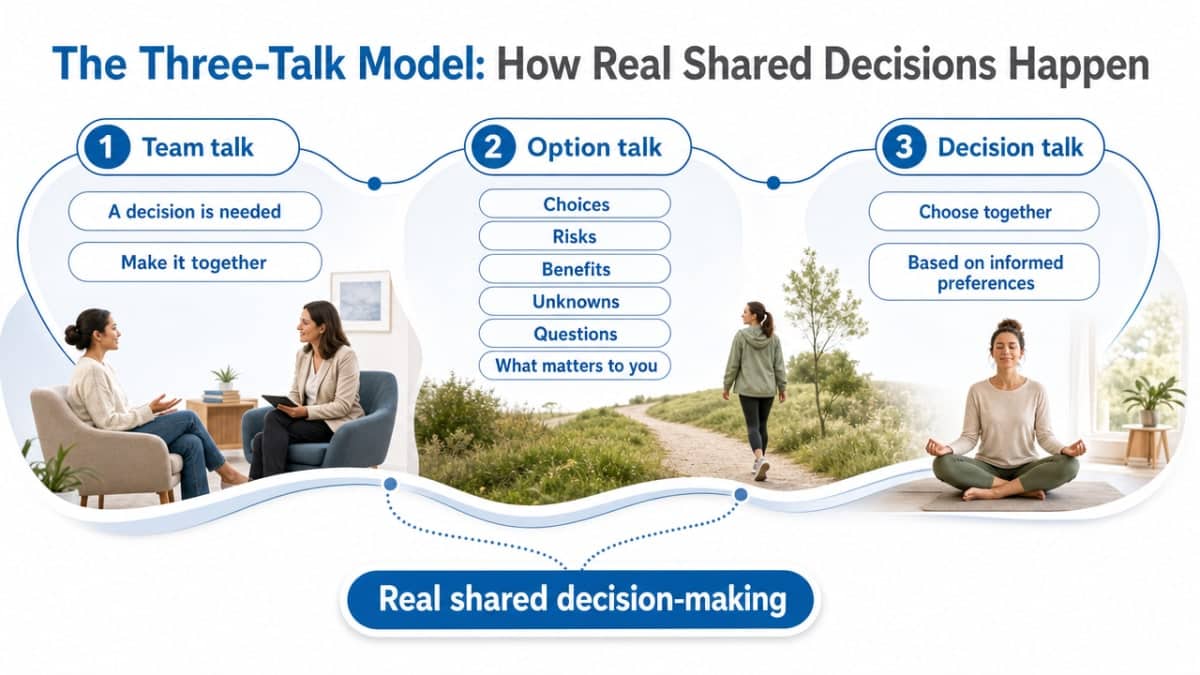
The clearest map for what a shared decision actually looks like in practice comes from something called the three-talk model. It breaks the conversation into three moves: team talk, option talk, and decision talk 1.
Team talk is the opening. You and your clinician acknowledge that a decision needs to be made and that you are going to make it together. Sounds obvious. It usually isn’t. Most appointments skip straight to a recommendation without anyone naming that there was a fork in the road.
Option talk is where the real information moves. Your clinician walks you through the actual choices — this mood stabilizer versus that one, adding therapy versus adjusting the dose, quarterly labs versus every six months — with the risks, benefits, and unknowns for each. You get to ask questions. You get to say the quiet part out loud, like “I can’t gain more weight, I’ll stop taking it.”
Decision talk is where you land the plane. You and your clinician settle on the plan, name what you’ll try first, and set the checkpoint for when you’ll revisit it.
A 2025 nationwide observational study of people receiving bipolar care found that these three components did not all do the same work. Team talk — the opening move that establishes you as a partner — was significantly positively associated with care that followed clinical guidelines. Decision talk — the closing move where the plan gets made explicitly with you — was positively associated with satisfaction with care and with medication adherence 1. Option talk mattered too, but the standout finding is that the bookends of the conversation carry a lot of weight.
One caveat worth naming: this was an observational study, not a randomized trial. It shows an association, not proof that adding team talk will single-handedly lift your adherence. But it does tell you something useful about where to spend energy in your appointments. If you feel rushed past the opening — no acknowledgment that a choice is being made — the whole rest of the conversation tends to collapse into instructions. If you leave without a clear decision talk — without hearing your clinician say back to you what you both agreed to and when you’ll check in on it — you often walk out unsure what the plan actually is.
A practical move for your next appointment: at the start, say something like, “I want to make this decision with you today. Can we walk through the options together?” At the end, ask, “So the plan is this, and we’ll revisit it on this date — is that right?” That is team talk and decision talk, in your own mouth, in about twenty seconds of appointment time.
The Medication Conversation You Probably Aren’t Having
Scripts for Side Effects, Preferences, and the Pill You Want to Stop Taking
Most people living with bipolar disorder want a real say in what medications they take. In one survey of people receiving bipolar care, participants clearly wanted to be involved in pharmacotherapy decisions, and that preference was especially strong among younger patients 6. If you have ever left an appointment with a new prescription and a vague feeling that you didn’t quite agree to it, you are not the exception. You are the norm.
The problem is that medication conversations in bipolar care are loaded. There is the tremor you’ve been hiding because you don’t want to lose the medication that finally stopped the racing thoughts. There is the twenty pounds you’ve gained on an antipsychotic that you have not mentioned because you’re afraid of what comes next. There is the pill you already stopped taking three weeks ago and haven’t told anyone about.
A few scripts that tend to open the door:
For a side effect you’ve been hiding: “I’ve been having [the specific thing] for about [how long]. I didn’t bring it up because I was worried you’d change the medication and I don’t want to lose what’s working. Can we talk about whether there’s a way to keep the benefit and reduce this?”
For a preference your clinician doesn’t know about: “Before we decide, there’s something I need you to know. [Sedation, weight gain, tremor, sexual side effects, whatever it is] is a dealbreaker for me — if it happens, I will stop taking it, and I’d rather we plan around that now than deal with it later.”
For a pill you already stopped: “I need to be honest — I stopped taking [medication] about [timeframe] ago. I want to tell you why, and I want us to figure out what to do next together.”
None of these scripts are magic. What they do is make it possible for the option talk in your appointment to be based on the real situation instead of a cleaned-up version. Your clinician cannot help you weigh tradeoffs they don’t know exist.
Planning the 12 to 18 Months After You Stabilize
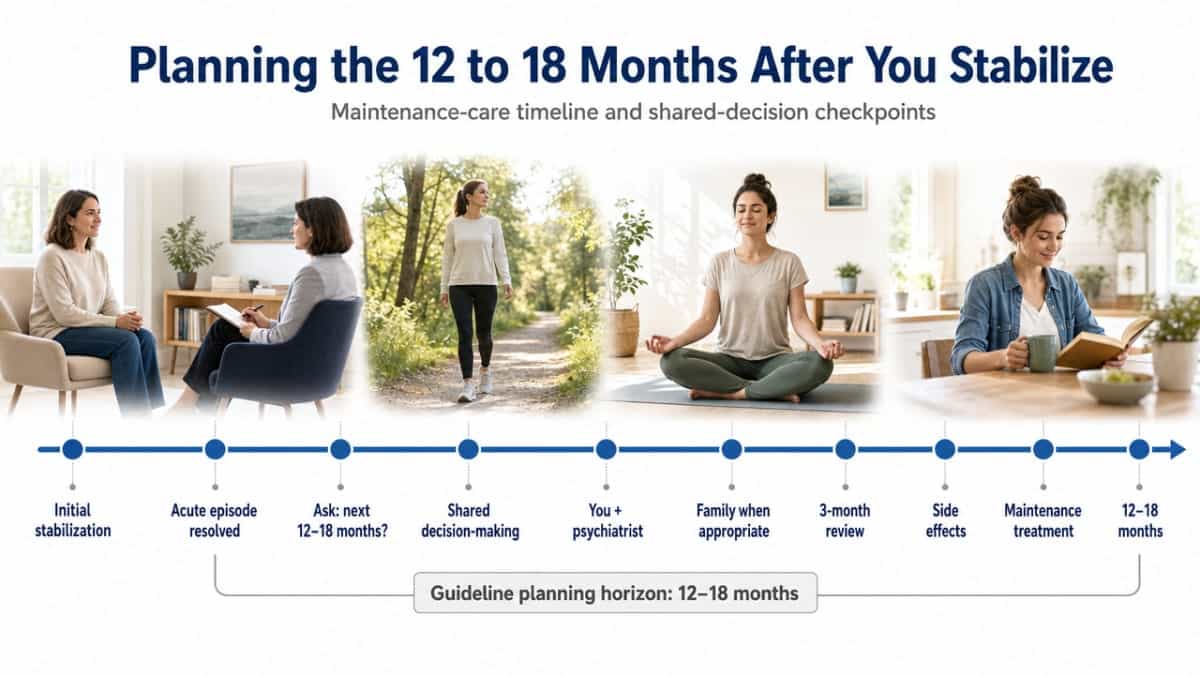
Stabilizing is not the finish line. It is the start of a much longer stretch of care that most people are never given a map for. The 2026 bipolar disorder guideline update recommends that maintenance treatment continue for at least 12 to 18 months after stabilization, and that the specific maintenance decisions be made through a shared decision-making approach with you and, when appropriate, your family 11. That window is the planning horizon you should be working with.
Here is what that year-plus actually contains, and where the shared-decision checkpoints belong:
Initial stabilization. You and your psychiatrist agree that the acute episode has resolved. This is the moment to say out loud: “What does the plan look like for the next 12 to 18 months?” If nobody answers that question, you are flying blind.
The 3-month review. Side effects that were tolerable at week two are sometimes not tolerable at month three. Your sleep, your weight, your labs, and your mood should all get checked. This is a natural place for option talk about small adjustments before they become big ones.
The 6-month review. By now you have real data on how life feels on this regimen. Are you actually functioning — working, sleeping, showing up for people — or just not in crisis? Those are different things, and the difference is worth naming.
The 12-month maintenance decision. This is the big one. Do you continue at the current dose? Simplify the regimen? Extend maintenance further? The guideline is explicit that this decision belongs to you and your clinician together, with family input if you want it 11.
What Your Team Should Be Tracking With You, Not Just For You
A good treatment alliance has a monitoring surface. There are specific things your care team should be watching over the long haul, and you should know what they are — not because you need to become your own clinician, but because it changes the relationship when you know what is on the checklist. You stop being the subject of care and start being a partner in it.
Reviews of collaborative bipolar care keep returning to five domains that separate strong programs from ones that just manage crises: suicide risk, substance use, medication side effects (including movement-related side effects like tremor or stiffness), metabolic health, and bipolar-specific psychoeducation 14. That last one is worth pausing on. Psychoeducation is not a lecture — it is your team making sure you understand your own illness pattern well enough to catch it early. It is a core quality measure, not a nice extra.
Here is what each of these looks like when your team is actually tracking with you:
Suicide risk. Not a one-time intake question. A recurring, direct check-in — especially during depressive episodes, medication changes, or major life events. You should feel able to say, “I’ve been having thoughts about not being here,” and know it triggers a real conversation, not a form.
Substance use. Alcohol, cannabis, stimulants — all of it interacts with mood and with your medications. Your team should be asking without judgment, and you should be answering honestly. Hiding this is one of the most common ways treatment quietly derails.
Medication side effects. Tremor, stiffness, restlessness, sedation, sexual side effects. If your psychiatrist is not asking about these at every visit, ask if you can add them to the standing agenda.
Metabolic health. Weight, blood pressure, blood sugar, cholesterol, thyroid, kidney function. Several bipolar medications affect these directly, and the labs should be on a schedule, not an afterthought.
Bipolar-specific psychoeducation. Your early warning signs. Your sleep patterns before an episode. Your personal triggers. Your team should know these as well as you do, and if they don’t, that is a conversation to schedule.
Ask your psychiatrist or therapist how they track these five with you. If the answer is vague, that is useful information about where your alliance needs work — and a small, specific thing to bring up at the next visit.

Bringing Family In Without Handing Over the Steering Wheel
Family involvement in bipolar care sits on a knife’s edge. Done well, it is one of the strongest supports you have. Done badly, it turns into a loop where a parent or partner starts speaking for you at appointments and you stop showing up as yourself. The 2026 guideline update names family involvement as one of the core alliance-building strategies alongside psychoeducation and shared decision-making, and it is specific about the form: active involvement of caregivers, collaborative decisions with the patient and family, and simplified regimens the household can actually track 11.
The key word there is with. Not for. Not instead of.
A useful move is to define, in writing, what your family actually does and does not do in your care. Something like: they are on the list of people your psychiatrist can call if you go three weeks without contact. They know your early warning signs — the ones you identified together during a stable stretch, not the ones they invented during a fight. They can attend the 6-month or 12-month maintenance decision appointment if you invite them, and they know that invitation is yours to give.
What they do not do is override your decisions when you are well. They do not phone the office behind your back. They do not decide when you need a medication change.
Have this conversation once, out loud, when your mood is steady. Tell your psychiatrist who is on your list and what they are allowed to know. That single document — informal or formal — prevents most of the family conflicts that derail treatment during a rough stretch 10.
Telehealth as Continuity, Not a Novelty
If you have moved, changed jobs, had a baby, or hit a stretch where getting to an office at 2 p.m. on a Tuesday is genuinely impossible, telehealth is not a downgrade. It is often the thing that keeps your alliance intact when in-person care would have quietly ended.
The evidence backs this up. A 2024 systematic review of tele-mental health for mood disorders, including bipolar disorder, found that video-based psychiatry and therapy produced clinical outcomes comparable to in-person care, and improved access and follow-up rates 9. Comparable is the important word. Not worse. Not a compromise. The same medication management, the same therapy protocols, delivered on a screen.
Where telehealth actually shines for a treatment alliance is continuity. You keep the same psychiatrist through a move across the state. You keep your therapist when your work schedule flips. You do not have to rebuild your history from scratch with a new provider every time life shifts — and rebuilding history is where a lot of bipolar care loses momentum.
Where it falls short is worth naming honestly. Subtle signs — a tremor in your hand, weight changes, the way you carry yourself when you walk into a room — are harder to read over video 9. Privacy at home is not always real; if your partner is in the next room, you may not say what you need to say. Digital literacy and a stable connection are not universal, and appointments held over spotty wifi degrade fast.
A few moves that make video appointments do more work: sit somewhere you can actually be alone, even if that means your car. Keep a running note on your phone of side effects, sleep changes, and mood shifts between appointments — you will not remember them at 9:47 a.m. on Thursday. Once or twice a year, if you can, do an in-person visit for the labs, the weight check, and the face-to-face read that video cannot replicate. Telehealth carries most of the alliance. The in-person visits catch what the camera misses.
When Hypomania Argues You Don’t Need This Anymore
Hypomania is a persuasive lawyer. It shows up with real evidence: you feel great, you’re productive, you’re sleeping less and getting more done, your creativity is back. And then it makes the case that the medication was the problem all along — that you are finally yourself again, and the pill is what was flattening you.
This is the moment where treatment alliances earn their keep. Not the calm months. This one.
The reason to build the alliance ahead of this moment is that hypomania will not let you build it during. When your judgment is the thing being pulled, you cannot rely on your judgment to catch it. What you can rely on is a plan you made when your mood was steady, with people who agreed to hold the line with you.
A few things to put in place while you are well: identify your two or three earliest warning signs — reduced sleep, spending changes, a specific kind of irritability, ideas coming faster than you can write them down — and tell your psychiatrist, your therapist, and one family member what they are. Give your team explicit permission, in writing if you can, to raise the alarm when they see the signs, even if you push back. Agree in advance that you will not make medication changes unilaterally during a suspected hypomanic stretch — that any change goes through a decision talk with your psychiatrist first 1.
The alliance you built during team talk and decision talk is what this plan runs on. It is why continuity matters. A clinician who has known you for a year can tell the difference between you and hypomania-you. A new one, meeting you at your most convincing, often cannot 12.
Auditing Your Alliance Before Your Next Appointment
You do not need a perfect care team to have a strong alliance. You need to know where the gaps are, so you can name one of them at your next appointment and start closing it.
Try this before you go. Ask yourself, honestly:
Team talk. When we make decisions, does my clinician acknowledge that a decision is being made, or does it just get handed to me?
Option talk. Do I hear the actual tradeoffs between choices, or just one recommendation?
Decision talk. Do I leave with a clear plan and a checkpoint on the calendar, or a vague sense of what to do next?
The seven elements. Which of these is thin right now — person-centered care, collaboration, shared decisions, open communication, trust, support, or continuity 12?
The five monitoring domains. Do I know how my team is tracking suicide risk, substance use, side effects, metabolic health, and my own early warning signs 14?
Family. Have I told my psychiatrist who is on my list and what they are allowed to know?
Pick one gap. Bring it up next visit. Say, “I want us to work on this piece of how we do this together.” That is how the alliance gets built — one specific conversation at a time. If you are looking for a starting point, an integrated psychiatry and counseling team like Mind Body Optimization is the kind of setting these conversations are designed to happen inside of.
Take Your Next Step Toward Mood Stability
Connect with a provider committed to collaborative, personalized care for your bipolar disorder journey.
Frequently Asked Questions
What is a bipolar disorder treatment alliance, and how is it different from just liking my psychiatrist?
A treatment alliance is your working relationship with the people treating you — built on shared decisions, open communication, trust, and continuity over time 12. Liking your psychiatrist helps. It is not the same thing. You can like someone who hands you a plan without ever asking your input, and you can build a strong alliance with someone whose personality does not match yours.
How do I bring up shared decision-making with a psychiatrist who seems set on one medication plan?
Try saying, “Before we finalize this, can you walk me through the other options and their tradeoffs? I want to make this decision with you.” That single sentence opens option talk. If your clinician is not willing to have that conversation, that is important information about your alliance. People living with bipolar disorder, especially younger patients, consistently say they want to be involved in medication decisions 6.
How long should I stay on medication after I stabilize?
Current guidelines recommend continuing maintenance treatment for at least 12 to 18 months after stabilization, with the specific plan made through shared decision-making between you, your clinician, and — if you choose — your family 11. Beyond that window, decisions about continuing, adjusting, or extending maintenance depend on your history, your risk of relapse, and your preferences. Bring this question to your stabilization appointment directly.
How much should my family be involved in my treatment decisions?
As much as you decide, and no more. Guidelines actively support family involvement in bipolar care — psychoeducation, monitoring warning signs, participating in maintenance decisions when you invite them 11. The key is defining the role while you are well: who is on your list, what they can know, when they can contact your team. That written boundary protects both your autonomy and their ability to help.
Can I really build a strong treatment alliance over telehealth?
Yes. Systematic review evidence shows telemental health for mood disorders produces clinical outcomes comparable to in-person care and often improves access and follow-up 9. What telehealth does especially well is protect continuity — keeping the same psychiatrist and therapist through moves, schedule shifts, and life changes. It falls short on subtle physical cues and household privacy, so occasional in-person visits for labs and face-to-face reads help fill the gap.
What should I do when hypomania makes me want to stop treatment?
Do the planning now, while you are steady. Identify your two or three earliest warning signs and share them with your psychiatrist, therapist, and one family member. Agree in advance that any medication change during a suspected hypomanic stretch goes through a decision conversation with your psychiatrist first — not a unilateral choice. The alliance you built when your mood was steady is what carries the plan through when your judgment is being pulled 12.
References
- Shared decision-making in the treatment of bipolar disorder. https://pubmed.ncbi.nlm.nih.gov/39377952/
- Developing a Decision Support Tool to Guide Shared Decision-Making in Treatment for Bipolar Depression. https://pubmed.ncbi.nlm.nih.gov/40491157/
- Mental Health Collaborative Care and Its Role in Primary Care Settings. https://pmc.ncbi.nlm.nih.gov/articles/PMC3759986/
- The impact of shared decision-making on the treatment of mental disorders: A systematic review. https://pmc.ncbi.nlm.nih.gov/articles/PMC8517854/
- Shared decision-making in mood disorders: A systematic review focusing on mood disorders. https://pubmed.ncbi.nlm.nih.gov/29589129/
- Shared decision making in pharmacotherapy decisions, perceived by patients with bipolar disorder. https://pmc.ncbi.nlm.nih.gov/articles/PMC6170516/
- Efficacy of shared decision-making on treatment adherence of patients with bipolar disorder: a cluster randomized trial (ShareD-BD). https://pmc.ncbi.nlm.nih.gov/articles/PMC5899333/
- Shared decision‐making interventions for people with mental health conditions. https://pmc.ncbi.nlm.nih.gov/articles/PMC9650912/
- The Efficacy of Telemental Health Interventions for Mood Disorders: A Systematic Review. https://pmc.ncbi.nlm.nih.gov/articles/PMC11180629/
- Clinical Practice Guidelines for Management of Bipolar Disorder. https://pmc.ncbi.nlm.nih.gov/articles/PMC5310104/
- Clinical practice guidelines for the management of bipolar disorder (2026 update). https://pmc.ncbi.nlm.nih.gov/articles/PMC12900052/
- Treatment alliance and adherence in bipolar disorder. https://pmc.ncbi.nlm.nih.gov/articles/PMC6230924/
- Bipolar Disorder in Primary Care: Integrated Care Experiences. https://pubmed.ncbi.nlm.nih.gov/29333108/
- Collaborative mental health and primary care for bipolar disorder. https://pubmed.ncbi.nlm.nih.gov/18677200/