

Key Takeaways
- Asian Americans have the lowest mental health service use of any major U.S. racial group, and the gap reflects cultural pressure, language, and access barriers rather than lower need 3.
- Anxiety and depression often surface first as physical symptoms like insomnia, headaches, or chest tightness, which is why so many cases go unnamed and untreated 2.
- Low aggregate suicide rates can hide individual risk, since Asian American decedents frequently have no documented mental health history before their deaths 9.
- Care that fits — culturally aware clinicians, integrated counseling and psychiatry, and telehealth used for privacy — lowers the cost of reaching out without forcing a choice between worlds 1.
The Sunday call you never quite finish
It’s Sunday evening. The rice cooker clicks off in the kitchen, your phone buzzes with the weekly call, and you already know how it will go. Your mom will ask if you’re eating. Your dad will ask about work. You’ll say everything is fine, because everything has to be fine. You hang up, sit on the edge of your bed, and feel that familiar tightness settle back into your chest.
You haven’t told them you’ve been waking up at 3 a.m. for months. You haven’t told them about the Slack message you re-read four times before sending, or how you cried in the bathroom at work last Tuesday and then went back to your desk and answered emails. You haven’t told anyone, really. Saying it out loud feels like it would make it real, and real feels like it would cost you something you can’t afford to lose.
If any of that lands, you’re not alone, and you’re not weak. Asian Americans have the lowest rate of mental health service use of any major racial group in the U.S., even when distress is clearly present 3. That gap isn’t about willpower. It’s about a tangle of love, expectation, language, and quiet math you’ve been doing your whole life.
This piece is for you. And if you’re the one watching someone you love go quiet, it’s for you too.
What ‘untreated’ actually looks like in the data
Here’s the part that surprised even the researchers. Asian Americans have the lowest mental health service utilization of any major racial group in the United States, and it isn’t because the need is lower 3. The need is there. The care isn’t reaching it.
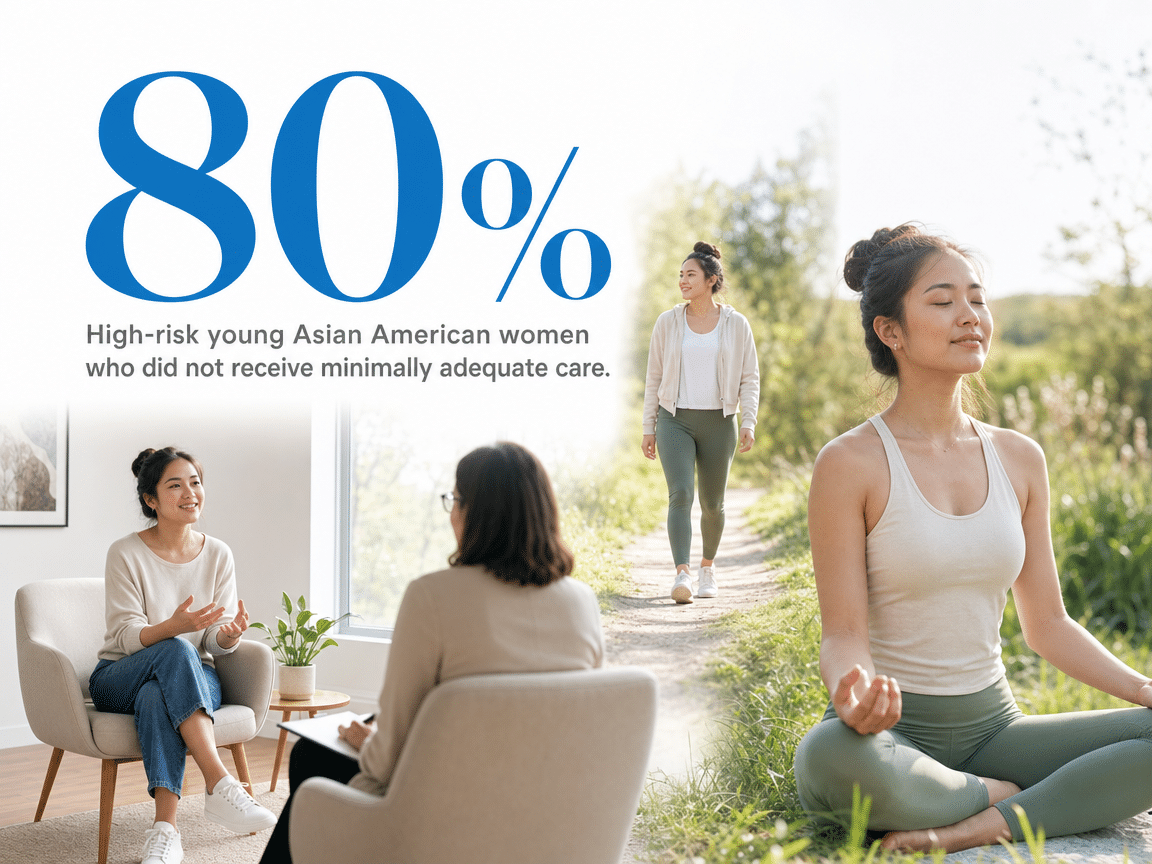
One study followed a group of young Asian American women who were already in crisis — they had documented depression and a history of suicidal behavior. By any clinical measure, this is exactly the group the system is supposed to catch. More than 60% of them did not access any mental health care at all. More than 80% did not receive what would be considered minimally adequate treatment 5. That’s a narrow, high-risk sample, not a stand-in for every Asian American reader, but it tells you something important about how deep the gap can go even when someone is visibly struggling.
National data echoes the same pattern in softer outlines. The 2020 National Survey on Drug Use and Health found that a substantial share of Asian and Native Hawaiian or Pacific Islander adults with a major depressive episode or serious mental illness did not receive any treatment in the prior year 11. People aren’t getting care. They’re absorbing it.
If you’ve been reading those numbers and thinking, that’s me, that’s my sister, that’s the friend who stopped texting back — you’re seeing it clearly. The silence around this isn’t proof that things are fine. It’s part of how the gap stays open.
When distress shows up in the body before the mind
Before you ever thought the word anxiety, your body was already telling you. The jaw that wakes up sore. The chest that tightens during a one-on-one with your manager. The stomach that knots up an hour before the family group chat lights up. The headaches that the doctor can’t quite explain. The insomnia that you’ve started calling “just being a light sleeper.”
This isn’t in your head — or rather, it is, but it’s also everywhere else. Researchers have long noted that emotional distress in Asian American communities often surfaces first as physical symptoms, not as the language of sadness or worry 6. There are good reasons for that. In many households, you grew up hearing about a sore back, a heavy stomach, poor sleep — concrete, fixable things — long before anyone said the words depressed or anxious. The body was the acceptable place to hurt. The mind was not.
So when something is wrong, your body speaks the language it learned. You go to urgent care for the chest pain. You get bloodwork for the fatigue. You try a new pillow for the headaches. The tests come back clean, and you walk out feeling both relieved and quietly worse, because something is still wrong and now you have one less explanation for it.
If this is where you are, you’re not imagining it and you’re not exaggerating. The somatic stuff is real. It’s also one of the most common ways anxiety and depression announce themselves in Asian American adults, which is part of why so many cases go unnamed and untreated 2. Naming what’s happening doesn’t make the physical symptoms less real. It just gives you a wider set of tools to actually help them ease.
Why the same values that hold the family together also keep care out
The model minority myth as a workplace problem
The model minority myth isn’t just a stereotype you read about in college. It’s a pressure you carry into every standup meeting, every performance review, every Slack thread where you stay quiet because speaking up feels like admitting you can’t handle it. You’re the one who answers emails on vacation. You’re the one who picks up the slack when a teammate is out. You’re the one who never calls in sick — and definitely not for something as fuzzy as your mental health.
Focus groups with Asian American young adults describe this exact bind: the pressure to meet parental expectations, live up to the model minority stereotype, balance two cultures, and manage discrimination — all at once, all without complaint 4. The workplace version of that pressure is quieter but just as constant. If you’re known as the dependable one, the high performer, the person who doesn’t need handholding, taking a Tuesday afternoon off for a therapy appointment can feel like breaking the spell.
And here’s the part nobody says out loud: the myth pays you for the silence. Promotions, good reviews, being trusted with the hard project. So when you start to wonder if you might be depressed, you also start doing the math on what naming it might cost. That math is real. It’s also a reason care keeps getting pushed to next quarter, and the quarter after that.
Filial piety, face, and the math of not burdening anyone
There’s a calculation you’ve probably run a hundred times without noticing. Your mom worked two jobs. Your dad doesn’t sleep well. Your grandparents survived things you can barely fathom. Set against all of that, what does your insomnia look like? What does your low-grade dread on a Sunday night weigh? Nothing, you tell yourself. Less than nothing. So you don’t say it.
This isn’t a flaw in your thinking. It’s filial piety doing what it was built to do — protect the people who protected you, preserve the family’s face, keep the household running smoothly. The trouble is that the same instinct that makes you a good daughter, a good son, a good eldest cousin also makes it nearly impossible to say I’m not okay out loud. Research on Asian American help-seeking calls this out directly: fear of creating disharmony in the family system causes many people to hide their struggles, and shame becomes one of the strongest predictors of not reaching out for professional help 13.
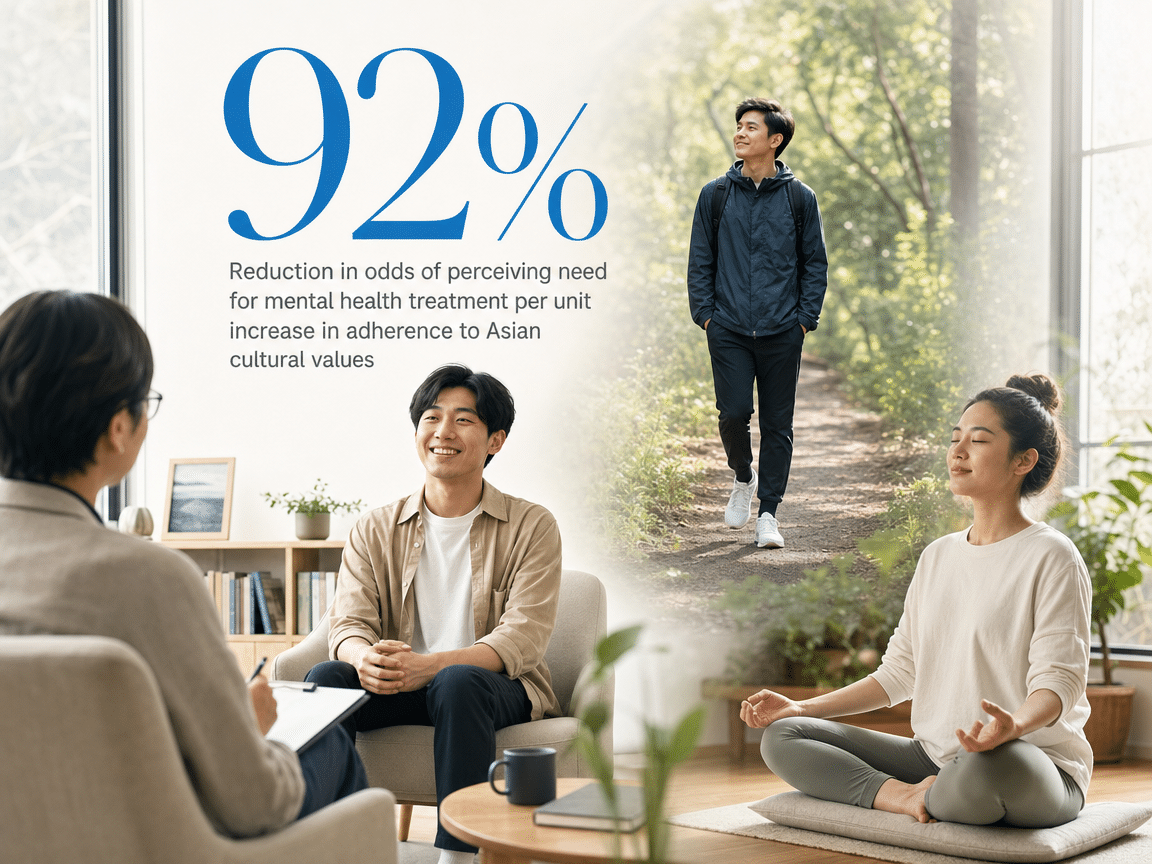
The data on cultural values puts a sharp number on it. In a study of Asian-identifying college students, each unit increase in adherence to Asian cultural values was associated with a 92% reduction in the odds of perceiving a need for mental health treatment, even when distress was present 12. That sample was college-age, so don’t read it as a verdict on every Asian American adult. But the direction is hard to miss: the more deeply you hold the values your family raised you with, the less likely you are to look at what you’re feeling and call it something a clinician could help with.
Here’s the reframe that matters. Getting care isn’t a betrayal of those values. It’s how you keep being the person your family raised — without burning out, going numb, or quietly disappearing inside your own life.
First-gen, 1.5-gen, second-gen: three different rooms in the same house
“Asian American” is not one experience, and the gap between you and your parents — or you and your kids, or you and your cousin who came over at age nine — isn’t a small one. It changes what distress feels like, what words you have for it, and whether therapy reads as foreign, threatening, or finally available.
If you’re first-generation, you may have arrived already carrying things that don’t translate. The CDC-linked research on the immigrant health paradox found that foreign-born Asian Americans report worse self-rated mental health than U.S.-born peers, yet show lower odds of a diagnosed disorder — a gap that likely reflects language barriers, different vocabularies for distress, and being missed by a system that wasn’t built for you 7. Fair or poor English in particular is strongly tied to all of those outcomes.
If you’re 1.5-generation — arrived as a kid, grew up half here and half there — you’re often the bridge. You translate at doctor’s appointments. You explain school forms. You hold two emotional languages and code-switch between them so fluently you forget you’re doing it. The cost of being the bridge is rarely tallied.
If you’re second-generation, you might have the vocabulary for anxiety and depression, the insurance card, maybe even friends in therapy — and still face a parent who hears “I’m seeing a counselor” as I failed you. The words are available. The conversation isn’t.
Each of these rooms has its own door. None of them are locked. They just open differently, and a clinician who understands that is half the work.
The quiet risk hidden under low aggregate numbers
There’s a number that gets quoted a lot, and it can do real harm if you stop reading at the headline. In 2023, the overall U.S. age-adjusted suicide rate was 14.1 per 100,000. Among non-Hispanic Asian persons, it was 6.5 per 100,000 — the lowest of any major racial group 8. On a chart, that gap looks like good news. In a living room, it can sound like proof that our community is fine, you’re fine, stop making a thing of it.
Please hear this gently: a lower aggregate rate is not the same as low individual risk. It’s an average pulled across dozens of subgroups, ages, immigration histories, and life circumstances. It can mask the person who is quietly drowning in a household where nobody knew to look.
If you’ve been telling yourself I can’t be that bad — look at the statistics, please let yourself off that hook. Distress that hasn’t been named, charted, or said out loud is still distress. It still deserves care. You don’t have to be a statistic to be worth reaching for help.
The access barriers that don’t get named at the dinner table
Even after you’ve decided, quietly, that maybe you do want help, a different set of walls shows up. These are the ones nobody warns you about because they’re boring on paper and brutal in practice.
Insurance is the first one. Research on adult Asian Americans found that having health coverage and being comfortable speaking English were two of the strongest predictors of whether someone actually used mental health services — not whether they needed them, whether they could reach them 14. If your plan has a narrow network, or you’re on a parent’s policy and the explanation of benefits goes to their address, or you work a salaried job that technically covers therapy but only at $40 a session out-of-pocket after the deductible, you already know how fast a good intention dies in a billing portal.
The second wall is finding someone who gets it without a long preamble. A national analysis of Asian Americans with perceived mental health needs flagged “difficulty finding a culturally appropriate therapist” as a real, named barrier — not a soft preference 1. Spending the first three sessions explaining what filial piety is, or why you can’t just “set a boundary” with your mother, is exhausting on top of being expensive.
The third wall is time. Standard 9-to-5 therapy hours collide with the same workday that’s making you sick. None of this is your fault. It’s the system. And it’s worth knowing the shape of it before you blame yourself for not having reached out yet.
What care can look like without asking you to choose between worlds
Integrated psychiatry and counseling, in plain language
Here’s what care can actually mean, stripped of the clinical packaging. Integrated treatment is a fancy way of saying that the person helping you with the medication side and the person helping you with the talking side are working from the same notes, on the same plan, for the same you. You’re not stuck repeating your story to a new face every six weeks.
Counseling is where you get to say the things out loud — the Sunday call, the Slack message, the headache that won’t quit — to someone trained to hold all of it. Psychiatry, when it’s part of the plan, looks at whether medication might take some of the edge off the sleep, the racing heart, the heaviness that has its own gravity. Not every person needs both. Some people start with counseling alone. Some need short-term medication to get steady enough to do the deeper work. A clinician who understands cultural context won’t push you toward either before you’re ready, and won’t treat your hesitation about medication as resistance — they’ll treat it as information.
What matters is that the plan fits your life, not the other way around.
Telehealth as a privacy strategy, not a convenience
The pitch for telehealth usually sounds like a feature list — flexible hours, no commute, log in from anywhere. That’s true, and it misses the point for a lot of Asian American readers.
If you live with your parents, or with a partner who hasn’t been let into this part of your life yet, or in a house where the walls are thin and the questions are constant, telehealth is sometimes the only door that opens. A session from your parked car on a lunch break. A session from a locked bedroom on a Thursday night, headphones in, while the rice cooker clicks off downstairs. A session before the family group chat wakes up on a Saturday morning. These aren’t workarounds. For a lot of people, they’re the entire reason care became possible at all.
An evening telehealth appointment also doesn’t show up on a calendar your manager can see, doesn’t require explaining a midday absence, and doesn’t ask you to perform composure in a waiting room. The privacy isn’t a perk. It’s the on-ramp.
If you’re the sibling, partner, or adult child noticing it
This part is for you — the one who has been watching. Maybe your younger brother stopped coming to dinner. Maybe your wife has been waking up at 4 a.m. and saying it’s just work. Maybe your mom has been quieter for a year and you don’t know how to ask without making her angry or sad. You’re not imagining what you’re seeing. And you’re allowed to want to help.
A few things that tend to land better than “Are you okay?” — a question most of us were trained to answer with yes before we even heard it. Try something specific instead: I noticed you’ve been really tired lately. Want to get pho on Saturday, just us? Specific is harder to deflect than general. Specific says I’m paying attention without demanding a confession.
Don’t lead with “you need therapy.” For someone raised in a household where seeking outside help can register as airing family business, that sentence can shut the door for months 13. Lead with presence. Sit with them. Drive them to the appointment if they get there. Offer to help research a clinician who understands cultural context — that search is genuinely hard, and naming it as a barrier rather than a personal failing matters 1.
If you’re worried about safety, take it seriously even if the usual warning signs aren’t loud. Asian American suicide decedents are often missing the documented mental health history that systems are trained to look for 9. Trust what you’re noticing. You don’t have to diagnose anything. You just have to stay close, and keep the door open.
A small next step that respects your pace
You don’t have to call your mom. You don’t have to come out to your whole family as someone who goes to therapy. You don’t have to decide today whether you’ll be on medication, or for how long, or what any of this means about who you are. None of that is the first step.
The first step is smaller. It might be writing down, just for yourself, the three things your body has been doing for the past month. It might be opening a browser tab and looking up what your insurance actually covers. It might be a fifteen-minute consult with a clinician who knows that filial piety and a Tuesday performance review can both be part of the same conversation.
Whatever has kept you from reaching out before — the cost, the language, the worry about who would find out, the quiet certainty that other people have it worse — it gets to come with you into the room. You don’t have to leave any of it at the door.
Start your path toward calmer, brighter days
Connect with a professional who truly understands your unique story and cultural experience.
Frequently Asked Questions
How do I know if what I’m feeling is anxiety or depression and not just stress from work?
Stress eases when the deadline passes. Anxiety and depression don’t. If the tightness, the 3 a.m. wake-ups, the dread before opening your laptop, or the flatness on weekends has lasted weeks or months — and it’s bleeding into how you eat, sleep, and show up for the people you love — that’s worth a conversation with a clinician. You don’t need a diagnosis to deserve one.
Can I start therapy without telling my family?
Yes. Therapy is confidential, and you get to decide who knows, when, and how much. Telehealth from a locked bedroom or a parked car works for exactly this reason. Many people start care quietly and tell family later — or not at all. That’s your call to make on your timeline, not a requirement of getting help.
What if my symptoms are mostly physical — headaches, stomach issues, chest tightness — and not sadness?
That’s one of the most common ways anxiety and depression show up in Asian American adults, and it’s a recognized pattern in the research 2. The physical symptoms are real, and so is what’s driving them. A clinician who understands somatic presentations won’t dismiss the body stuff or insist you cry on cue. Both layers get attention.
How do I find a therapist who actually understands the cultural piece?
This is a named barrier in the research, not a personal failing of yours 1. Ask directly on a consult call: Have you worked with first- or second-generation Asian American clients? How do you think about family obligation and shame in treatment? The answer tells you a lot in two minutes. Group practices with diverse clinicians and integrated care teams tend to have more options.
My parent or sibling won’t talk about it. What can I say without making things worse?
Skip “you need therapy.” Try specific presence instead: I noticed you haven’t been sleeping. Want to take a walk after dinner? Sit with them. Don’t push. If safety is on your mind, take it seriously even without the usual warning signs — research shows those signals are often missing in Asian American risk 9. Stay close. Keep the door open. That’s the work.
Does taking medication for anxiety or depression mean I’ll be on it forever?
No. For many people, medication is a bridge — something to steady the sleep, the racing heart, the heaviness — while counseling does the longer work underneath. Some stay on it for a season. Some longer. Some never need it. A psychiatrist who listens won’t push you toward or away from medication. The plan adjusts as you do, and stopping is a conversation, not a failure.
References
- Correlates of Mental Health Treatment Receipt Among Asian Americans with Perceived Mental Health Problems. https://pmc.ncbi.nlm.nih.gov/articles/PMC7606267/
- Factors Associated with Mental Health Help-Seeking Among Asian Americans. https://pmc.ncbi.nlm.nih.gov/articles/PMC8170060/
- Predicting the Behavioral Health Needs of Asian Americans through Data Disaggregation. https://pmc.ncbi.nlm.nih.gov/articles/PMC10052246/
- Model Minority at Risk: Expressed Needs of Mental Health by Asian American Young Adults. https://pmc.ncbi.nlm.nih.gov/articles/PMC3296234/
- Factors influencing the underutilization of mental health services among Asian American women with a history of depression and suicide. https://pmc.ncbi.nlm.nih.gov/articles/PMC4673784/
- Mental Health Care for Asian Americans and Pacific Islanders (Chapter 5, Mental Health: Culture, Race, and Ethnicity). https://www.ncbi.nlm.nih.gov/books/NBK44245/
- Does an Immigrant Health Paradox Exist Among Asian Americans? Associations of Nativity and Occupational Class with Self-Rated Health and Mental Disorders. http://stacks.cdc.gov/view/cdc/217256
- Notes from the Field: Differences in Suicide Rates, by Race and Ethnicity, Sex, Age Group, and Urbanicity — United States, 2018–2023. https://www.cdc.gov/mmwr/volumes/74/wr/mm7435a2.htm
- Examining the Etiology of Asian American Suicide in the United States. https://pmc.ncbi.nlm.nih.gov/articles/PMC12241123/
- Asian Americans and discrimination during the COVID-19 pandemic. https://www.pewresearch.org/race-and-ethnicity/2023/11/30/asian-americans-and-discrimination-during-the-covid-19-pandemic/
- Asian Slides for the 2020 National Survey on Drug Use and Health. https://www.samhsa.gov/data/sites/default/files/reports/slides-2020-nsduh/2020NSDUHAsianSlides072522.pdf
- Shared Cultural Values Influence Mental Health Help-Seeking Behaviors Among Asian and Latinx College Students. https://pmc.ncbi.nlm.nih.gov/articles/PMC9249685/
- Asian Americans’ Perceptions of Mental Health Help-Seeking. https://thekeep.eiu.edu/cgi/viewcontent.cgi?article=5995&context=theses
- Use of Mental Health–Related Services Among Adult Asian Americans. https://www.ncbi.nlm.nih.gov/pmc/articles/PMC3051360/