

Key Takeaways
- Suicide loss is its own category of bereavement, with survivors facing higher rates of complicated grief, PTSD, depression, and suicidal thoughts than other bereaved groups 10, 14.
- Match the resource to your current moment — crisis tonight, first weeks, ongoing grief, or clinical territory — rather than trying to jump ahead of where you actually are.
- If you’re in crisis tonight, call or text 988, move away from anything you could use to harm yourself, and tell one person you’re not okay 7.
- In the first thirty days, stabilize with one clinician check-in, a survivor hotline saved in your phone, one person who knows the whole story, and permission to say no.
- Peer support groups like AFSP Loss & Healing and Alliance of Hope ease isolation and shame in ways general bereavement spaces can’t, though clinical evidence is still emerging 4, 13.
- Structured clinical care — grief-informed therapy, psychiatric evaluation, telehealth, and integrated treatment — has real signal for suicide-bereaved adults, even if the overall evidence base is small 2, 3.
- Escalate from peer support to clinical care if sleep is broken, intrusive images replay, work slips, substance use rises, or thoughts of your own death get harder to shake.
- Prolonged grief disorder is a distinct, treatable diagnosis for grief that stays frozen past six months, and suicide loss survivors carry higher rates of it 5, 14.
- Working adults can protect their careers using telehealth sessions, evening peer groups, EAP benefits, FMLA or short-term disability, and one trusted person at work.
- Supporting a survivor means saying the person’s name, offering specific help, showing up months later, and avoiding phrases like ‘at least’ or ‘everything happens for a reason’ 14.
- Leaders responding to a community loss should follow CDC’s three-phase framework: share factual information with 988 in the first 48 hours, screen close contacts within a month, then connect people to longer-term care 7, 9.
- A realistic next step is small: save 988 as a contact and put one specific support action — a group, EAP call, telehealth intake, or text — on your calendar this week.
Why suicide loss needs its own map of support
If you’re reading this, you’ve probably already noticed that the grief resources you find online don’t quite fit. General bereavement books talk about long illnesses and slow goodbyes. Well-meaning friends offer casseroles and clichés. None of it addresses the specific weight you’re carrying: the unanswered questions, the guilt loop that runs at 3 a.m., the stigma that makes people go quiet when you say how the person you loved died.
You’re not imagining that gap. Suicide loss is its own category of bereavement, and the research backs that up. A 2024 study of 161 suicide loss survivors measured how often clinical conditions showed up in the months and years after a loss: 22.0% met criteria for prolonged grief disorder, 12.4% for complex PTSD, 5.0% for PTSD, and 41.6% had at least moderate depressive symptoms 11. That’s a single study with a specific sample, not a universal verdict on every survivor. But it tells you something important — a substantial share of people in your situation are dealing with something clinical, not just sad.
Broader reviews echo the pattern. Suicide survivors face higher rates of complicated grief, depression, PTSD, and suicidal thoughts than people bereaved by other causes 10, 14. That’s why the resources that actually help tend to be built specifically for suicide loss — peer groups where you don’t have to explain why your grief is different, and clinicians who know what to screen for.
The rest of this guide is that map. Pick the layer you need tonight, and come back for the others when you’re ready.
Match the resource to where you actually are
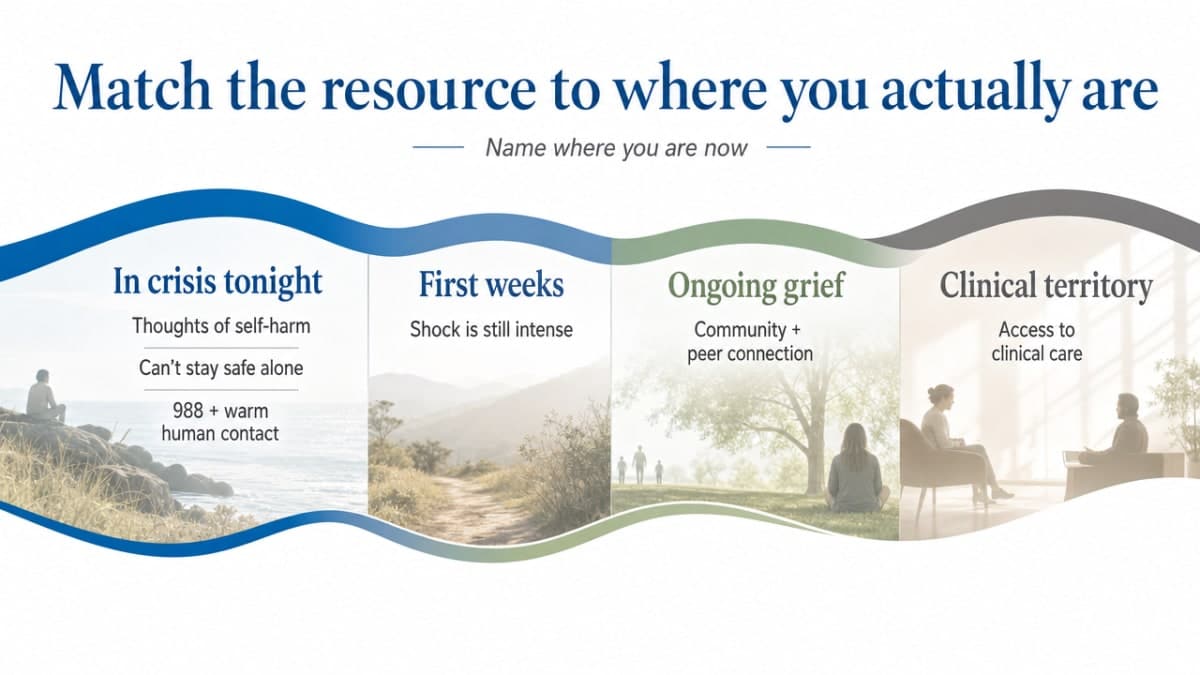
Grief after suicide doesn’t move in a straight line, and the resource that helps you tonight is probably not the one you’ll need six months from now. The most useful thing you can do before scrolling any further is name where you actually are right now — not where you think you should be.
National postvention and prevention frameworks organize survivor support along a similar arc: immediate crisis response, early stabilization, ongoing community and peer connection, and access to clinical care for people whose grief has crossed into something more 8. The bands below mirror that arc. They also mirror the sections that follow, so you can jump straight to what fits.
- In crisis tonight. You’re having thoughts of harming yourself, or you can’t stay safe alone. Start with 988 and a warm human contact.
- First weeks after a loss. The shock is still loud. You need stabilizing basics — a clinician for a check-in, a survivor-specific hotline, one trusted person who knows.
- Ongoing grief. Weeks have become months. Peer support groups built for suicide loss can carry a lot of weight here.
- Signs it has become clinical. Sleep, work, or safety is slipping. This is where structured outpatient care earns its place.
You may sit in more than one band at once. That’s normal. Pick the one that describes your hardest hour this week, and start there.
If you are in crisis tonight
If you’re a veteran, press 1 after dialing 988 to reach the Veterans Crisis Line. If you’re more comfortable in Spanish, press 2. If you’re LGBTQ+ and want to talk to someone trained for that, the Trevor Project offers 24/7 support at 1-866-488-7386 or by texting START to 678-678.
Here’s what to do while you wait for someone to answer, or while you decide whether to call:
- Move to a safer space. If there’s anything nearby you could use to hurt yourself, put distance between you and it. Ask a neighbor to hold medications overnight. Lock a firearm in a car trunk or leave it with a friend. This one step buys you time, and time is protective.
- Tell one person. Text a friend, a sibling, a coworker — anyone. You don’t need a script. “I’m not okay tonight, can you stay on the phone with me” is enough.
- Go to the nearest emergency room if you can’t stay safe. You can drive yourself, ask someone to drive you, or call 911.
Reaching out tonight isn’t a failure. It’s the whole point of these lines existing. You’re allowed to use them.
The first thirty days: stabilizing supports
The first month after a suicide loss is a strange, cracked-open time. You may find yourself functional at 10 a.m. and unable to breathe by 2 p.m. Sleep is often the first thing to go. So is appetite, concentration, and the ability to sit through a normal meeting without your mind sliding sideways. You don’t need to have a long-term plan yet. You need supports that keep you upright while the shock does its work.
A few things worth putting in place this month:
- One clinician check-in. If you already have a primary care doctor or a therapist, get on their calendar in the next week or two. Tell them what happened. Ask them to screen you for depression, PTSD symptoms, and sleep problems. Suicide loss survivors carry higher rates of complicated grief, depression, PTSD, and suicidal thoughts than people bereaved by other causes, and a baseline visit now makes it easier to notice if something shifts later 10, 14. If you don’t have anyone, a telehealth intake with an outpatient mental health provider — including virtual options across Texas, Tennessee, Oklahoma, and Missouri — is a reasonable first door.
- A survivor-specific hotline in your phone. Save 988 as a contact, along with the American Foundation for Suicide Prevention’s Loss Survivor resources. Having the number stored means you don’t have to search for it at 1 a.m. The CDC points survivors and worried loved ones to 988 as an evidence-anchored first step 7.
- One person who knows the whole story. Not five people who know pieces. One person you can text without a preamble. A sibling, a friend from college, a coworker you already trust. If you don’t have that person yet, a peer group in the next section can become that person.
- Permission to say no. Funerals, casseroles, well-meaning check-ins from distant relatives — you’re allowed to decline. “Thank you, not this week” is a complete sentence.
Sleep, food, water, and a few short walks are not glamorous, but they’re the ground your brain needs to process what happened. If you accomplish only those basics plus one appointment this month, you’re doing the work.
Peer support built for suicide loss survivors
There’s a specific kind of relief that comes from sitting in a room — or a Zoom square — with other people who lost someone the same way you did. You don’t have to explain why you’re still stuck on the “why.” You don’t have to soften the story for anyone. Someone across the circle nods before you finish your sentence because they’ve had the same thought at the same hour of the night.
Peer-led groups for suicide loss survivors are one of the most widely available forms of postvention, and national policy frameworks increasingly treat them as a core piece of survivor support, not a nice extra 4. A few worth knowing:
- AFSP Loss & Healing programs. The American Foundation for Suicide Prevention runs Healing Conversations (one-on-one peer support from a trained volunteer who is also a survivor) and maintains a directory of suicide loss support groups across the country, including virtual options that work if you’re outside a major metro.
- Alliance of Hope. An online community built specifically for suicide loss survivors, with a moderated forum, message boards organized by relationship (partner, parent, sibling, friend), and virtual groups. Useful if evenings are the hardest time and you need something at 11 p.m.
- Survivors of Suicide Loss (SOSL) and local chapter groups. Many counties in Texas, Tennessee, Oklahoma, and Missouri have in-person groups run through hospice organizations, faith communities, or NAMI affiliates. A quick search for “suicide loss support group” plus your city usually surfaces them.
- Relationship-specific groups. Parents Of Suicides, Friends & Families of Suicides, and sibling-focused groups exist because losing a child is not the same as losing a sibling, which is not the same as losing a spouse. If a general group feels off, try a narrower one.
Be honest with yourself about what peer support does well and what it doesn’t. Groups tend to help most with isolation, shame, and the sense that no one else can hear your story without flinching 4. Formal outcome research on peer-led programs is still emerging, and reviewers note that evidence for reducing clinical symptoms is thinner than the experiential benefit reported by members 4, 13. That’s not a reason to skip a group — it’s a reason to pair one with clinical care if your symptoms are heavy. Try two or three meetings before deciding whether a group fits. The first one is almost always the hardest.
Structured clinical care for grief, trauma, and depression
At some point, peer support and a good night’s sleep stop being enough. That’s not a failing on your part — it’s information. When grief is tangled up with trauma symptoms, depression that won’t lift, or thoughts of your own safety, structured clinical care is the layer that can move the needle.
Here’s the honest evidence picture. A systematic review of grief interventions built specifically for suicide loss survivors found that five of seven studied interventions reduced grief intensity on at least one outcome measure — bereavement groups helped most with uncomplicated grief, while writing-based interventions addressed the suicide-specific dimensions like guilt, blame, and unanswered questions 2. A broader review found the most promising programs share a pattern: supportive, therapeutic, and educational in nature, involving the people around the bereaved person, and running across multiple sessions led by trained facilitators 3. Not a magic bullet, but real signal.
What that looks like in practice for a working adult:
- A therapist who knows suicide loss. Ask directly. “Have you worked with clients bereaved by suicide?” is a fair first-session question. Modalities with the most support for this population include cognitive behavioral therapy adapted for grief, complicated grief treatment, and trauma-focused approaches like EMDR when intrusive images or nightmares are prominent.
- A psychiatric evaluation if sleep, appetite, or mood have been off for weeks. Medication is not a moral failure or a shortcut around grief. It’s a way to keep your brain functional enough to do the grief work.
- Telehealth as a real option. Virtual sessions mean you can do therapy from your living room on a lunch break instead of burning PTO for a commute. Outpatient providers across Texas, Tennessee, Oklahoma, and Missouri — including Mind Body Optimization — offer both in-person and virtual care, which matters when your evenings and mornings are already thin.
- Integrated care if there’s more than one thing going on. If you were already managing anxiety, depression, or a substance use pattern before the loss, a provider who can hold both the grief work and the underlying condition in one treatment plan will save you from stitching together three separate offices.
One caveat worth naming: reviewers consistently point out that the overall evidence base for suicide bereavement interventions is small and mixed in quality 1, 12. You’re not choosing between proven and unproven — you’re choosing between promising options with real experiential support and doing nothing. Promising and available beats perfect and hypothetical every time.
When to escalate from peer support to clinical care
Peer support is powerful, but it isn’t designed to treat clinical conditions. If you’ve been going to a group and still feel like you’re sinking, that’s not a sign the group failed. It’s a sign you may need a second layer alongside it.
Here are the signals worth taking seriously. Consider reaching out to a clinician if any of these have been true for more than a few weeks:
- Sleep is broken most nights. Not one bad night — a pattern of two or fewer hours, or waking at 3 a.m. and not getting back down.
- Intrusive images or nightmares keep replaying. If you found the person, or you keep imagining the scene, that’s a trauma symptom, not a character flaw. Suicide loss survivors carry elevated rates of PTSD and complicated grief compared with people bereaved by other causes 10, 14.
- Work is slipping in ways coworkers are noticing. Missed deadlines, missed meetings, or hours lost to dissociation at your desk.
- You’re using more alcohol, cannabis, or medication than you did before to get through evenings or fall asleep.
- You’re having thoughts of joining the person you lost, or thoughts of your own death that feel harder to shake. This one is non-negotiable — tell a clinician this week, and use 988 tonight if the thoughts are active.
- Six months in, the grief still has the same shape it did in week two. Ordinary grief shifts and softens unevenly, but it does move. Grief that stays frozen may be prolonged grief disorder, which is treatable 5.
Escalating doesn’t mean quitting your group. Most survivors who add therapy or medication keep going to peers too — the layers do different work. Ask your group facilitator for a referral, or book a telehealth intake so you don’t have to leave work for a first appointment.
Prolonged grief disorder: a category worth knowing
If six months have passed and your grief still has the same weight, the same shape, the same intrusive quality it had in week two, there’s a name for what you might be experiencing. Prolonged grief disorder was added to the diagnostic manuals in the last few years, and researchers now treat it as a distinct condition rather than a personal failing to “move on” 5.
The core feature is grief that stays intense and disabling long past when most people begin to reorganize their lives — persistent yearning, difficulty accepting the death, a sense that part of you died too, or trouble reengaging with work and relationships. Suicide loss survivors carry higher rates of it than people bereaved by other causes 5, 14.
Knowing the category exists matters for two reasons. First, it’s treatable — targeted therapies for prolonged grief have real support, and asking a clinician to screen you for it is a reasonable next step. Second, naming it can loosen the private shame of thinking you should be “further along” by now. You’re not broken. You may be carrying something clinical that has a name and a treatment path.
Working through it: resources for people with jobs and deadlines
Grief doesn’t pause for your quarterly review. If you’re back at your laptop three days after the funeral because bills don’t stop and your team is waiting, you’re not doing it wrong — you’re doing what a lot of survivors do. The trick is building supports that bend around your calendar instead of asking you to abandon it.
A few options built for people with jobs:
- Telehealth therapy sessions. A 45-minute virtual appointment on a Tuesday lunch break beats a two-hour round trip you’ll cancel by month two. Providers across Texas, Tennessee, Oklahoma, and Missouri, including Mind Body Optimization, offer virtual counseling and psychiatric visits that fit between meetings.
- Evening and weekend peer groups. AFSP and Alliance of Hope both list groups that meet after 7 p.m. or on Saturday mornings. You do not have to burn PTO to sit with other survivors.
- Your Employee Assistance Program. Most EAPs cover a handful of free confidential counseling sessions and can fast-track a referral. HR does not see the details. Look up your EAP number tonight so you have it when you want it.
- FMLA and short-term disability. If grief has crossed into a diagnosable condition — prolonged grief disorder, major depression, PTSD — a clinician can document it. That can protect your job while you get treatment 5.
- A single trusted person at work. One manager or peer who knows the basics can quietly reroute a meeting when you need it.
Using these supports is not weakness. It is how working adults keep their careers intact while doing hard interior work.
Supporting a survivor without making it worse
If you’re reading this because someone you care about lost a person to suicide, the good news is that showing up matters more than saying the perfect thing. There is no perfect thing. What survivors remember is who kept coming back after the casseroles stopped.
A few things that actually help:
- Say the name of the person who died. Survivors often feel like everyone is tiptoeing around them. Hearing their brother’s name, their wife’s name, spoken casually and warmly, is a gift.
- Offer specific help, not open-ended check-ins. “I’m bringing dinner Thursday, is 6 okay?” lands better than “let me know if you need anything.” Decision-making is expensive when you’re grieving.
- Keep showing up at month three, month six, month twelve. That’s when the world moves on and survivors feel most alone 14.
- Ask before sharing theories. Speculating about why the person died, or replaying what could have been done, adds weight. Follow their lead.
What to avoid: “at least,” “everything happens for a reason,” and any sentence that starts with “you should be.” If they mention their own safety is slipping, don’t panic — ask directly if they’re having thoughts of suicide, and help them dial 988 7.
If you manage a workplace, school, or community after a loss
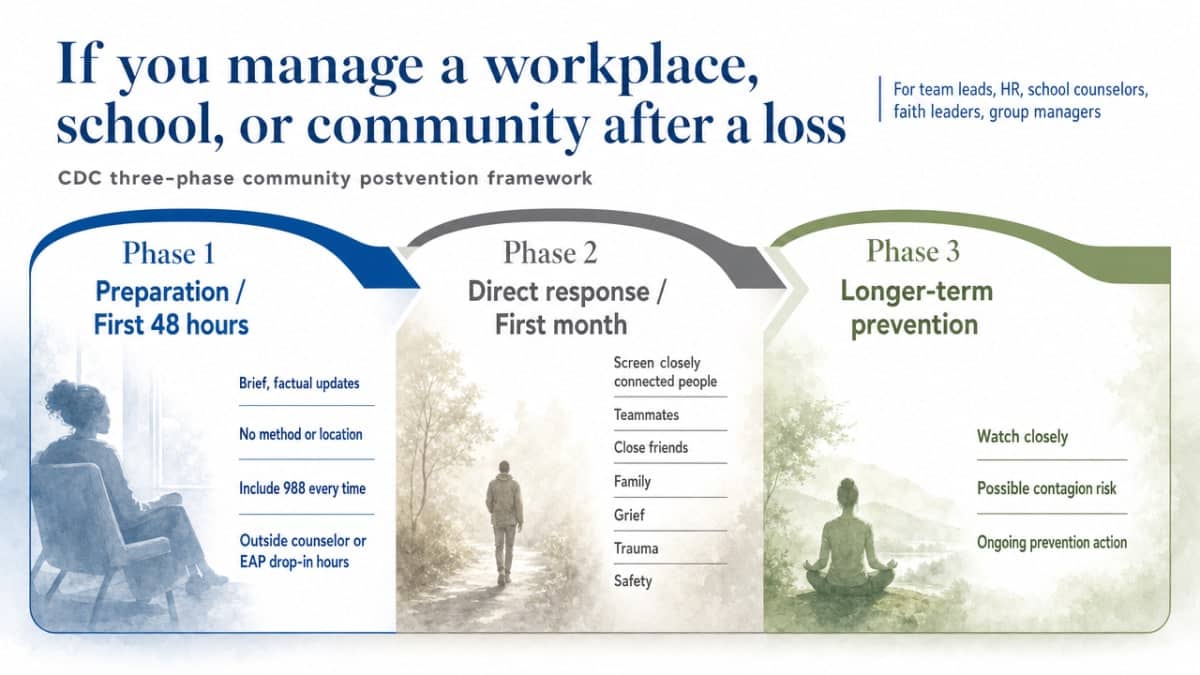
A quick audience note: this section is for team leads, HR partners, school counselors, faith leaders, and anyone else responsible for a group of people after a suicide loss. If that’s not you, skip ahead — but bookmark it, because someone may hand you this role someday.
CDC guidance for communities responding to a suicide loss lays out three phases: preparation, direct response, and longer-term prevention action 9. Translated into your week:
- In the first 48 hours, share brief, factual information without describing method or location. Offer 988 in every communication 7. Bring in an outside counselor or EAP contact for drop-in hours.
- In the first month, screen closely connected people — teammates, close friends, family of the person who died — for grief, trauma, and safety 9. Watch for signs of a possible cluster and keep a lower-key check-in rhythm going.
- Beyond the first month, connect people to survivor-specific peer groups and clinical care, and review whatever policies (leave, mental health benefits, firearm storage guidance) shaped the response 8.
Your job isn’t to be a therapist. It’s to keep the door to help wide open and easy to walk through.
A realistic next step for this week
You don’t have to build the whole plan tonight. You just have to pick one thing.
If it’s Sunday and the week ahead feels heavy, try this: save 988 as a contact in your phone right now. Then choose one item from earlier in this guide — a survivor-specific group meeting, an EAP call, a telehealth intake, a text to the one person who already knows. Put it on your calendar for a specific day and hour before Friday.
That’s it. One number saved, one appointment set. Reading this far was already work. Doing one small thing this week is how the layers of support actually start to hold you.
You lost someone. You’re still here, still reading, still looking. That counts for something.
Reach Out for Thoughtful Support Today
Connect with a professional who truly understands the challenges of surviving loss and moving forward.
Frequently Asked Questions
Is grief after suicide loss really different from other kinds of grief?
Yes, and you’re not making that up. Suicide loss survivors carry higher rates of complicated grief, depression, PTSD, and suicidal thoughts than people bereaved by other causes 10, 14. The guilt, the unanswered questions, and the stigma that follows a suicide death shape grief in ways general bereavement resources often miss. That’s why survivor-specific support exists.
How do I know if I need a support group or a therapist?
Start with a group if you feel isolated, stuck on the story, or desperate to talk with someone who gets it. Add a therapist if sleep is broken most nights, work is slipping, intrusive images keep replaying, or you’re having thoughts of your own safety. Most survivors benefit from both — peer connection and clinical care do different work, and one doesn’t replace the other.
What can I do tonight if I’m struggling and can’t reach a group or clinician?
Call or text 988. It’s free, confidential, and open every hour of every day, and the CDC points people in distress there as the first door to walk through 7. Then text one person you trust — a sibling, a friend, a coworker — and ask them to stay with you, on the phone or in person, until the wave passes.
Are peer support groups for suicide loss survivors actually effective?
The honest answer: members consistently report relief from isolation and shame, and peer-led groups are treated as a core piece of national postvention policy 4. Formal outcome research on clinical symptoms is thinner and still developing 4, 13. So groups are worth trying, especially for isolation and stuck grief, and worth pairing with clinical care if symptoms are heavy. Give any group two or three meetings before deciding.
What is prolonged grief disorder, and how is it different from ordinary mourning?
Prolonged grief disorder is a diagnosable condition marked by grief that stays intense and disabling long past when most people begin to reorganize their lives — persistent yearning, difficulty accepting the death, a sense that part of you died too 5. Ordinary grief shifts and softens unevenly but does move. Suicide loss survivors carry higher rates of prolonged grief, and targeted therapies can treat it 5.
How do I support a friend or coworker who lost someone to suicide without saying the wrong thing?
Say the name of the person who died. Offer specific help — “I’m bringing dinner Thursday at 6” — instead of open-ended check-ins. Keep showing up at month three, six, and twelve, when most people have moved on 14. Skip “at least,” “everything happens for a reason,” and any sentence starting with “you should be.” If they mention their safety is slipping, ask directly and help them dial 988 7.
References
- Interventions for people bereaved through suicide: systematic review. https://pubmed.ncbi.nlm.nih.gov/19043143/
- Grief interventions for people bereaved by suicide: A systematic review. https://pubmed.ncbi.nlm.nih.gov/28644859/
- Effectiveness of interventions for people bereaved through suicide: A systematic review of controlled studies. https://pmc.ncbi.nlm.nih.gov/articles/PMC6354344/
- Scoping Review of Peer-Led Support for People Bereaved by Suicide. https://pmc.ncbi.nlm.nih.gov/articles/PMC8954346/
- Prolonged Grief Disorder in Bereaved Individuals After Suicide: A Review. https://pmc.ncbi.nlm.nih.gov/articles/PMC9551042/
- Suicide Bereavement and Postvention: Current Status and Future Directions. https://pmc.ncbi.nlm.nih.gov/articles/PMC8775125/
- Strategies For Action. https://www.cdc.gov/suicide/resources/prevention.html
- Suicide Prevention Resource for Action. https://stacks.cdc.gov/view/cdc/124648
- CDC Guidance for Communities Assessing, Investigating and Responding to Suicide Clusters, United States, 2024. https://www.cdc.gov/mmwr/volumes/73/su/pdfs/su7302-H.pdf
- Suicide bereavement and complicated grief. https://pmc.ncbi.nlm.nih.gov/articles/PMC3384446/
- Understanding the complexity of suicide loss: PTSD, complex PTSD and prolonged grief disorder following suicide bereavement. https://pubmed.ncbi.nlm.nih.gov/38913771/
- Effectiveness of interventions for people bereaved through suicide: a systematic review of controlled studies of grief, psychosocial and suicide-related outcomes. https://pubmed.ncbi.nlm.nih.gov/30700267/
- Suicide Postvention Service Models and Guidelines 2014–2019. https://pmc.ncbi.nlm.nih.gov/articles/PMC6896901/
- What Do We Know about Suicide Bereavement, and What We Can Do to Help Suicide-Loss Survivors?. https://pmc.ncbi.nlm.nih.gov/articles/PMC10138333/