

Key Takeaways
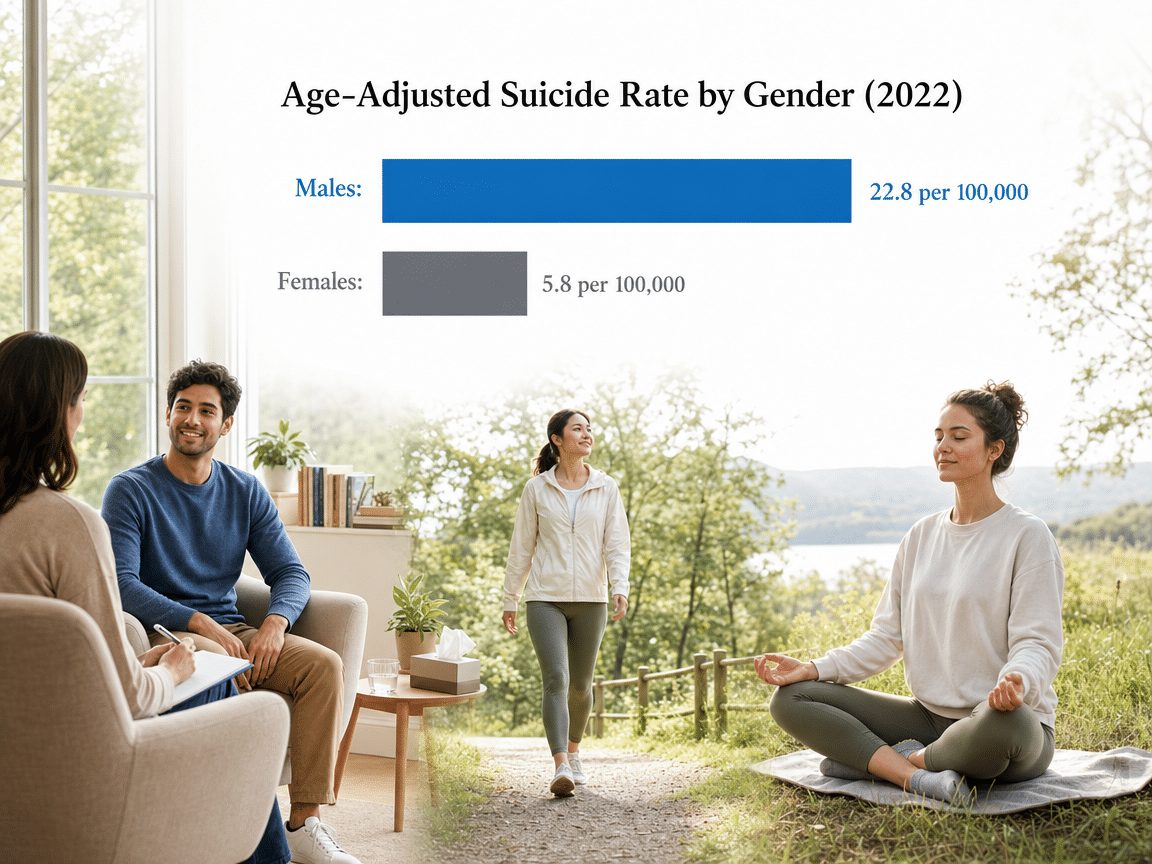
- Men consistently delay mental health care due to socialized norms around self-reliance and toughness, a documented pattern with measurable consequences including sharply higher suicide mortality 4.
- Four modifiable frictions drive avoidance: confidentiality worries, stigma, time and cost, and the sense that traditional therapy formats weren’t built with men in mind 8.
- Men often report irritability, sleep disruption, physical complaints, focus issues, and heavier drinking rather than classic sadness, and mood and substance use disorders frequently co-occur 1, 6.
- Integrated outpatient care pairing psychiatry with counseling, delivered via telehealth when useful, removes practical barriers and treats overlapping issues together rather than in isolation 11.
The Tuesday Night Nobody Talks About
It’s 11:47 p.m. on a Tuesday. You told yourself you’d be asleep by ten. Instead, you’re on the edge of the bed, phone in hand, replaying a Slack message from your manager and running the math on next month’s rent. Your chest feels tight in a way that isn’t quite anxiety and isn’t quite nothing. You had three beers instead of one. You skipped the gym again. Your girlfriend asked if you were okay and you said yeah, just tired.
You’ve had this Tuesday before. You’ll have it again this week.
This exact scene, the quiet, functional version of not-okay, is where most men live for years before they ever talk to anyone. Not in crisis. Not on the floor. Just running a little hotter, sleeping a little worse, drinking a little more, and telling yourself you’ll deal with it once the current project ships.
This article isn’t going to lecture you about self-care or tell you to journal. You’re a working adult. You already know something is off. What you might not have yet is a clear, honest picture of why it’s so hard for men to move from that Tuesday night to a first appointment, and what a first appointment actually looks like when you finally do.
Let’s talk about it plainly.
Why Capable Men Wait Too Long
The Help-Seeking Gap Is Real, and It’s Measurable
You’re not imagining the pattern. Across a meta-analysis of studies on men’s help-seeking attitudes and intentions, men consistently report less favorable views of psychological help and lower intentions to actually book an appointment than women do, with effect sizes that hold up across cultures and age groups 10. This isn’t a personality flaw. It’s a documented, group-level tendency that shapes what capable, high-functioning men do when something feels off.
The gap shows up in treatment data too. NIMH figures indicate that a smaller share of men with any mental illness receive services in a given year compared with women, even though prevalence between the sexes isn’t dramatically different 7. Translation: men aren’t necessarily healthier. They’re just less likely to be in the room where care happens.
What Masculinity Norms Are Actually Doing to Your Calendar
You probably don’t think of yourself as someone shaped by “masculinity norms.” You think of yourself as someone who’s busy, practical, and disciplined about not making things a big deal. That framing is exactly the mechanism the research is describing.
Narrative reviews of male help-seeking find that men socialized into traditional norms around self-reliance, emotional control, and toughness are systematically less willing to seek mental health support, and more likely to hold negative beliefs about what treatment involves 1. Those beliefs don’t announce themselves as beliefs. They show up as scheduling decisions. The primary care visit you keep pushing to next quarter. The therapy website you opened, scanned, and closed. The mental note that you’ll deal with the sleep thing after the launch.
Look at your own calendar for the last three months. If a persistent physical problem, say, a knee that kept giving out on runs, had lasted this long, you would have booked something by now. When it’s mood, sleep, focus, or drinking, the same problem tends to sit there uncoded, filed under “stress” or “phase.”
That isn’t weakness. It’s a script you were handed young and never asked to review. The point of naming it isn’t to shame you. It’s to notice, once, that the reason you haven’t called anyone isn’t because nothing is wrong. It’s because the version of you that decides what counts as “a real problem” was trained to underweight this exact category. You get to update that setting.
A Note on Intersectional Nuance
Men with stronger traditional masculinity beliefs, and men who face racial discrimination, report more barriers to seeking care, and the two often compound each other 2. Culturally responsive care matters, and one-size messaging misses a lot of people.
This article is deliberately broad, aimed at male gender norms across backgrounds. If your identity, faith, or community adds layers to any of this, that’s real, and worth naming with a provider who can hold both threads at once. It’s not a reason to wait longer.
The Four Frictions Keeping You Out of Care
When researchers systematically review why men don’t book the appointment, the same four frictions show up again and again: confidentiality worries, perceived stigma, time and financial constraints, and the belief that mental health services weren’t built with men in mind 8. That’s it. Not some mysterious character flaw. Four modifiable barriers, most of which have practical answers.
Let’s walk through them the way you’d actually think about them.
- Confidentiality.
You don’t want your manager, your insurance file, your partner’s parents, or a coworker in the waiting room to know you’re seeing someone. That concern is legitimate, and it’s one of the most consistently reported barriers in the research 8. What you may not know: outpatient mental health care is protected health information. Your employer doesn’t get a call. Telehealth visits happen from your car, your home office, or a parked truck on a lunch break. Nobody sees you walk in.
- Stigma.
This is the voice in your head, not usually the voices of the people around you. The story that getting help means you couldn’t handle it. Ask yourself who exactly you’re picturing judging you, and how many of them have actually said anything close to that this year. Most men find the imagined jury is quieter than the real one.
- Time and cost.
Real barriers, not excuses. A 6 p.m. commute plus a 45-minute drive to a clinic in a strip mall is a hard sell after a 10-hour day. And out-of-pocket therapy at $200 a session doesn’t fit every budget. The workable answer is a provider who takes your insurance, publishes what things cost, and offers virtual visits that fit inside a workday.
- “This isn’t designed for me.”
If your mental image of therapy is a soft-lit room, a box of tissues, and being asked how that makes you feel, it’s fair to wonder whether the format fits. Integrated outpatient care, where a psychiatrist can address sleep, focus, or medication questions and a counselor works on the patterns underneath, tends to feel more like problem-solving than performance. That’s closer to how most men prefer to work.
None of these frictions require you to become a different person. They require a service that meets you where you are.
What You’re Feeling Probably Has a Name
The Symptoms Men Actually Report
Here’s something that might land differently than you expect. When men do finally describe what’s going on, they often don’t say “I’m depressed” or “I have anxiety.” They say the tone-neutral, functional version.
I can’t sleep past 4 a.m. and I lie there running loops. My fuse is short with my kid and I hate it. I can’t focus long enough to finish a deck I used to bang out in an hour. My back hurts and my stomach’s off and my doctor says it’s stress. I don’t want sex the way I used to and I’m not sure why. I’m drinking more than I want to. I feel flat.
Those aren’t personality problems. Those are the symptoms men most commonly report, and they map cleanly onto conditions like anxiety, depression, and post-traumatic stress that outpatient providers treat every day. The narrative review on male help-seeking notes that men often present with irritability, physical complaints, sleep disruption, and substance use rather than the classic “sad, tearful” picture, which is part of why their conditions get missed by others and by themselves 1.
If you’ve been telling yourself you’re just stressed, tired, or off, it’s worth knowing that the language you’re using is exactly the language the research expects from a man who has something treatable going on.
When the Third Beer Is Doing a Job
Let’s talk about the drinking, because for a lot of men this is where the whole picture actually lives.
You’re not drinking to party. You’re drinking to come down. The third beer takes the edge off the day. The two pours of whiskey slow the loop in your head enough that you can sleep. The weekend is louder than you’d like, and Monday morning you feel worse than the workload alone explains.
Here’s what’s underneath that pattern. NIDA data indicates that people with a mood or anxiety disorder are approximately twice as likely to also have a substance use disorder, and the reverse is also true 6. Two things going on at once, feeding each other. The anxiety makes the drinking feel necessary. The drinking makes the anxiety worse the next day. The next day, you drink again to manage what the drinking helped create.
This isn’t a character defect and you are not “an alcoholic” in the cartoon sense the word usually implies. You’re a man whose nervous system found a tool that works fast, and you’ve been using it because nothing else was on offer.
What matters practically: treating just one side of that loop rarely holds. If a provider only addresses the drinking, the anxiety it was managing comes roaring back. If a provider only addresses the anxiety, the drinking keeps blunting the medication and the therapy work. Integrated care, where a psychiatrist and a counselor coordinate on both threads at once, is the model the research keeps pointing toward for exactly this pattern 6.
You don’t have to have hit a bottom to bring this up. You don’t have to label yourself anything before the first appointment. You can walk in and say, honestly, “I’m drinking more than I want to, and I think it’s tied to how I’ve been feeling.” That sentence is enough. A good provider takes it from there.
What Integrated Outpatient Care Actually Looks Like
If you’ve never done this before, the phrase “integrated outpatient care” probably sounds vague. Here’s the concrete version.
Integrated outpatient means two clinicians working the same case: a psychiatric provider who can evaluate what’s happening biologically, and a counselor who works on the patterns and history underneath. They talk to each other about you. You don’t have to translate between them or re-explain your story every visit.
A first appointment is usually a psychiatric evaluation, roughly an hour, mostly conversation. Sleep, energy, focus, appetite, mood, anxiety, alcohol or substance use, family history, physical symptoms, what your week actually looks like. No couch. No pressure to cry. If medication makes sense, you talk about options, side effects, and what you’d want to try. If it doesn’t, you don’t leave with a prescription.
From there, counseling usually runs weekly or every other week, 45 to 50 minutes. The work depends on what’s driving things. Cognitive behavioral therapy for the anxious loops. EMDR or trauma-focused work if something older is running the show. Motivational interviewing if the drinking is part of the picture. Not “how does that make you feel” for an hour. Structured, goal-directed work you can measure.
For men who are self-medicating, this coordination is the point. Treating the anxiety and the drinking in the same care plan, with two providers on the same page, is the model the evidence keeps pointing toward for dual diagnosis 6. It’s also the model men often prefer once they see it, because it feels like a team solving a problem rather than a single hour of talking in a room.
Labs and hormone testing sometimes get pulled in when symptoms suggest it, so a low mood that turns out to be a thyroid issue or a testosterone question doesn’t sit inside the wrong diagnosis for a year.
Why Telehealth Fits a Working Man’s Week
The old picture of therapy assumes you have a spare hour, a car, and a tolerance for sitting in a waiting room where you might see someone you know. Most working men don’t have all three. That mismatch is a real reason care never starts.
Telepsychiatry changes the math. Research on remote mental health services finds that telehealth is associated with better follow-up and attendance among patients who previously faced transportation or scheduling barriers, and men are well represented in that group 11. When the appointment fits inside a lunch break or a 7 a.m. slot before standup, it stops competing with everything else on your plate.
Practically, here’s what that looks like for you. A 45-minute session from your home office with the door closed. A psychiatric check-in from your truck in a jobsite parking lot. An evening slot after your kid is down. No sign-in sheet, no small talk in a lobby, no explaining to a coworker why you’re leaving early on Wednesdays. Same clinician each visit, so you’re not starting over.
There are honest limits. If your Wi-Fi is unreliable, or you share a small apartment with roommates and can’t get real privacy, telehealth is harder 11. Some men prefer sitting in a room with someone, especially early on. A good outpatient provider offers both, and lets you switch. In-person for the first evaluation if that helps you take it seriously, virtual for follow-ups once the rapport is there.
The point isn’t that telehealth is better than in-person. The point is that it removes the specific frictions that keep men out of care in the first place: time, distance, and the risk of being seen walking in. When the format bends to fit your week, the appointment actually happens.
Wellness Month as a Timing Hook, Not a Theme
August is National Wellness Month, and June is Men’s Mental Health Awareness Month. You’ll see the hashtags. You can ignore most of them. What actually matters about these campaigns isn’t the branding, it’s the permission structure.
Reviews of men’s mental health promotion find that outreach timed around broader wellness campaigns tends to increase help-seeking and reduce self-stigma, especially when the messaging treats mental health as part of whole-person health rather than a separate, softer category 9. The mechanism is simple. When “wellness” is already on the calendar at work, in your gym’s newsletter, in your primary care portal, the mental piece stops feeling like a confession and starts feeling like a checkbox you skipped.
Use that. Not because a month is magic, but because a month gives you cover to do something you’d have been embarrassed to do in February for no reason. If your friend asks why you finally booked, “it’s Wellness Month, figured I’d take my own advice” is a perfectly good sentence. It’s also true.
The article would read the same in any month. The month is just the excuse. Take the excuse.
A Realistic First Step This Week
Here’s the version of the next step that doesn’t require you to overhaul your life or announce anything to anyone.
Block 20 minutes this week. Not to fix everything. To make one confidential call or fill out one intake form. That’s the whole task. You’re not committing to years of therapy or a medication you didn’t ask for. You’re booking a consultation with a provider who takes your insurance, understands men who don’t love talking about this, and can meet you virtually if a lobby feels like too much.
Mind Body Optimization offers confidential consultations across Texas, Tennessee, Oklahoma, and Missouri, in person and by telehealth, with integrated psychiatry and counseling under one roof. If the drinking, the sleep, the focus, or the flatness has been running your Tuesday nights, that’s the exact kind of picture the intake conversation is built to hear.
You don’t have to have the right words. You don’t have to know if it’s anxiety, burnout, or something else. You just have to make the appointment while the version of you reading this still has the momentum. The you at 11:47 p.m. next Tuesday will be grateful.
One call. This week. That’s the step.
Take a Confident Step Toward Wellness Today
Easily access confidential support that fits your schedule and helps you prioritize your own wellbeing.
Frequently Asked Questions
How do I know if what I’m feeling is a real problem or just stress?
Short answer: if you’ve been asking that question for more than a few weeks, it’s worth a conversation. Persistent sleep trouble, a shorter fuse, trouble focusing, appetite or libido changes, physical symptoms your doctor can’t pin down, or drinking more than you want to are the signals men most often report before a diagnosis 1. You don’t need to be certain it’s “real.” A consultation exists to help you figure that out.
Will my employer or insurance company find out if I start therapy or see a psychiatrist?
Your employer doesn’t get told. Outpatient mental health visits are protected health information, and your HR team isn’t in that loop. Insurance sees a claim with a diagnosis code for billing, same as any medical visit, but that isn’t shared with your workplace. Confidentiality concerns are one of the most consistently reported barriers keeping men out of care 8, and they’re worth naming directly with a provider on your first call.
I’m drinking more than I used to. Do I need rehab, or can I still see a regular provider?
Most men in this spot don’t need residential treatment. They need someone to look at the drinking and what’s underneath it at the same time. Mood or anxiety disorders and substance use commonly co-occur, roughly at a 2x rate in either direction 6, and outpatient integrated care handles that overlap. Bring it up at your first appointment in plain language. “I’m drinking more than I want to” is enough to start.
Does telehealth actually work, or is it a watered-down version of real care?
It’s real care. Research on telepsychiatry shows improved follow-up and attendance among patients who previously ran into transportation or scheduling barriers, and men are well represented in that group 11. Same clinician, same treatment plan, same medication management if needed. The tradeoffs are practical, not clinical: you need decent Wi-Fi and a private spot. If those pieces work at your place, telehealth holds up.
What’s the difference between counseling and psychiatry, and do I need both?
Psychiatry evaluates what’s happening biologically and can prescribe medication if it fits. Counseling works on the patterns, history, and skills underneath, using structured approaches like CBT or EMDR. Some men need one, some need both. If your sleep and focus are wrecked, psychiatry might come first. If you’re managing but stuck in loops, counseling might be enough. Integrated outpatient care means those two clinicians coordinate rather than working in silos.
What actually happens on a first appointment?
Mostly conversation. About an hour, in person or virtual. A provider asks about sleep, energy, focus, mood, anxiety, alcohol or substance use, family history, physical symptoms, and what your week actually looks like. No couch, no pressure to cry, no forced disclosures. You leave with a working picture of what’s going on and options for next steps. If medication makes sense you discuss it. If it doesn’t, you don’t.
References
- Improving Mental Health Service Utilization Among Men. https://pmc.ncbi.nlm.nih.gov/articles/PMC6560805/
- Masculinity and race-related factors as barriers to health help-seeking among African-American men. https://pmc.ncbi.nlm.nih.gov/articles/PMC4979354/
- Use of Professional and Informal Support by Black Men with Mental Disorders: The National Survey of American Life. https://pmc.ncbi.nlm.nih.gov/articles/PMC3113612/
- Suicide Facts & Figures. https://www.cdc.gov/suicide/facts/index.html
- Suicide Mortality in the United States. https://www.cdc.gov/nchs/pressroom/sosmap/suicide-mortality/suicide.htm
- The Connection Between Substance Use Disorders and Mental Illness. https://www.drugabuse.gov/publications/research-reports/common-comorbidities-substance-use-disorders/part-1-connection-between-substance-use-disorders-mental-illness
- Mental Illness – Statistics. https://www.nimh.nih.gov/health/statistics/mental-illness
- Barriers to Accessing Mental Health Services Among Men: A Systematic Review. https://www.ncbi.nlm.nih.gov/pmc/articles/PMC7489393/
- Men’s Mental Health Promotion: Strategies and Evidence. https://www.ncbi.nlm.nih.gov/pmc/articles/PMC7355392/
- Help-Seeking Attitudes and Intentions in Men: A Meta-Analysis. https://www.ncbi.nlm.nih.gov/pmc/articles/PMC4049905/
- Telepsychiatry and Mental Health Service Engagement Among Men. https://www.ncbi.nlm.nih.gov/pmc/articles/PMC7936604/