

Key Takeaways
- July’s observance exists because Bebe Moore Campbell refused to accept a mental health system that overlooked communities of color, and Congress formalized her fight in 2008.2
- The real disparity isn’t just access — it’s treatment continuation. Racial and ethnic minorities are about half as likely to get care and more likely to drop out early.3
- Community-level numbers make the stakes concrete: a 36% treatment gap for Black adults, a 91% higher suicide rate among AI/AN people, and eight percentage points still separating Latine treatment rates.4,5,6
- Culturally responsive care means universal screening, warm handoffs, adapted evidence-based therapy, and providers who treat discrimination as clinical information— start with a matching process that front-loads fit before a first session.7,16
The Author Behind July: Bebe Moore Campbell’s Fight for Recognition
Before July became a national observance, it was a personal fight. Bebe Moore Campbell was a bestselling author, journalist, and co-founder of NAMI Urban Los Angeles who watched someone she loved struggle inside a mental health system that didn’t quite see them. She wrote about it. She spoke about it. She kept naming what a lot of families already knew: that stigma inside communities of color and bias inside clinical settings were quietly costing people their care, their jobs, and sometimes their lives.
In 2008, Congress formally recognized July as Bebe Moore Campbell National Minority Mental Health Awareness Month. She had died two years earlier, but her advocacy carried the resolution across the finish line. The month was never meant as a hashtag. It was meant as a standing appointment on the country’s calendar to look at a specific question: are Black, Latine, Asian American, American Indian and Alaska Native, and Native Hawaiian and Pacific Islander communities actually getting mental health care that works for them?2
Federal agencies have been answering that question in public ever since. The CDC uses July to highlight how discrimination, neighborhood conditions, and limited access to services shape mental health outcomes for racial and ethnic minority groups. The FDA’s Office of Women’s Health frames the month around the specific challenges these communities face with mental illness, including access barriers and stigma. The U.S. Interagency Council on Homelessness pulls together federal equity resources so state and local systems have somewhere to start.1,20,19
If you’re reading this in the middle of a workday, tired, wondering whether it’s worth trying therapy again, here’s the part that matters: the observance exists because people like you were told to be quiet about it for a very long time. Campbell refused. That refusal is why the rest of this article can even be written.
Available Care vs. Usable Care: The Gap That Defines the Observance
There’s a quiet distinction that changes everything about how you think about this month: care that exists and care that actually works for you are not the same thing. A clinic in your zip code, a name in your insurance directory, a telehealth link on a benefits portal — those things prove availability. Whether you finish treatment, keep going after the first hard session, and come back for medication adjustments six months later is a different question entirely.
That second question is where the disparity lives. NIMHD’s research spotlight lays it out directly: racial and ethnic minorities with mental disorders are about half as likely as white adults to get treatment, and among those who do start, they’re more likely to drop out before completing it. Read that sentence twice. The gap isn’t only at the front door. It’s inside the room, after the intake paperwork, after the first two or three sessions, when something doesn’t click and there’s no obvious reason to keep the next appointment on the calendar.3
If you’ve ever quit a therapist after a few visits, you already know what this feels like from the inside. Maybe the provider asked a question that landed sideways. Maybe they nodded through a piece of your family context that took real courage to share, then pivoted to a worksheet. Maybe you left the session more tired than when you walked in. The research calls that pattern early discontinuation. You probably called it “this isn’t for me.”
Both things can be true. Care can be technically available and functionally unusable at the same time. And when usability breaks down along racial and ethnic lines — as it does, repeatedly, across decades of evidence — the observance stops being symbolic. It becomes a diagnosis of the system itself.8
Hold onto that reframe as you read the rest. When the numbers show up — 36%, 47.4%, 91% — they’re not just describing who gets in the door. They’re describing who stays long enough to feel better.
What the Numbers Look Like Community by Community
Black Adults: The 36% Treatment Gap and PTSD Among Younger Women
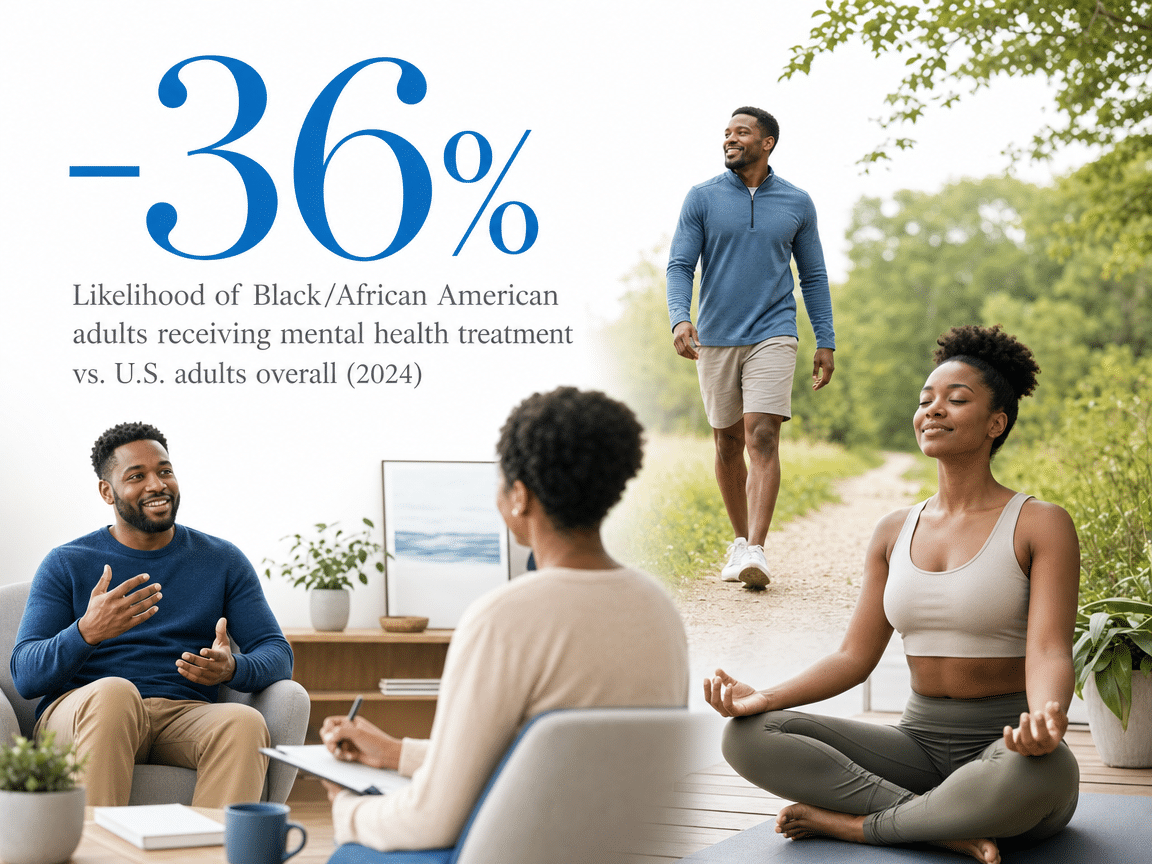
Start with the number that keeps showing up in federal data. In 2024, Black/African American adults were 36% less likely than U.S. adults overall to have received mental health treatment in the past year. That’s not a niche finding tucked into an academic journal. That’s the Office of Minority Health’s headline statistic on its own community page, updated for the current year. 4
Sit with what a gap that size means in a workday context. If you’re a Black professional dealing with anxiety spikes before big meetings, or replaying a hard conversation with your manager at 2 a.m., you are statistically less likely to be in care right now than a colleague with the same symptoms and a different racial background. Not because the symptoms are milder. Not because you don’t know therapy exists. The gap sits in a different place — closer to the question of whether care, once you find it, is going to feel like it was built with you in mind.
The trauma load underneath that gap is heavier than the general population narrative suggests. One epidemiologic study estimated lifetime PTSD prevalence among Black women ages 18–34 at 14.0%, compared with 8.7% among Black women ages 50 and older. Younger, not older, is where the burden concentrates. If you’re in your late twenties or thirties and something happened years ago that you’ve never fully unpacked with anyone — a loss, an assault, a chronic experience of being unsafe — you are inside that number, not adjacent to it.10
And this shows up at work in ways your calendar doesn’t label. Hypervigilance in meetings. Difficulty sleeping the night before performance reviews. A short fuse you don’t recognize as yours. PTSD in Black adults gets underdiagnosed partly because it doesn’t always announce itself as a flashback. It hides inside “I’m just tired.” The observance exists in part so that sentence gets a second look — and so the treatment that follows doesn’t ask you to translate your life for someone who never learned to read it.10
Latine and Hispanic Adults: Treatment Rates, Discrimination, and Time in the U.S.
The numbers for Latine and Hispanic adults tell a story of slow, uneven progress with a clear gap still visible. In 2023, 55.1% of non-Hispanic/Latino people living with a mental illness received treatment, compared with 47.4% of Hispanic/Latino people with the same conditions. That’s up from 39.6% in 2022 — real movement, worth naming — but roughly eight percentage points still separate the two groups.6
What’s driving the remaining gap isn’t a single thing. Discrimination is one of the loudest variables in the recent research. A 2025 analysis of Hispanic/Latino adults found that mental health symptoms and loneliness were strongly associated with experiences of discrimination, with U.S.-born individuals actually reporting more frequent discrimination than immigrants. Each unit increase in loneliness was linked to a 29% higher risk for daily or weekly discrimination. Read that pairing carefully: the mental health toll and the discrimination exposure move together, and being born here doesn’t insulate you from either.13
Time in the U.S. matters too, in ways that push back on the assumption that acculturation is protective. Hispanic/Latino immigrants with 21 or more years in the U.S. reported moderate to severe psychological distress at 25%, compared with 18% among those with less than 10 years here. Longer exposure to the U.S. environment — not shorter — correlated with more distress in that study. The mechanism the researchers point to is not culture itself but discrimination and perceived social standing accumulating over decades.12
If you’re a first- or second-generation professional balancing family expectations, code-switching at work, and a Sunday call home in Spanish or Portuguese, you already know the load. The observance’s job here is to move that load out of the “just how it is” category and into a clinical conversation that takes discrimination seriously as a mental health input.
American Indian and Alaska Native Adults: The Suicide and Distress Burden
The starkest single number in this whole article belongs to American Indian and Alaska Native communities. In 2022, AI/AN people were 91% more likely to die by suicide than the U.S. population overall. Nearly double the rate. That’s not a lagging indicator or a decades-old study. It’s the current federal figure, and it sits at the center of why every conversation about minority mental health has to give AI/AN adults their own paragraph, not a footnote.5
Distress at the community level tracks that mortality burden. A UCLA disaggregated data study found that more than 1 in 3 American Indian and Alaska Native adults in California — roughly 33.3% — experienced moderate or serious psychological distress in the past year. One in three. And that headline number varies significantly across tribal communities inside the state, which is part of why the researchers pushed for disaggregated data in the first place. A single AI/AN average smooths over the actual variation between nations, regions, and urban versus reservation experiences.14
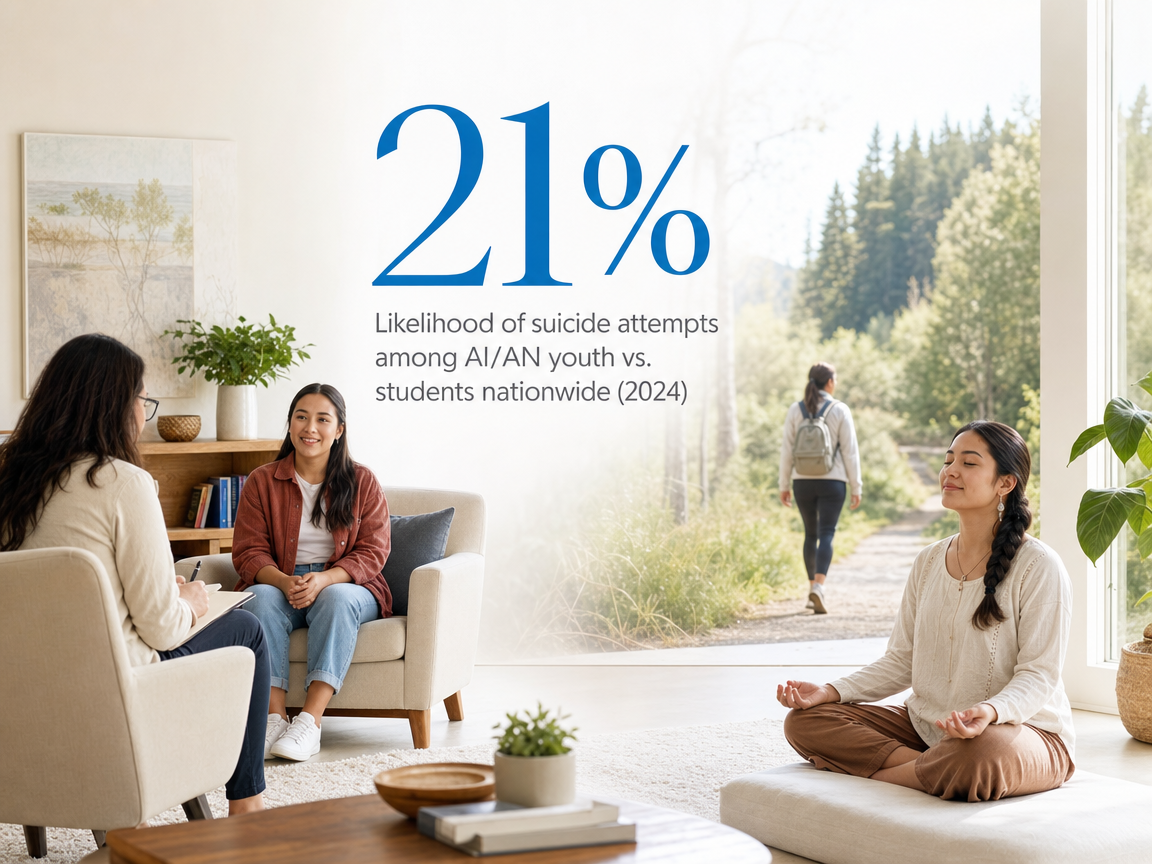
OMH’s community page adds more shape to the picture. AI/AN adults are about 11% more likely than U.S. adults overall to have a mental illness, and 17% less likely to receive treatment. AI/AN youth are 21% more likely than students nationwide to report attempting suicide. Every one of those numbers points back to the same operational reality: services that reach these communities are frequently under-resourced, geographically distant, and rarely designed with tribal sovereignty and cultural context at the center.5
If you’re an AI/AN professional reading this — maybe you left home for a city job, maybe you’re the first in your family to work a corporate schedule — you are carrying a community-level burden into a workday that doesn’t have language for it. The observance was built to make sure that burden gets named in federal data and in the therapy room, not left to individuals to explain from scratch every time they book an intake.
Asian American, Native Hawaiian, and Pacific Islander Adults: What Disaggregated Data Reveals
Asian American, Native Hawaiian, and Pacific Islander mental health rarely shows up in headline federal statistics — and that absence is itself the story. When these communities get aggregated into a single “AAPI” bucket, the differences between, say, a fourth-generation Japanese American and a first-generation Hmong or Samoan adult disappear into an average that describes no one accurately. Researchers pushing for disaggregated data across minority communities have made that case explicitly.14
What the broader disparities literature does say applies here too. Racial and ethnic minorities face fragmented services, cultural mismatch with providers, and mistrust of treatment systems even after controlling for income, insurance, and symptom expression. Race-related stress and discrimination are documented contributors to depression, anxiety, and psychological distress across populations of color, including Asian adults.7,21
If you’re an Asian American or NHPI professional and the data feels thin, that’s not your imagination. The observance is one of the few times a year that federal agencies actively surface community-specific tools and push for the kind of granularity that would let you see yourself in the numbers. Until the data catches up, culturally responsive care means a provider who asks about your specific background — not one who assumes an average.19
Why the Gap Exists: Discrimination, Mistrust, and the Cost of Explaining Yourself
The gap isn’t a mystery. It’s the accumulated weight of three things that stack on top of each other: race-related stress that shows up in the body long before you name it, earned mistrust of systems that have treated people badly, and the exhausting labor of having to teach your provider about your own life before they can help you with it.
Start with the stress itself. A large review of race-related stressors found that discrimination is positively associated with depression, anxiety, psychological distress, and even psychotic experiences across African American, Latine, Asian, and Caribbean Black adults. Not correlated with in a vague sense. Positively associated with. The microaggression in the Tuesday morning meeting, the security guard following you in the store, the assumption from a colleague that you’re the assistant — those aren’t just annoyances. They’re inputs the research has already linked to clinical symptoms.7
Then there’s mistrust, which gets flattened in a lot of coverage as if it’s an irrational holdover. It isn’t. A study focused on Black adults found that racism itself causes mistrust in mental health service systems, and that college-educated respondents were often more skeptical, not less, precisely because they’d seen how institutions actually operate. If you’ve watched a family member get overmedicated, underdiagnosed, or dismissed in an ER, your hesitation about a new intake form isn’t a bias to overcome. It’s a data-informed decision.9
The third layer is the one professionals feel most acutely: the cost of explanation. When you show up to a first session and have to walk your provider through what a quinceañera means to your mother, why your grandfather won’t say the word depression out loud, or how being the only Black woman on your team factors into your anxiety before every 1:1 — you’re doing unpaid teaching before any therapy has actually happened. Providers who face fragmented training, cultural mismatch, and language barriers can miscommunicate and misdiagnose even with the best intent. That risk falls on you to prevent.21
And this is where PTSD in particular slips through. VA research on civilian populations found that racial and ethnic minorities reported longer time to PTSD and depression treatment initiation than non-Hispanic white adults. The delay isn’t only about getting to a clinic. It’s about arriving somewhere that recognizes what you’re describing as trauma in the first place, instead of routing it into a generic anxiety worksheet.18
So when you hesitate before booking, you’re not being avoidant. You’re weighing a real cost against an uncertain benefit. The point of a culturally attuned match isn’t to eliminate that weighing entirely. It’s to lower the cost of showing up enough that the benefit has a chance to land.
What Culturally Responsive Care Actually Looks Like in Practice
Culturally responsive care is not a poster in the waiting room. It’s a set of specific practices you can feel in the first fifteen minutes of a session — and if they’re missing, you’ll feel that too.
Start with the intake. In an integrated behavioral health model, everyone gets screened for depression, anxiety, and trauma at the front end, not just the patients a provider decides “look like” they need it. That matters because underdiagnosis in Black, Latine, AI/AN, and Asian American communities often begins at the exact moment someone finally shows up. Universal screening pulls the question out of the provider’s gut and onto a standardized form that asks everyone the same thing.16
Then there’s the warm handoff. If your primary care visit surfaces something bigger — panic attacks, sleep loss, a trauma history you didn’t plan to mention — a warm handoff means a behavioral health clinician is introduced to you in that same visit, not scheduled six weeks out. For a working professional who took an hour off to be there, the difference between “here’s a referral, good luck” and “let me walk you down the hall” is often the difference between starting treatment and not.16
Culturally adapted evidence-based therapy is the piece that gets talked about least and matters most. Cognitive behavioral therapy, EMDR, and DBT all work — but they work better when a clinician adapts the examples, the metaphors, and the treatment goals to your actual life. A CBT worksheet about “catastrophic thinking” reads differently when the therapist understands that your worry about a traffic stop or your mother’s undocumented status isn’t catastrophizing — it’s an accurate risk assessment that needs a different intervention.16
Cultural competence at the provider level has its own working parts:17
- preventing bias in assessment,
- offering language access,
- recruiting a staff that actually reflects the communities being served,
- and practicing cultural humility as an ongoing habit rather than a one-time training.
“to provide culturally respectful and effective care”. Respectful and effective. Not one without the other.
What this looks like from your side of the room is smaller and more specific than the checklist suggests. Your provider asks about your family and doesn’t flinch at the answer. They know the difference between religious coping and religious avoidance. They ask what you want from treatment instead of assuming. They don’t require you to translate community-specific language before they’ll engage with it. They notice when discrimination is a stressor and treat it as clinical information, not a political aside.7
And when the fit still isn’t right — because sometimes it isn’t — a responsive practice makes it easy to switch providers without starting your entire history from scratch. That last piece is what protects the treatment continuation the whole observance is trying to fix. You shouldn’t have to choose between a bad-fit provider and no provider at all.3
A Realistic Next Step for a Full Calendar
Here’s the honest math of your week: you have somewhere between 30 and 60 minutes of genuine bandwidth for something new, probably split across two evenings and a Saturday morning. That’s the container. Any next step that doesn’t fit inside it won’t happen, and pretending otherwise is how another July passes without anything changing.
So start small enough to actually finish. Ten minutes with a matching quiz that asks about your background, your symptoms, and what you want from therapy is a real first move — not a rehearsal for one. The point isn’t to commit to a year of weekly sessions before you’ve met anyone. The point is to shorten the distance between “I’ve been meaning to” and “I have a name and a first appointment.” Federal messaging around the observance points to the same idea: connect with a provider, use crisis resources like 988 if you need them, and treat this as ongoing care rather than a one-time errand 20.
Telehealth exists for the calendar you actually have. A 45-minute session between meetings, from a locked office or your car in a parking garage, counts. It’s not a lesser version of care. For people balancing demanding jobs with family obligations and long commutes, virtual visits are often what makes treatment continuation possible at all — which, per NIMHD, is where the disparity actually lives.3
One more thing worth saying plainly. If you tried therapy before and it didn’t work because your provider didn’t understand your context, that wasn’t a verdict on you or on therapy. It was a matching problem. Matching problems have solutions. The observance is Bebe Moore Campbell’s reminder; the next appointment is yours to book.2
Start care with someone who truly understands you
Connect with a provider who values your background and supports your unique mental health journey.Frequently Asked Questions
When is Minority Mental Health Month and who started it?
It’s observed every July. The formal name is Bebe Moore Campbell National Minority Mental Health Awareness Month, first designated by Congress in 2008 to honor the author and NAMI advocate who spent years pushing for better mental health support in communities of color. Federal agencies including the CDC use the month to spotlight access barriers and health equity gaps.1,2
What does culturally responsive care actually mean?
It’s care where your provider adapts standard evidence-based therapy — CBT, EMDR, medication management — to your actual cultural context, language, and life circumstances. In practice, that includes universal screening at intake, language access, staff who reflect the communities they serve, and cultural humility as an ongoing habit rather than a one-time training. You feel it in the first session or you don’t.16,17
Do I have to see a therapist who shares my exact background for therapy to work?
No. Shared background can help, but what the research actually points to is cultural competence and humility — a provider trained to recognize race-related stress as clinical information, prevent bias in assessment, and adapt treatment to your context. Plenty of people build strong therapeutic relationships with providers from different backgrounds. The question isn’t identity match. It’s whether the provider does the work.17
I tried therapy before and my provider didn’t get my cultural context. Is it worth trying again?
Yes, and your hesitation makes sense. Early discontinuation after a bad-fit first experience is one of the most documented patterns in minority mental health research. That wasn’t a verdict on you or on therapy — it was a matching problem, and matching problems have solutions. A quiz-based intake that asks about your background and preferences upfront shortens the distance between a first appointment and a provider who can actually help.3
Can telehealth therapy really work for anxiety and burnout when my schedule is packed?
For working professionals, virtual visits are often what makes staying in treatment possible at all — and treatment continuation is where the disparity actually lives. A 45-minute session from a locked office, your car, or your kitchen counts. Federal messaging around the observance points to the same idea: use the care that fits your life, and know that 988 is available if things escalate.3,20
How do I find a provider who understands my background without interviewing ten of them?
Start with a matching quiz that asks about your background, symptoms, and what you want from therapy before you book anyone. That front-loads the fit question so you’re not doing unpaid cultural teaching in a first session. Look for practices that offer universal screening, warm handoffs between psychiatry and counseling, and easy provider switches if the first match isn’t right. Ten minutes now saves months later.16
References
- Prioritizing Minority Mental Health. https://www.cdc.gov/minority-health/features/minority-mental-health.html
- July is Minority Mental Health Awareness Month. https://www.ncdhhs.gov/blog/2020-07-28/july-minority-mental-health-awareness-month
- Examining Why Mental Health Service Use and Dropout Rates Vary among Racial/Ethnic Groups. https://www.nimhd.nih.gov/news-events/research-spotlight/examining-why-mental-health-service-use-and-dropout-rates-vary
- Mental Health and Black/African Americans. https://minorityhealth.hhs.gov/mental-and-behavioral-health-blackafrican-americans
- Mental Health and American Indians/Alaska Natives. https://minorityhealth.hhs.gov/mental-and-behavioral-health-american-indiansalaska-natives
- 5 Fast Facts About Latino Mental Health. https://cisneros.columbian.gwu.edu/5-fast-facts-about-latino-mental-health
- Stress and the Mental Health of Populations of Color: Advancing Our Understanding of Race-related Stressors. https://pmc.ncbi.nlm.nih.gov/articles/PMC6532404/
- Racial and Ethnic Disparities in Mental Health Care: Evidence and Policy Implications. https://pmc.ncbi.nlm.nih.gov/articles/PMC3928067/
- Mental Health Care among Blacks in America: Confronting Racism and Constructing Solutions. https://pmc.ncbi.nlm.nih.gov/articles/PMC6407345/
- Prevalence, Severity and Burden of Post-Traumatic Stress Disorder among Black Adults in the United States. https://pmc.ncbi.nlm.nih.gov/articles/PMC9175561/
- Mental Health Status by Race, Ethnicity and Socioeconomic Status among Young Adults in the United States. https://pmc.ncbi.nlm.nih.gov/articles/PMC12147708/
- Mental Health and Exposure to the United States: Immigrant Hispanic/Latino Experiences. https://pmc.ncbi.nlm.nih.gov/articles/PMC4552578/
- Mental Health Symptoms and Discrimination among Immigrant and U.S.-born Hispanic/Latino Adults. https://pmc.ncbi.nlm.nih.gov/articles/PMC12076878/
- Mental Health Inequities Observed across American Indian and Alaska Native Adults in California. https://newsroom.ucla.edu/releases/AIAN-mental-health-disaggregated-data-study
- Mental Health Dashboard – Texas Health Data. https://healthdata.dshs.texas.gov/dashboard/mental-health/mental-health
- Culturally Responsive Care in Integrated Behavioral Health. https://ibhequity.sfsu.edu/sites/default/files/documents/Culturally%20Responsive%20Care.pdf
- The Importance of Cultural Competence in Mental Health Treatment. https://online.okcu.edu/clinical-mental-health-counseling/blog/cultural-competence-in-mental-health
- Racial and Ethnic Disparities in PTSD. https://www.ptsd.va.gov/publications/rq_docs/V31N4.pdf
- Resources for National Minority Mental Health Awareness Month. https://www.usich.gov/news-events/news/resources-national-minority-mental-health-awareness-month
- National Minority Mental Health Awareness Month. https://www.fda.gov/consumers/knowledge-and-news-women-owh-blog/national-minority-mental-health-awareness-month
- Racial Disparities in Mental Health Treatment. https://online.simmons.edu/blog/racial-disparities-in-mental-health-treatment/